
 English
 中文简体
中文简体 Español
 English
 中文简体
中文简体 Español
The Direct Answer: Air Fryers Cook Fairly Evenly, But Most Foods Still Benefit From a Midway Flip or Shake
In most cases, an air fryer cooks food more evenly than a conventional oven because the rapid, circulating hot air reaches food from nearly every angle rather than heating primarily from the top and bottom. That said, evenness is rarely perfect, and the majority of foods, especially small, irregularly shaped, or tightly packed items, still benefit from being flipped or shaken once during the cooking cycle. Testing across multiple models shows that skipping a midway shake can result in a color and texture difference of 15 to 25 percent between the top layer of food and the pieces sitting underneath, particularly in baskets loaded beyond half capacity.
The short practical rule is this: thin, single-layer foods like a few chicken tenders or a single portion of vegetables need little to no shaking, while foods stacked in multiple layers, such as french fries, wings, or breaded items, almost always cook more evenly with one or two shakes. Machines with rotating baskets or paddle mechanisms can reduce or eliminate this need entirely, and basket design, including whether it uses a stainless steel air fryer basket or a nonstick coated one, also plays a meaningful role in how heat transfers to the food resting against its surface.
How an Air Fryer Cooks Food and Why Some Unevenness Is Unavoidable
An air fryer works by pulling air through a heating coil and pushing it through the cooking chamber with a high-speed fan, creating a convection effect that surrounds food with hot air rather than relying on direct contact with a heated surface. This design is what gives air-fried food its characteristic crisp exterior without the need for submerging it in oil.
Airflow Direction and Layered Food
The fan is almost always positioned at the top or back of the unit, meaning hot air enters the chamber from one primary direction before circulating downward and around the basket. Food sitting closest to the airflow entry point is exposed to hotter, faster-moving air, while food underneath or shielded by other pieces receives comparatively less direct exposure. This is the core reason unevenness happens: it is not a flaw in the appliance so much as a natural consequence of how convection heating distributes air in an enclosed space.
Basket Shape and Depth
Deeper, narrower baskets tend to trap more heat at the bottom while allowing less airflow to reach the top layer evenly, whereas wider, shallower baskets promote more uniform circulation because food has more direct exposure to moving air on multiple sides. This is one reason a compact air fryer with a shallow, wide basket can sometimes produce more even results than a taller unit with greater total capacity, even though it holds less food per batch.
air fryer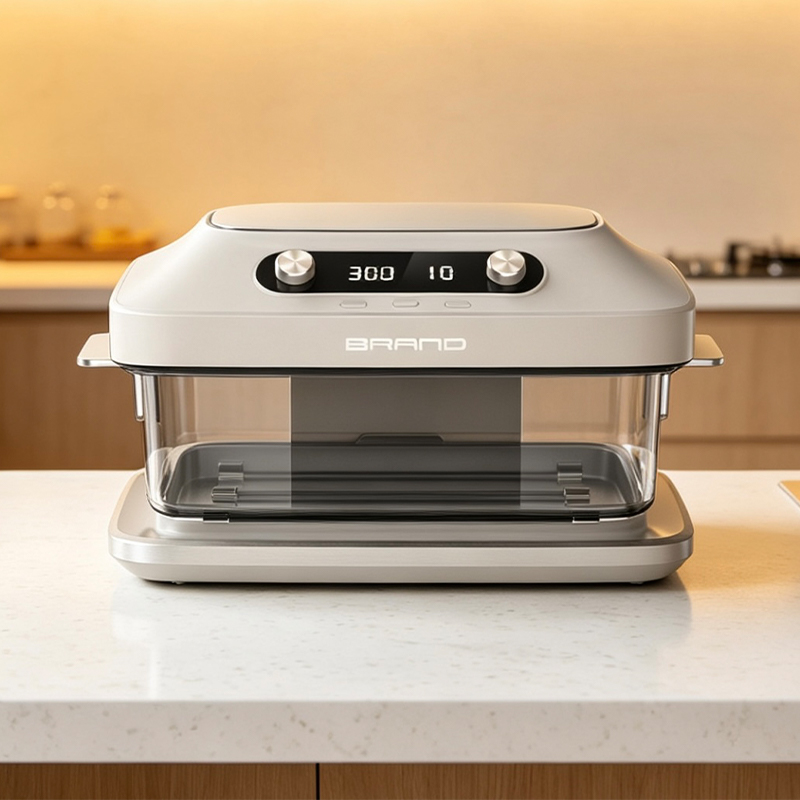
Key Factors That Determine How Evenly Food Cooks
Evenness is not determined by the appliance alone. A combination of food characteristics, loading habits, and machine design all interact to produce the final result. The most influential factors include:
- Batch size relative to basket capacity, since overfilling blocks airflow to lower layers
- Food shape and thickness, as irregular pieces cook at different rates even within the same batch
- Moisture content, since wetter foods like marinated meats release steam that can slow browning on the side facing away from airflow
- Basket material, which affects how much residual heat is retained and radiated back into the food from below
- Whether the basket rotates, rocks, or remains completely stationary during the cycle
Of these, batch size is the single most correctable factor. Filling a basket to only 60 to 70 percent of its stated capacity consistently produces more even browning than filling it to the maximum line, because it preserves enough open space for hot air to pass completely around each piece rather than becoming trapped between them.
Does Food Actually Need to Be Flipped or Shaken Midway?
For most foods cooked in more than a single, spaced-out layer, the answer is yes. Shaking or flipping redistributes pieces so that ones previously shielded from direct airflow are rotated into more exposed positions, and vice versa. This single action can meaningfully close the gap in doneness between the top and bottom of a batch.
The table below outlines general guidance for common foods based on typical cooking behavior observed in testing.
| Food Type | Typical Layering | Shaking Recommended | Frequency |
|---|---|---|---|
| Frozen french fries | Multiple overlapping layers | Yes | Every 5-7 minutes |
| Chicken wings | Single to double layer | Yes | Once, at the midpoint |
| Whole chicken breast | Single layer | Recommended | Once, flip only |
| Roasted vegetables | Loosely spread, single layer | Optional | Once, for even color |
| Baked goods, muffins | Fixed position in tray | No | Not applicable |
Foods with a fixed shape that cannot shift positions without spilling, such as batters, muffin cups, or foods in a fixed baking tray, are the clear exception and should not be shaken at all.
How Compact Air Fryer Models Handle Even Cooking Differently
A compact air fryer, typically sized for one to three servings, has a smaller internal chamber, which means hot air travels a shorter distance between the heating element and the food. In practical terms, this often results in more consistent heat exposure across a single-layer batch, since there is simply less room for the air to unevenly circulate before reaching every surface.
The tradeoff is that a compact unit has very little tolerance for overfilling. Because the chamber is small to begin with, adding even a modest amount of extra food can quickly restrict airflow and reintroduce the same unevenness problems seen in larger units that are packed too full. For anyone using a compact model, keeping batches to a single, non-overlapping layer is the most reliable way to preserve the evenness advantage that the smaller chamber size otherwise provides.
Compact models are also generally easier to shake by hand, since the reduced weight and size make it simple to grip and agitate the basket without spilling contents, which further supports even cooking outcomes when a midway shake is needed.
Why Basket Material Affects Cooking Evenness
The material lining the cooking basket influences how heat is conducted and retained at the surface where food makes direct contact, which in turn affects browning consistency.
Stainless Steel Baskets and Heat Retention
A stainless steel air fryer basket conducts and retains heat differently than a nonstick coated basket, generally holding residual warmth slightly longer after each heating cycle. This can help maintain more consistent surface contact heat on the underside of food, which supports more even browning on the bottom layer, particularly for items like vegetables or thinly sliced foods that rest directly against the basket surface. Stainless steel is also more resistant to scratching from metal utensils, which matters over time since a damaged or warped nonstick surface can create uneven contact points that lead to inconsistent cooking in specific spots.
Nonstick Coatings and Even Release
Nonstick baskets heat up slightly faster and release food more easily, which can be an advantage for delicate items that might otherwise stick and tear unevenly during a shake. However, as the coating wears down over repeated use, its heat distribution can become less consistent, occasionally contributing to spotty browning that was not present when the basket was new.
Practical Techniques to Improve Even Cooking Results
Several simple habits can meaningfully improve consistency regardless of which model is being used:
- Arrange food in a single layer whenever possible, leaving small gaps between pieces rather than letting them touch
- Cut or portion food into similarly sized pieces so that everything finishes cooking at approximately the same rate
- Shake or flip at the midpoint of the cooking time rather than near the very end, when the change has less time to make a difference
- Rotate the basket itself 180 degrees if the unit does not have a rotating mechanism, since some chambers have a consistently hotter side
- Avoid stacking breaded or battered items, since breading traps steam and slows even browning far more than it does with plain ingredients
Preheating the unit for two to three minutes before adding food also helps, since starting with a stable chamber temperature reduces the initial temperature swing that often causes the first few minutes of cooking to be less even than the rest of the cycle.
Common Mistakes That Lead to Uneven Results
Even with a capable machine, certain habits consistently undermine even cooking:
- Filling the basket to the very top line instead of leaving breathing room for airflow
- Mixing foods of different sizes or densities in the same batch, such as small florets with large chunks
- Forgetting to shake multi-layer foods entirely, assuming the fan alone will compensate
- Using a basket with a warped or heavily worn surface, which creates uneven contact points
- Opening the basket too frequently, which causes repeated temperature drops that disrupt the cooking rhythm
Among these, overfilling remains the leading cause of uneven results reported by users, echoing the same pattern seen with temperature regulation complaints, since airflow restriction is the common thread behind both issues.
Final Takeaway on Achieving Consistently Even Air-Fried Food
Air fryers generally cook more evenly than traditional ovens due to their circulating convection design, but true evenness still depends heavily on batch size, food shape, and whether the basket is shaken or flipped at the right moment. Multi-layer or irregularly shaped foods almost always benefit from a midway shake, while thin, single-layer items need little intervention. Choosing the right equipment also matters: a compact air fryer can offer more consistent results for small batches thanks to its shorter airflow path, provided it is not overfilled, and a stainless steel air fryer basket can support steadier heat retention and more even bottom-layer browning compared to a nonstick surface, particularly as the basket ages.
In practice, the combination of a well-designed basket, sensible batch sizing, and a simple midway shake addresses the vast majority of unevenness issues, making it entirely possible to achieve restaurant-quality, uniformly cooked results at home without relying on trial and error for every recipe.