
 English
 中文简体
中文简体 Español
 English
 中文简体
中文简体 Español
Modern kitchens increasingly depend on tools that make healthy cooking faster, cleaner, and more enjoyable. Consumers want to prepare fresh vegetables in attractive shapes without spending excessive time on repetitive slicing, shredding, or cutting. Restaurants, hotels, catering operations, supermarkets, and household users all benefit from equipment that improves preparation efficiency while remaining simple to operate. A well-designed spiral slicer answers this need by turning ordinary fruits and vegetables into continuous spirals, noodles, curly strips, slices, and chips.
The GS002 Spiral Slicer 3 in 1 is a manual vegetable preparation appliance developed for versatile everyday use. It combines a practical turning wheel, interchangeable cutting blades, four suction feet, and a stable body made from ABS and stainless steel. Its purpose is straightforward: help users process vegetables and fruits quickly, consistently, and attractively, without relying on electrical power or complicated controls.
This article examines the product’s design, operating advantages, application potential, material selection, packaging specifications, and manufacturing background. It also explains why a 3-in-1 manual spiral slicer can offer meaningful advantages over less versatile kitchen tools and how an experienced appliance manufacturer can support wholesale buyers, distributors, retailers, and professional food-service customers.
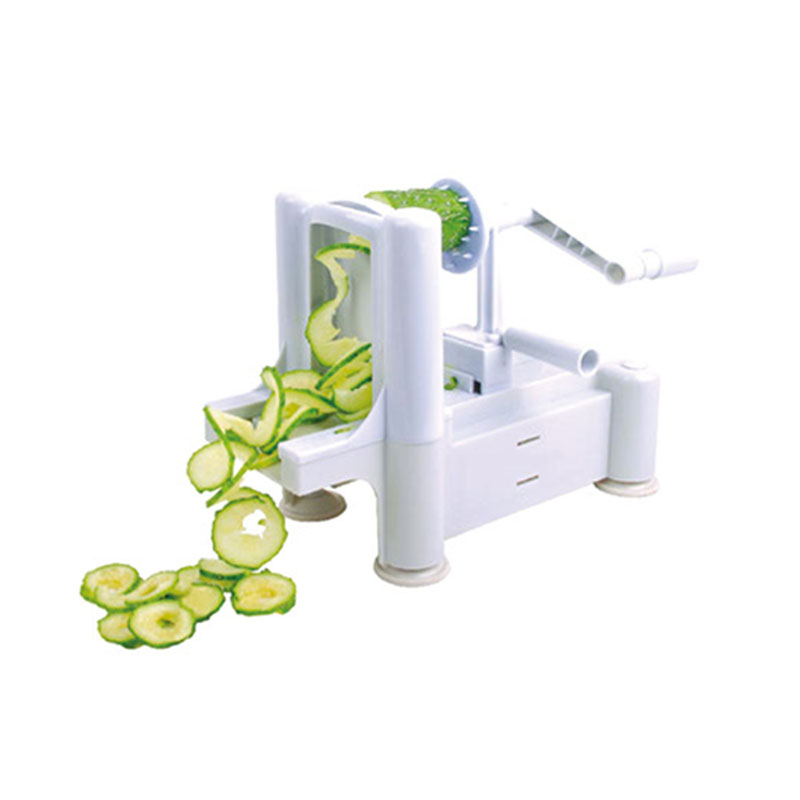
GS002 Spiral Slicer 3 in 1
Product Overview and Core Function
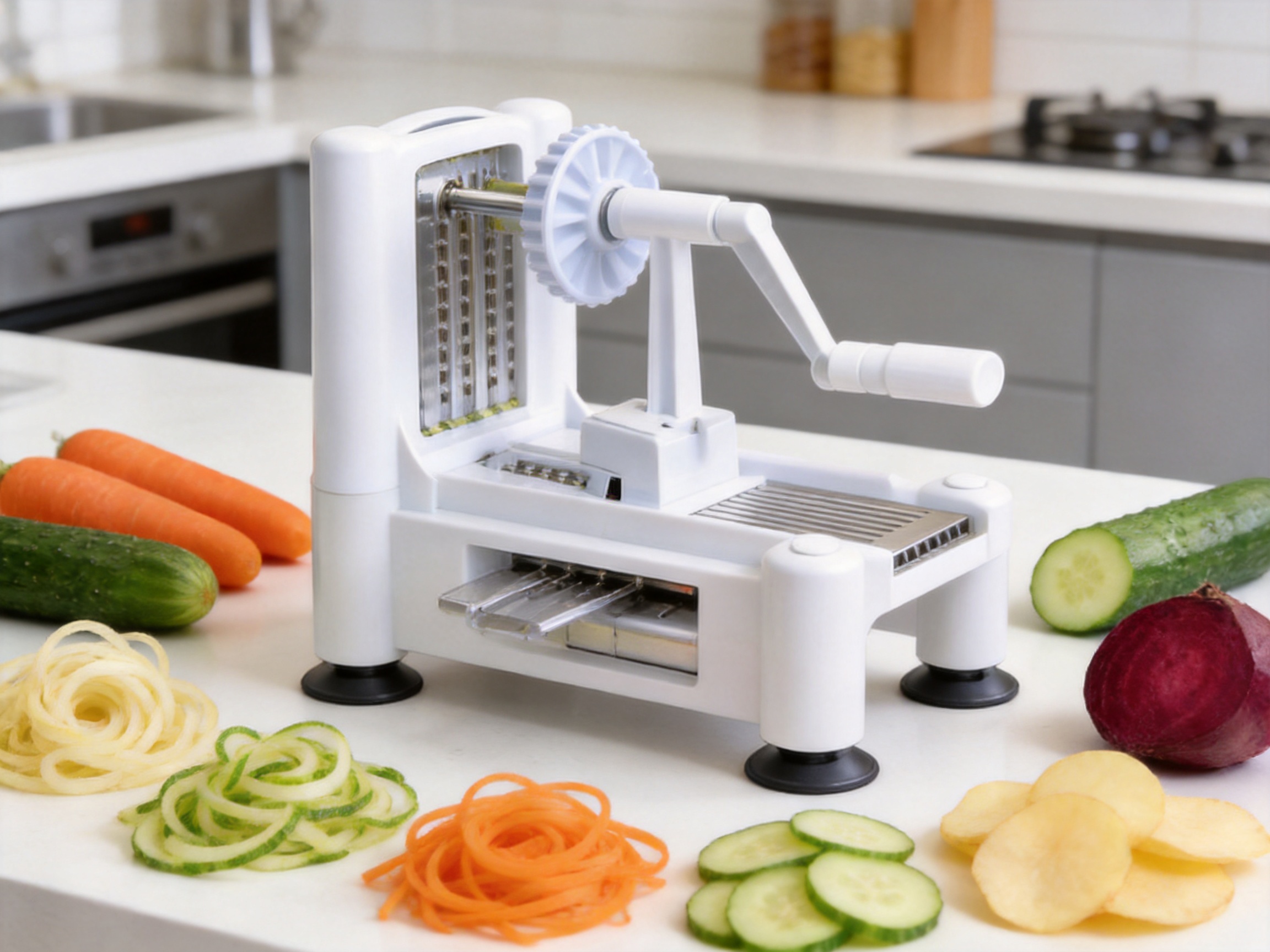
The GS002 is identified as a 3-in-1 spiral slicer under the manual vegetable slicer category. Rather than performing only one cutting function, it is designed to provide several preparation results through a replaceable blade system. Users can create medium-cut vegetable noodles, thick-cut spirals, curled julienne strips, shredded vegetables, slices, and chips, depending on the selected blade and the food being processed.
The product is particularly suitable for zucchini pasta, vegetable noodles, decorative salads, curly fries, garnishes, fruit preparations, and other creative dishes. It helps transform common ingredients into visually appealing forms that may encourage healthier eating and provide greater menu variety.
Unlike electric food processors, the GS002 does not require a motor, power cord, socket, or battery. The user turns the operating wheel manually, allowing the cutting process to remain under direct control. This makes the slicer convenient in kitchens where electrical access is limited, as well as in outdoor food preparation, demonstrations, market stalls, cooking classes, and compact home kitchens.
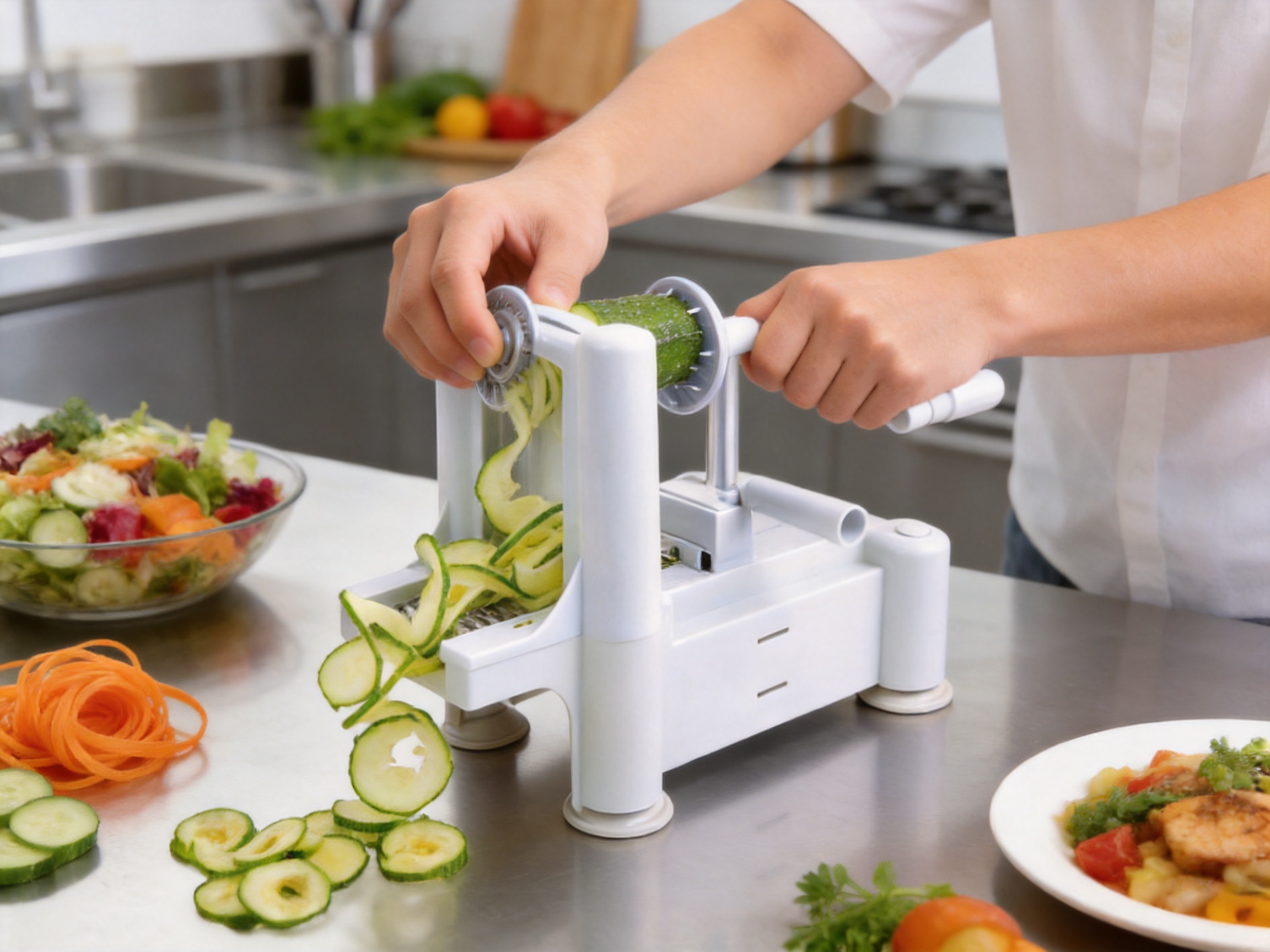
The product’s main operating principles are simple. The food is positioned against the cutting assembly, the selected blade is inserted, the body is secured using its suction feet, and the turning wheel is rotated. As the wheel advances the ingredient through the blade, the slicer produces continuous spiral strands or curled julienne strips. This continuous cutting action is one of its most important functional characteristics.
Main Product Specifications
The following table summarizes the available product and logistics information.
| Specification | Details |
|---|---|
| Item Number | GS002 |
| Product Name | Spiral Slicer 3 in 1 |
| Product Category | Manual Vegetable Slicer |
| Main Materials | ABS and stainless steel |
| Cutting Functions | Spiralizing, julienne preparation, slicing, shredding, and chipping applications |
| Operating Method | Manual turning wheel |
| Stability System | Four suction feet |
| Carton Quantity | 6 pieces per carton |
| Carton Measurement | 51.5 × 32.5 × 49 cm |
| Net Weight | 6.8 kg per carton |
| Gross Weight | 7.5 kg per carton |
| Estimated 20-Foot Container Capacity | 2,100 pieces |
| Estimated 40-Foot High-Cube Capacity | 5,100 pieces |
| Minimum Order Quantity | 2,000 pieces |
| Standard Delivery Time | 30 days |
These specifications make the GS002 appropriate for wholesale distribution and private-label purchasing. The six-piece carton configuration supports organized handling, while the stated container quantities help importers estimate purchasing and transportation requirements. The minimum order quantity of 2,000 pieces is suitable for distributors, retail chains, online sellers, and kitchenware brands planning a substantial market launch.
Three Functions in One Practical Kitchen Tool
The most direct advantage of a 3-in-1 slicer is functional consolidation. Consumers do not need to purchase several separate tools for spiralizing, julienne cutting, and decorative vegetable preparation. A single body with interchangeable blades can support multiple recipes and preparation styles.
Vegetable Noodles
One of the most popular uses for a spiral slicer is the preparation of vegetable noodles. Zucchini, carrots, cucumbers, beets, and similar vegetables can be transformed into long strands that resemble noodles. These strands can be served raw in salads, lightly cooked, mixed with sauces, or combined with pasta and other ingredients.
Vegetable noodles are attractive to consumers seeking lighter meals, more vegetables, lower-carbohydrate alternatives, or creative recipes. The GS002 supports this trend without requiring a powered appliance. Its manual operation gives users immediate control over the speed and pressure of processing.
Curled Julienne Strips
Julienne strips are useful for salads, stir-fries, sandwiches, wraps, soups, garnishes, and side dishes. The product is designed to produce curled julienne results that are visually distinctive compared with ordinary straight strips. Curled pieces can add texture and volume to a dish while improving presentation.
For food-service businesses, visual presentation is important. A more attractive cut can help restaurants create signature salads, decorative plates, seasonal menus, and promotional food photography. For home users, the same feature can make daily meals more interesting without requiring advanced knife skills.
Slicing, Shredding, and Chipping
The product description also emphasizes the ability to shred, slice, and chip many fruits and vegetables. These functions increase the range of possible applications. Users can prepare ingredients for slaws, vegetable toppings, garnishes, chips, salads, and snack recipes.
Combining these functions within one compact product offers a practical alternative to single-purpose cutters. A basic slicer may produce only flat slices, while a simple julienne tool may create only narrow strips. The GS002 is designed to provide a broader range of results through its 3-in-1 blade configuration.
Advantages Over Less Versatile Competitor Products
Kitchen tools vary widely in design quality, flexibility, stability, cleaning convenience, and commercial suitability. The GS002 is positioned to compete not only through its core spiralizing function but also through a combination of features that improve the overall user experience.
Greater Versatility Than Single-Function Slicers
A single-function slicer may perform one task well but offer limited value once that task is complete. The GS002 is designed around multiple cutting results. This gives retailers a stronger product story because the item can be promoted for vegetable noodles, salads, curly fries, garnishes, fruit preparation, and meal decoration rather than for one recipe alone.
Versatility can also improve household value. Instead of buying a spiralizer, julienne cutter, and separate slicer, a consumer can use one multi-function tool. This saves storage space and reduces the number of kitchen accessories that must be cleaned and maintained.
Continuous Spiral Production
Many basic handheld cutters produce short pieces or require repeated manual strokes. The GS002 is designed to create continuous spiral strands and curled julienne strips. Continuous output provides a more attractive presentation and can reduce the number of interruptions during preparation.
Long strands are especially useful for zucchini pasta and decorative salads. They can also create a stronger visual effect in retail demonstrations and online product videos. The continuous cutting process gives the product an engaging operating motion that is easy for customers to understand.
Four Suction Feet for Improved Stability
Stability is essential when a manual slicer is operated on a countertop. If the product moves during use, the user may experience uneven cuts, slower preparation, or increased frustration. The GS002 includes four suction feet intended to anchor the unit to a smooth working surface.
The four-point support system distributes contact across the base and helps keep the slicer steady while the operating wheel is turned. This is a meaningful advantage over lightweight handheld tools that must be held continuously during cutting. A stable body allows the user to concentrate on feeding the ingredient and maintaining a consistent motion.
Users should place the product on a clean, dry, smooth surface for the suction feet to work effectively. The exact holding performance may vary according to countertop material, moisture, dust, and surface texture. Proper placement and cleaning are therefore important parts of safe and efficient operation.
Easy-to-Operate Turning Wheel
The turning wheel gives the user a clear mechanical control point. It avoids the need to learn complicated buttons, settings, or electronic programs. This straightforward mechanism is suitable for a broad range of users, including families, older consumers, cooking students, small food businesses, and retail demonstration staff.
Manual operation also offers flexibility. The user can stop immediately, inspect the food, change the ingredient, or replace the blade without waiting for a motor to shut down. It can be used in locations where electrical appliances are inconvenient or unsuitable.
Easy Blade Insertion
Interchangeable blades are valuable only when they can be installed and removed conveniently. The GS002 is designed for easy blade insertion, helping users switch between different cutting styles without a complicated assembly process.
For commercial users, an accessible blade system can shorten preparation changes during busy periods. For household users, it makes the product less intimidating and encourages experimentation with different recipes. The blade area should always be handled carefully, and users should follow appropriate safety procedures when inserting, removing, or cleaning cutting components.
Convenient Cleaning and Storage
The product is described as easy to clean and store. This is important because vegetable preparation can leave behind moisture, starch, pulp, and small food particles. A tool that is difficult to clean may be used less frequently, even if its cutting performance is good.
The manual format also avoids motor housings and electrical components that can complicate washing. Users should separate removable parts where appropriate, rinse away food residue promptly, and dry the components before storage. Compact storage is another benefit for kitchens with limited cabinet or countertop space.
Material Selection and Product Durability
The main materials specified for the GS002 are ABS and stainless steel. Each material serves a different purpose in the product structure.
ABS Structural Components
ABS is widely used in consumer products because it combines practical rigidity, impact resistance, design flexibility, and relatively low weight. For a kitchen slicer, ABS can be molded into a stable body with defined supports, attachment points, handles, and exterior contours.
A well-designed ABS body helps keep the product manageable for users while providing sufficient structure for manual operation. Its lower weight compared with an all-metal construction can also reduce shipping and handling costs. At the same time, the material supports consistent production through injection molding, which is useful for maintaining repeatable dimensions across large orders.
Stainless Steel Cutting Components
Stainless steel is appropriate for cutting edges and food-contact components because it offers corrosion resistance and can maintain a sharp working edge when properly manufactured and used. It also provides a clean appearance and is commonly associated with kitchen durability.
The interaction between the ABS body and stainless steel blades creates a practical balance. The body can remain lightweight and easy to handle, while the cutting parts use a harder material suited to repeated contact with fruits and vegetables.
As with any kitchen cutting product, performance depends on correct use. Users should avoid unsuitable hard materials, excessive force, and improper storage. Blades should be dried after cleaning and kept away from children when not in use.
Designing for Household and Commercial Applications
The GS002 is suitable for more than one sales channel. Its design can support retail household sales, food-service distribution, promotional kitchenware programs, and hospitality procurement.
Home Kitchens
For household users, the main attraction is the ability to create healthier and more attractive meals without a complex appliance. The slicer can be used for weekday meal preparation, weekend cooking, family activities, and special occasions.
Parents may use it to make vegetables more appealing to children. Health-conscious consumers can prepare vegetable noodles and fresh salads. Home entertainers can create decorative garnishes and colorful side dishes. Because the product is manual, it can be used quickly without preparing an electrical appliance or finding a suitable socket.
Restaurants and Cafes
Restaurants and cafes can use spiralized vegetables as menu components, toppings, garnishes, or seasonal specials. A consistent cutting method can help staff reproduce a visual style across multiple dishes.
Small food businesses may also appreciate the straightforward mechanism. It does not require electrical maintenance, motor replacement, or programming knowledge. Staff can learn the basic operating method quickly, while the interchangeable blades provide menu flexibility.
Hotels and Catering Operations
Hotels and catering companies often need attractive food presentation for buffets, banquets, conferences, and special events. Spiral vegetables and curled garnishes can add height, texture, and color to serving trays.
The product is also useful for demonstration kitchens and culinary training environments. Students can observe the relationship between ingredient positioning, blade selection, and cutting results. Since the mechanism is visible and manual, it can help explain the basic principles of spiral food preparation.
Retail Demonstrations and Online Sales
The GS002 has strong demonstration potential. A salesperson can show the transformation of a zucchini or carrot into long strands within a short time. Online retailers can illustrate the product through recipe images, operating videos, before-and-after comparisons, and multi-function demonstrations.
Products that produce a visible result are often easier to explain to consumers. The cutting action, turning wheel, suction feet, and interchangeable blades can all be presented as clear selling points. Retail packaging and promotional materials can emphasize convenience, creativity, healthy cooking, and space-saving value.
Manufacturing Strengths and Development Experience
The manufacturer behind the product has experience in the design and production of small kitchen appliances and innovative food-preparation products. Its product range includes blenders, slicers, choppers, food processors, smokeless grills, hot pots, air fryers, air ovens, ice buckets, beverage dispensers, pitchers, slicers, and graters.
This broad product range is relevant to the GS002 because it indicates familiarity with different kitchen-use scenarios, consumer expectations, materials, mechanical structures, and product categories. Experience across both electric and non-electric kitchen products can help a manufacturer understand how users compare convenience, durability, safety, appearance, and cost.
Product Development Background
The company’s development history began with trading and sourcing experience before expanding into product design, manufacturing, and engineering. Its earlier work with television shopping products provided exposure to consumer demonstrations, product differentiation, and international market requirements.
The company later developed non-electric innovative products, including spiralizer drum graters, iced pitchers, and iced bowls. This history is directly relevant to a manual spiral slicer because it combines mechanical operation, food preparation, consumer-friendly design, and visual product performance.
The transition into electric product development expanded the company’s technical capabilities. Its product portfolio now covers both manual and powered kitchen appliances, enabling it to evaluate when a mechanical solution is more appropriate than an electric one. For buyers, this broad perspective can support more informed product customization and category planning.
Factory and Workforce Resources
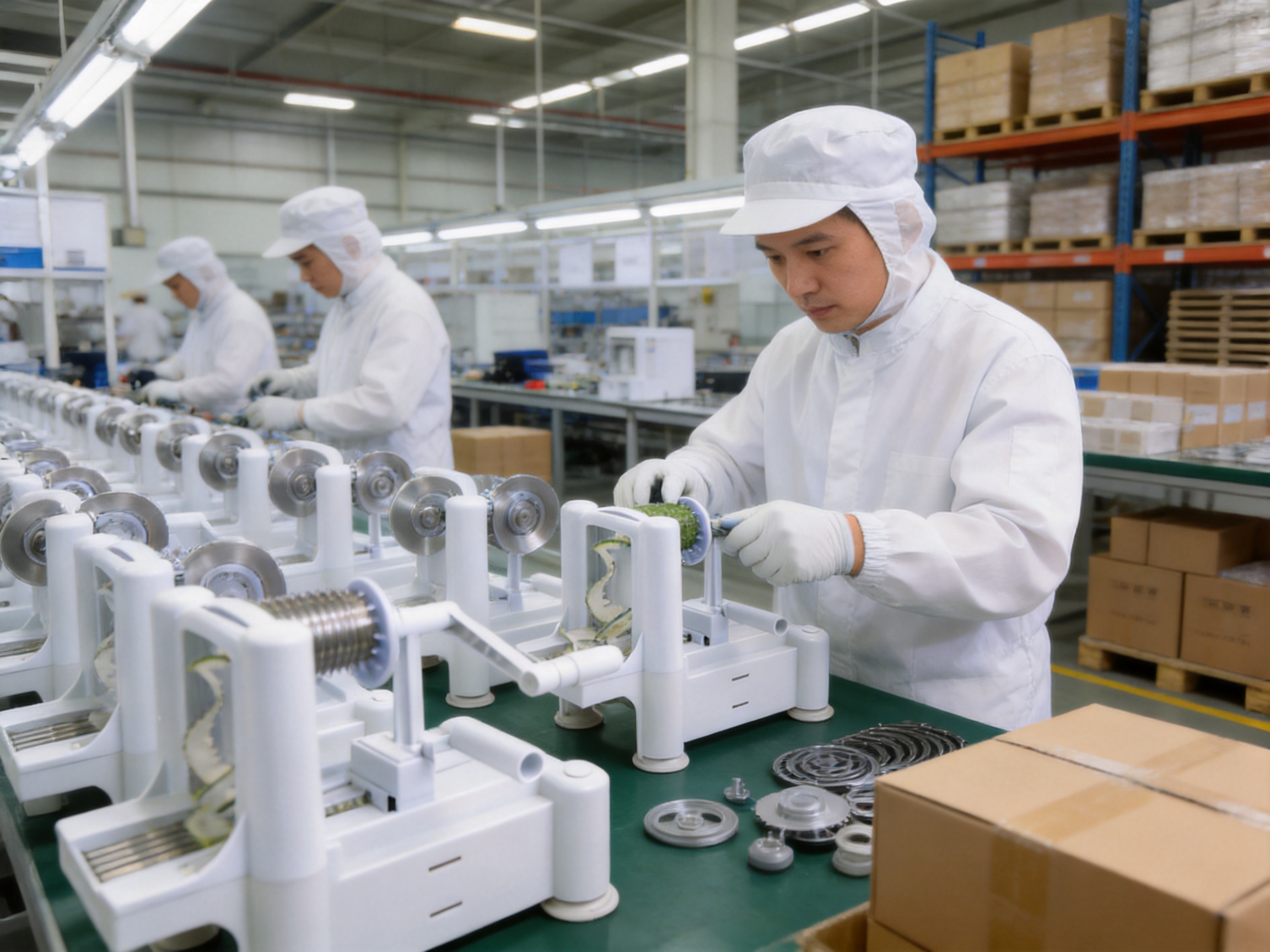
The available company information describes a wholly owned production facility with a large manufacturing area, more than 200 experienced workers, engineering personnel, and a dedicated quality-control team. It also reports a factory area of approximately 10,000 square meters in one stage of its development and a production area of approximately 15,000 square meters in later company information.
A factory structure of this type can support multiple activities, including product assembly, component management, packaging, quality inspection, production scheduling, and order coordination. The presence of engineers is particularly important for products that require both mechanical accuracy and user-oriented design.
For wholesale customers, manufacturing scale can provide several advantages. It may support larger production runs, more organized procurement of raw materials, better coordination between design and production, and a more stable approach to delivery planning. Buyers should still confirm current capacity, lead times, quality standards, packaging requirements, and inspection procedures for each order.
Research and Development Capability
The company reports an engineering and research-and-development team responsible for designing and developing products. This capability is valuable because kitchenware buyers increasingly seek differentiated items rather than generic copies.
Product development involves more than changing external appearance. It may include evaluating blade placement, turning resistance, suction performance, component fit, user safety, cleaning convenience, packaging efficiency, and manufacturing cost. An experienced development team can review these factors together and help transform a product concept into a scalable commercial item.
The company’s stated philosophy emphasizes innovative products, competitive pricing, quick delivery, after-sales service, and cooperation with customers as engineering partners. For distributors and brands, this suggests a willingness to discuss product requirements rather than offering only a fixed catalog item.
Quality Control Considerations for a Manual Slicer
Quality control is essential for a product that combines moving components, sharp blades, food contact, and repeated manual force. A reliable production process should evaluate both individual parts and the assembled product.
Material Inspection
Incoming ABS and stainless steel materials should be checked for consistency, appearance, dimensions, and suitability for the intended components. Proper material control helps reduce variation between production batches and supports stable product performance.
Blade and Cutting Inspection
Cutting parts should be inspected for edge condition, alignment, attachment security, surface quality, and consistent positioning. The blade must fit correctly within the product and remain secure during operation. Any sharp component should also be packaged in a way that reduces the risk of damage or accidental contact during transportation.
Assembly Inspection
Assembly checks should confirm that the turning wheel, blade holder, body, supports, and suction feet are correctly installed. The wheel should rotate smoothly, and removable parts should fit without excessive looseness or difficulty.
Stability and Functional Testing
Functional testing can include operating the wheel, checking the engagement of the suction feet, inserting and removing blades, and processing representative vegetables. These checks help identify problems that may not be visible during a simple appearance inspection.
Packaging Inspection
Packaging should protect the product, blades, and accessories from movement, impact, moisture, and compression during transportation. Carton strength, internal arrangement, product count, labeling, and shipping marks should be confirmed before dispatch.
Wholesale buyers may request pre-production samples, production samples, inspection reports, third-party inspections, or customized packaging checks. These requirements should be agreed upon with the supplier before mass production begins.
Efficiency, Storage, and Logistics Benefits
The GS002 is designed as a compact countertop product rather than a large commercial machine. This makes it easier to store in household kitchens, retail warehouses, restaurant preparation areas, and hotel service rooms.
Its manual operating system can also reduce certain ownership concerns associated with electric appliances. There is no motor to maintain, no power consumption during use, and no electrical connection required. These characteristics may appeal to consumers who prefer simple mechanical kitchen tools or who want a backup preparation solution.
From a wholesale perspective, the product has defined carton and container information. The stated packaging quantity is six pieces per carton, with a carton measurement of 51.5 by 32.5 by 49 centimeters. The stated net weight is 6.8 kilograms per carton, while the gross weight is 7.5 kilograms. The listed loading estimates are 2,100 pieces for a 20-foot container and 5,100 pieces for a 40-foot high-cube container.
These figures can help purchasing teams estimate warehouse requirements and freight planning. However, actual loading quantities may change according to packaging updates, pallet use, carton orientation, shipping regulations, and buyer-specific requirements. Final logistics data should always be confirmed against the approved production packaging.
How to Use the Slicer Effectively
Effective use begins with selecting fresh, firm produce that is suitable for spiralizing or slicing. Vegetables should be washed and trimmed before processing. Extremely soft, damaged, or irregular ingredients may not produce the best results.
The product should be placed on a clean, dry, smooth countertop. Users should press the suction feet firmly against the surface and check that the unit does not slide. The appropriate blade should then be selected and inserted according to the product instructions.
The ingredient should be positioned securely against the cutting area. Users can rotate the wheel with a smooth, consistent motion rather than applying sudden force. A steady motion generally produces more uniform strands and reduces unnecessary pressure on the mechanism.
After use, the product should be disassembled as recommended, and food residue should be removed promptly. Cutting parts should be handled carefully, washed using an appropriate method, and dried thoroughly. The product should be stored in a dry location, with blades kept safely away from children and unprotected contact.
Recommended Food Applications
The product can support a wide range of recipes and food-service ideas. Zucchini noodles are an obvious application, but users can also explore carrot ribbons, cucumber spirals, beet salads, vegetable garnishes, curly potato preparations, fruit decorations, and mixed vegetable platters.
In restaurants, spiral vegetables can be paired with grilled foods, seafood, sandwiches, burgers, rice dishes, and cold salads. In home kitchens, the slicer can help prepare lunch boxes, picnic dishes, party platters, and healthy snacks.
For retailers, recipe-based marketing can communicate the product’s value more effectively than technical specifications alone. A demonstration showing one vegetable prepared in three different ways can quickly explain the meaning of the 3-in-1 design.
Why the Product Is Suitable for Wholesale Programs
The GS002 offers several characteristics that are relevant to wholesale customers. It belongs to a recognizable kitchenware category, has an easily demonstrated function, supports health-oriented cooking trends, and can be sold to both household and professional users.
Its manual design may also provide a different market position from motorized spiralizers. Some consumers want an electric appliance for high-volume processing, but others prefer a tool that is quieter, simpler, less dependent on electricity, and easier to store. The GS002 can therefore complement rather than directly replace electric food processors.
The product is also suitable for promotional bundles. It can be paired with salad bowls, vegetable storage containers, recipe cards, kitchen utensils, meal-preparation accessories, or healthy-cooking campaigns. Retailers may position it as a seasonal item for summer salads, a back-to-school meal-preparation tool, or a gift product for cooking enthusiasts.
For private-label buyers, the manufacturer’s development and production experience may support discussions about packaging design, branding, instruction manuals, color combinations, accessory selection, and market-specific requirements. Any customization should be reviewed for tooling, minimum quantities, testing, lead time, and cost before order confirmation.
Buyer Evaluation Checklist
Before placing a wholesale order, buyers should evaluate the product according to the needs of their target market. Important questions include whether the selected materials match the intended price position, whether the blade configuration is appropriate for local recipes, whether the packaging communicates safe use clearly, and whether the product is suitable for the planned sales channel.
Buyers should also confirm the following points:
• Final product dimensions and weight.
• Blade quantity and cutting functions included in the standard package.
• User manual language and safety instructions.
• Product color, packaging design, and carton marks.
• Sample approval procedure.
• Production lead time and delivery schedule.
• Quality inspection requirements.
• Applicable import, food-contact, packaging, and consumer-product regulations in the destination market.
• Warranty and after-sales service arrangements.
• Final container loading quantities based on approved packaging.
Careful confirmation of these details helps reduce misunderstandings and supports smoother cooperation between the supplier and buyer.
Q&A: Frequently Asked Questions
What is the GS002 Spiral Slicer 3 in 1?
It is a manual vegetable slicer designed to produce spiral strands, curled julienne strips, slices, shreds, and chips from suitable fruits and vegetables. It uses a turning wheel and interchangeable blades rather than an electric motor.
Is the product suitable for zucchini noodles?
Yes. The slicer is specifically promoted for making zucchini pasta and vegetable noodles. Users can also experiment with firm vegetables such as carrots, cucumbers, and beets, depending on the desired result and the selected blade.
Does it require electricity?
No. The product is manually operated. It does not require a power cord, electrical socket, battery, or motor.
How does the product remain stable during operation?
The product includes four suction feet designed to improve stability on a smooth, clean, dry countertop. Users should ensure that the surface is suitable and that the suction feet are firmly attached before turning the wheel.
What materials are used?
The listed materials are ABS and stainless steel. ABS is used for structural components, while stainless steel is suitable for cutting and food-contact components.
Can the blades be changed?
Yes. The product is designed with easy-to-insert blades so users can change cutting styles. Blades should be inserted, removed, and cleaned carefully because they contain sharp edges.
Is the slicer suitable for restaurants?
It can be suitable for restaurants, cafes, hotels, catering businesses, and other food-service operations that need decorative vegetables, salad ingredients, garnishes, or vegetable noodles. Buyers should evaluate expected processing volume and confirm that the manual format fits their workflow.
How is the product cleaned?
Food residue should be removed soon after use. Removable components should be cleaned according to the product instructions, dried thoroughly, and stored safely. Cutting parts require careful handling during washing and storage.
How many pieces are packed in one carton?
The stated packing quantity is six pieces per carton.
What is the minimum order quantity?
The stated minimum order quantity is 2,000 pieces. Buyers should confirm the current minimum quantity and any requirements for customized packaging or product specifications.
What is the stated delivery time?
The standard delivery time provided is 30 days. The actual schedule may depend on order quantity, packaging approval, production planning, inspection, and shipping arrangements.
What makes this product different from a basic handheld julienne tool?
The GS002 combines a stable countertop structure, a manual turning wheel, four suction feet, continuous spiral production, and multiple cutting functions. A basic handheld tool may perform only one cutting action and may require the user to hold both the tool and the ingredient during operation.
Can the product be customized for wholesale orders?
Potential customization should be discussed directly with the manufacturer. Possible topics may include packaging, colors, instruction materials, branding, accessories, and market-specific requirements. Customization can affect minimum quantities, tooling, cost, and delivery time.
Conclusion
The GS002 Spiral Slicer 3 in 1 is a practical manual kitchen tool designed to make vegetable preparation more creative, efficient, and accessible. Its combination of interchangeable blades, continuous spiral production, easy-to-operate turning wheel, four suction feet, ABS body, and stainless steel cutting components gives it a strong position within the manual vegetable slicer category.
Compared with single-function cutters, it offers broader recipe potential and better product versatility. Compared with electric spiralizers, it provides a simple, quiet, power-free operating method that is easy to store and demonstrate. These characteristics make it suitable for households, restaurants, cafes, hotels, catering businesses, cooking schools, retailers, and wholesale kitchenware programs.
The manufacturing background supporting the product adds further value. Experience in small kitchen appliances, non-electric food-preparation products, engineering, production management, and quality control can help provide a more complete supply solution for international buyers. A factory with product-development resources and a broad appliance portfolio is better positioned to support design discussions, production planning, packaging coordination, and long-term product cooperation.
For buyers seeking a functional, visually demonstrable, and commercially adaptable kitchen product, the GS002 provides a balanced combination of versatility, mechanical simplicity, countertop stability, and wholesale potential. Its ability to turn ordinary vegetables into attractive noodles, spirals, strips, slices, and chips gives it clear value in the growing market for convenient and healthy food preparation.
References
1. Product specification and feature information for the GS002 Spiral Slicer 3 in 1, including materials, packaging data, operating features, and applications.
2. Manufacturer-provided company profile describing product development history, factory resources, engineering capability, quality-control personnel, and kitchen-appliance categories.
3. General food-preparation principles concerning spiralized vegetables, julienne cutting, slicing, shredding, and decorative food presentation.
4. General product-development considerations for ABS structures, stainless steel cutting components, manual kitchen tools, and injection-molded consumer products.
5. General wholesale purchasing considerations covering minimum order quantities, carton packing, container loading, delivery schedules, sample approval, and quality inspection.