
 English
 中文简体
中文简体 Español
 English
 中文简体
中文简体 Español

In today’s kitchens, consumers are looking for tools that make food preparation faster, cleaner, and more enjoyable without taking up valuable storage space. The Mini Spiral Slicer is designed to answer that need. As a compact manual vegetable slicer, it provides a simple way to create spiral cuts and attractive vegetable presentations while avoiding the complexity, noise, and maintenance associated with larger electric food-processing machines.
The product is identified as GS015 and is manufactured by CIXI GSTAR ELECTRIC APPLIANCE CO., LTD., a Chinese producer of small kitchen appliances, food-preparation tools, and hospitality equipment. Although the Mini Spiral Slicer does not require electrical power, it belongs to a broader product development system that includes electric blenders, slicers, choppers, food processors, air fryers, air ovens, hot pots, smokeless grills, and other kitchen products.
Its compact design, practical material combination, efficient packing specifications, and straightforward operation make it suitable for household kitchens, retail programs, promotional campaigns, supermarkets, restaurants, and food-service businesses. More importantly, it reflects a product-development philosophy centered on useful innovation: creating products that are easy to understand, economical to operate, convenient to store, and suitable for regular use.
1. The Growing Demand for Compact Food-Preparation Tools
Food preparation habits have changed significantly in recent years. Many consumers want to eat more vegetables, prepare attractive meals at home, and reduce their dependence on packaged convenience foods. At the same time, modern homes are often designed with smaller kitchens and limited counter space. These conditions have increased demand for compact preparation tools that deliver useful results without requiring a large appliance footprint.
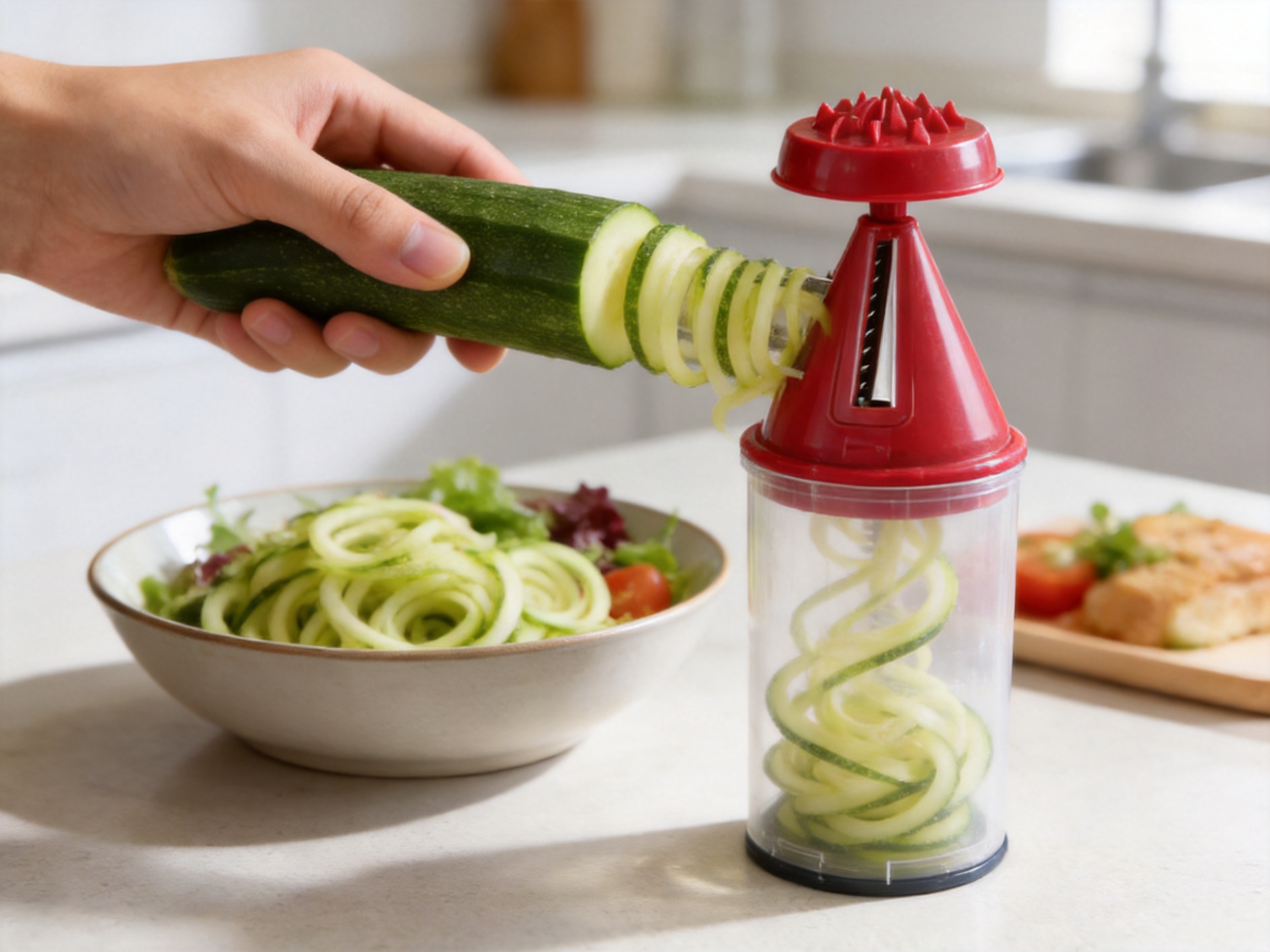
A spiral slicer is especially relevant to this trend because it creates visually appealing vegetable shapes. Spiralized vegetables can be used in salads, garnishes, side dishes, meal-preparation boxes, and low-carbohydrate recipes. The same vegetable can take on a different appearance and texture when cut into a spiral form, making simple meals more interesting and attractive.
Large electric food processors may provide multiple functions, but they can also involve higher purchase costs, electrical requirements, motor noise, complicated attachments, and more demanding cleaning procedures. A compact manual slicer offers a different value proposition. It focuses on one practical task and allows users to control the preparation process directly.
The Mini Spiral Slicer is therefore positioned between a traditional knife and a multifunction electric appliance. It offers more specialized cutting performance than a knife while remaining simpler and more accessible than a motorized machine. This balance is one of its primary competitive advantages.
2. Product Overview
The GS015 Mini Spiral Slicer is a manual vegetable slicer developed for compact, everyday food preparation. Its product name communicates its main strengths: small size, spiral-cutting capability, and straightforward operation. The design is intended for users who want to prepare vegetables in an attractive format without installing a large appliance or connecting to a power supply.
The product uses a combination of ABS, stainless steel, and PP materials. Each material contributes a specific performance benefit. ABS is commonly used for structured housings because it is lightweight, rigid, and suitable for molded product components. Stainless steel is appropriate for the cutting section because it offers hardness, corrosion resistance, and a clean surface when properly maintained. PP is widely used in kitchen products for functional components that need a balance of durability, lightness, and practical chemical resistance.
The combination of ABS, SS, and PP allows the product to remain compact while providing a suitable balance between structure, cutting performance, and user handling. Instead of relying on a heavy metal body or a large motor assembly, the slicer uses carefully selected materials to keep the product manageable for ordinary kitchen use.
The product specifications are summarized below.
| Specification | Details |
|---|---|
| Item Number | GS015 |
| Product Name | Mini Spiral Slicer |
| Product Category | Manual Vegetable Slicer |
| Primary Materials | ABS, stainless steel, and PP |
| Carton Quantity | 50 pieces per carton |
| Carton Measurement | 43.5 x 34 x 44.5 cm |
| Net Weight | 10.6 kg per carton |
| Gross Weight | 11.6 kg per carton |
| Minimum Order Quantity | 2,000 pieces |
| Standard Delivery Time | Approximately 30 days |
| Estimated 20-Foot Container Loading | 21,200 pieces |
| Estimated 40-Foot High-Cube Container Loading | 51,500 pieces |
The packing information is also commercially important. Fifty units per carton provide a practical balance between carton efficiency and handling convenience. The stated container-loading quantities allow importers and distributors to plan purchasing programs, warehouse capacity, transportation, and retail launches with greater accuracy.

MINI SPIRAL SLICER
3. Key Advantages Over Conventional Alternatives
3.1 Compact Size and Efficient Storage
The most immediate advantage of the Mini Spiral Slicer is its compact format. Many kitchens have limited drawer, cabinet, and counter space. A bulky food processor may be powerful, but it can be inconvenient to store and may be used less frequently because of the effort required to retrieve, assemble, and clean it.
A smaller manual tool is easier to keep within reach. This encourages regular use and supports quick meal preparation. Consumers can use it for a single vegetable without setting up a large appliance. Retailers can also display the product efficiently, whether in a kitchenware aisle, a seasonal promotion, a supermarket endcap, or an online product assortment.
Compact products are also attractive for smaller households, student accommodation, apartments, office kitchens, holiday homes, and recreational vehicles. Their usefulness is not restricted to large family kitchens. The Mini Spiral Slicer can serve consumers who value flexibility and space efficiency.
3.2 No Electricity Required
Because the Mini Spiral Slicer is manually operated, it does not require a power outlet, battery, charger, or motor. This makes the product suitable for locations where electrical access is limited or where users prefer not to operate powered equipment.
The absence of a motor provides several practical benefits. There is no motor noise during use, no electrical cord to manage, and no concern about compatibility with different voltage systems when selling into international markets. The product can also be used outdoors, in temporary kitchens, at campsites, or during travel when a stable power supply is unavailable.
For retailers and importers, a non-electric product can simplify certain distribution considerations. It does not need the same electrical labeling, plug variations, or voltage-specific packaging associated with powered appliances. This can support a more flexible international sales strategy, subject to the regulatory requirements of the target market.
3.3 Direct User Control
Manual operation gives the user direct control over the preparation process. Users can determine the pace of cutting and stop immediately when the desired quantity has been produced. This is useful when preparing small portions or when different vegetables require different levels of pressure and speed.
Direct control can also make the tool approachable for consumers who prefer simple kitchen equipment. Some users are comfortable with a tool that has a clear physical action rather than a control panel, multiple programs, or interchangeable electrical attachments. The Mini Spiral Slicer is intended to make its primary function easy to understand.
3.4 Attractive Food Presentation
Spiral-cut vegetables can improve the visual appeal of everyday dishes. The shape can add texture to salads, create an attractive garnish, or provide an alternative form for vegetables served as side dishes. In food retail and hospitality, presentation can influence customer perception, and a compact spiral slicer gives staff a convenient way to add visual interest.
Home users may also find that attractive preparation encourages children and family members to eat more vegetables. While the product does not replace sound nutrition or proper food handling, it can make healthy ingredients more engaging and enjoyable.
3.5 Lower Operational Complexity
A multifunction electric appliance may include several components that must be assembled, cleaned, and stored. A compact manual slicer has a more focused purpose. Its simple construction can make routine preparation less intimidating for first-time users.
Lower operational complexity can be especially valuable in retail products. Consumers often prefer products that can be understood quickly from packaging, demonstrations, or a short instruction guide. The Mini Spiral Slicer can be introduced through visual merchandising and product demonstrations without requiring an explanation of multiple electronic settings.
3.6 Commercial Flexibility
The product can be positioned through several sales channels. It may be offered as a standalone kitchen tool, included in a healthy-living assortment, promoted with vegetable-storage products, or presented alongside other food-preparation products. Its compact size and broad household relevance make it suitable for supermarkets, department stores, specialty kitchen retailers, online marketplaces, hospitality suppliers, and promotional programs.
The stated minimum order quantity of 2,000 pieces is appropriate for importers, regional distributors, private-label programs, and organized retail buyers. It allows a commercial customer to develop a meaningful market launch while remaining more accessible than extremely large production commitments.
4. Material Selection and Product Durability
Material selection is a critical part of kitchen-tool design. A successful product must be light enough for comfortable handling, strong enough for repeated use, and suitable for contact with food when manufactured and used according to applicable standards.
ABS provides a practical foundation for molded structural elements. It is valued in many consumer products because it can be formed into precise shapes and can support integrated design features. A well-designed ABS housing can help protect internal or cutting-related components while keeping overall weight under control.
Stainless steel is especially important in a slicing product. The blade or cutting surface must provide an effective edge and maintain functional performance through repeated use. Stainless steel is also commonly selected for kitchen applications because of its resistance to corrosion and its clean appearance. Users should still follow appropriate cleaning and drying instructions to maintain the cutting component over time.
PP can contribute to handles, supports, containers, or other functional components. Its lightweight character helps keep the product easy to handle. It is also widely used in household goods where resistance to everyday moisture and cleaning conditions is required.
The combination of these materials demonstrates a practical engineering approach rather than an unnecessary focus on excessive weight or decorative complexity. The objective is to assign the right material to the right product function.
5. Product Design Considerations
5.1 Ergonomic Handling
Manual tools must be designed around the user’s hand movements. The product should be comfortable to hold and stable enough to support controlled cutting. A compact design helps reduce unnecessary arm movement and makes the product easier to use for small preparation tasks.
Ergonomics also involves the relationship between the slicer, the vegetable, and the work surface. A reliable product design should help the user maintain control, reduce slipping, and guide the food consistently. The exact operating method should be explained through clear instructions supplied with the product.
5.2 Safe Use
Any product containing a stainless-steel cutting edge requires responsible handling. Users should read the instructions before operation, keep fingers away from the cutting area, and keep the product out of reach of young children when it is not in use. Cleaning should be performed carefully, and the product should be stored in a dry and secure location.
Safety is not limited to the cutting component. Stability, grip, component fit, and packaging protection all influence the overall user experience. For this reason, quality control must consider the complete product rather than inspecting only the visible blade.
5.3 Cleaning and Maintenance
Kitchen tools are more likely to be used regularly when they are easy to clean. A compact manual slicer has fewer motorized areas and no electrical housing that must be protected from water. This can simplify routine maintenance, although the cutting area must still be cleaned carefully.
After use, food residue should be removed promptly. Components should be cleaned according to the product instructions, dried thoroughly, and stored in a way that protects the cutting surface. Proper care supports hygiene, preserves product appearance, and helps maintain cutting performance.
6. Manufacturing Strengths Behind the Product
The quality of a kitchen product depends not only on its design but also on the manufacturer’s ability to develop, produce, inspect, and deliver it consistently. CIXI GSTAR ELECTRIC APPLIANCE CO., LTD. has developed experience across both non-electric innovative products and small electric kitchen appliances.
The company’s product history began with non-electric household and television-shopping products, including spiralizer-related items, graters, pitchers, and bowls. This background is relevant to the Mini Spiral Slicer because it indicates familiarity with compact consumer products, practical mechanisms, product presentation, and high-volume retail requirements.
Over time, the company expanded into electric products such as blenders, choppers, food processors, air fryers, air ovens, hot pots, and smokeless grills. This broad portfolio requires knowledge of mechanical design, plastic molding, electrical integration, product testing, assembly, packaging, and after-sales support.
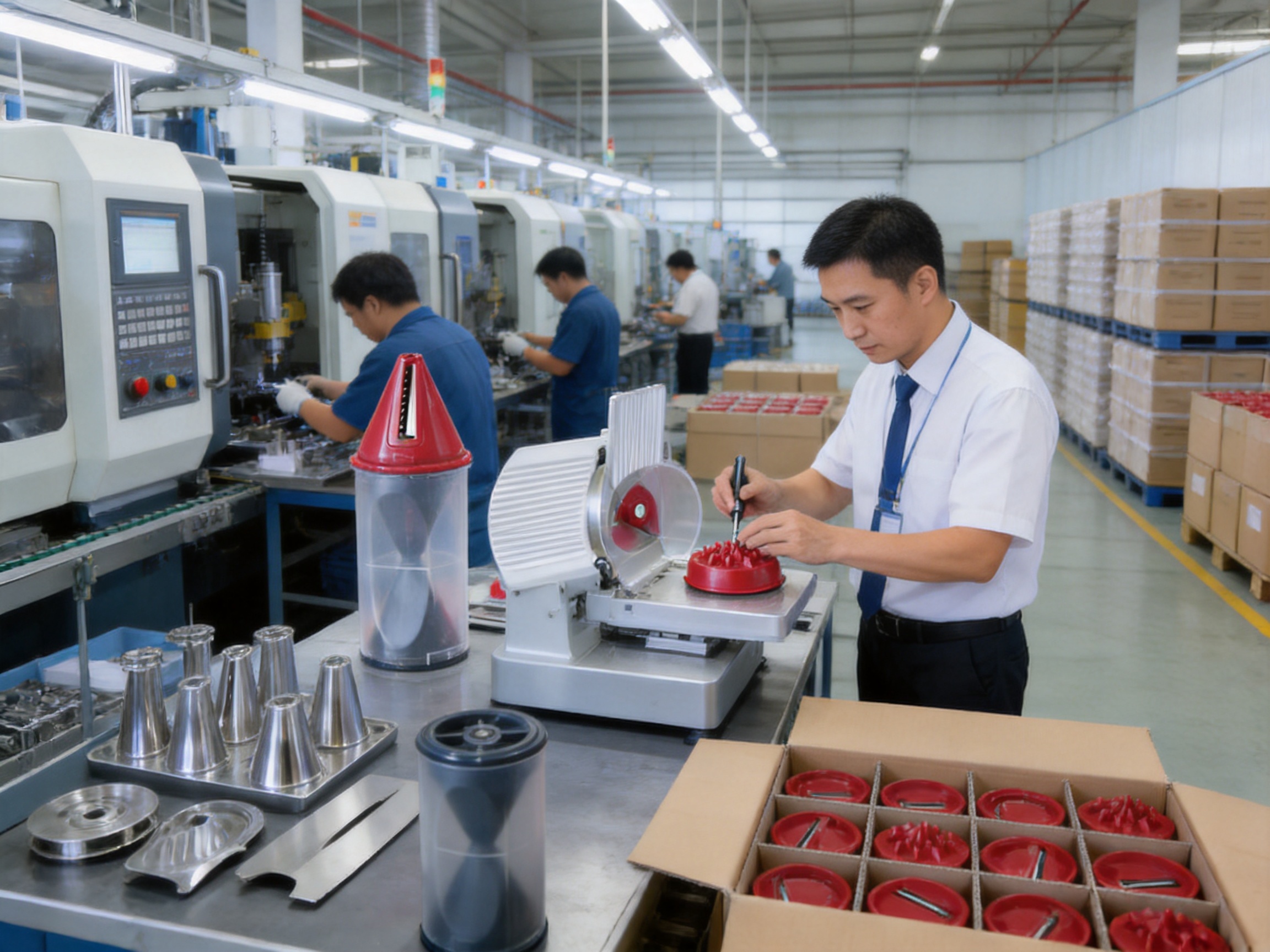
The company reports a factory with substantial production space, an experienced workforce, engineers in research and development, and personnel dedicated to quality control. The provided company information refers to a production area of approximately 15,000 square meters, more than 200 experienced workers, 10 engineers in the R&D department, and 10 people in quality control. These resources support a structured manufacturing operation rather than a purely trading-based supply model.
7. Research and Development Capabilities
Research and development is particularly important for small kitchen tools because seemingly simple products still require careful decisions about shape, material, usability, manufacturing cost, packaging, and safety. A successful product must be practical for consumers and efficient for production.
The company’s development history emphasizes original product design and innovation. It has worked on products with its own patents and has developed items intended for international retail markets. This experience can help transform a basic kitchen concept into a commercially viable product with a clear function and suitable appearance.
For the Mini Spiral Slicer, product development may involve evaluating the blade geometry, food-guiding structure, grip areas, component strength, assembly method, and packaging protection. Each detail can influence the user’s perception of quality. If the product is difficult to hold, difficult to clean, or inconsistent in operation, its commercial performance may suffer even if the general concept is attractive.
Engineering teams also need to consider production repeatability. Components must be manufactured within suitable tolerances so that they fit together correctly. The product must maintain consistent performance across different production batches. This is where design engineering and factory process control become closely connected.
8. Advanced Manufacturing Processes
8.1 Molded Plastic Component Production
ABS and PP components are generally produced through controlled plastic molding processes. These processes allow manufacturers to create repeated shapes with consistent dimensions and integrated features. Proper mold design is essential because it affects the appearance, strength, fit, and production efficiency of every component.
Manufacturing teams need to manage material selection, mold temperature, injection conditions, cooling, ejection, and visual inspection. Poorly controlled conditions can lead to warping, sink marks, flash, surface defects, or dimensional variation. A mature production system addresses these risks through equipment management, process settings, and inspection standards.
8.2 Stainless-Steel Component Processing
The stainless-steel cutting component requires its own process controls. Metal thickness, cutting-edge formation, surface finish, alignment, and resistance to corrosion can all influence performance. The component must be fitted securely and checked for defects before final assembly.
Quality inspection may include visual checks, dimensional checks, sharpness or cutting-performance checks, and verification that the component is correctly positioned. The goal is not simply to produce a sharp edge but to create a cutting element that functions consistently within the complete product structure.
8.3 Assembly and Fit Testing
Assembly is where individual components become a finished product. Workers or assembly equipment must ensure that the ABS, PP, and stainless-steel parts are correctly positioned and securely connected. Any moving or interacting components should be checked for smooth operation and proper alignment.
Fit testing is important because a product may look acceptable while still having excessive looseness, friction, or instability. Assembly inspection helps identify these issues before products are packed and shipped.
8.4 Quality Control Throughout Production
A strong quality system does not wait until the end of production to identify problems. Incoming materials should be checked, production processes should be monitored, and finished products should undergo final inspection. This approach reduces waste and supports more consistent output.
The company’s dedicated quality-control personnel provide a foundation for this type of system. Quality teams can establish inspection procedures, monitor production batches, review defects, and coordinate corrective action with engineering and manufacturing departments.
8.5 Packaging and Shipment Preparation
Packaging protects the product during handling, loading, transportation, and storage. For a slicer with a cutting component, internal protection is especially important. The product should be positioned securely so that it does not move excessively inside the carton.
The stated carton quantity of 50 pieces and carton measurement of 43.5 x 34 x 44.5 cm indicate a planned packing structure suitable for commercial distribution. Efficient carton design helps reduce unnecessary logistics costs and supports better use of container space.
9. Supply-Chain and Export Advantages
The company is located in Cixi, Ningbo, China, an area connected to established manufacturing and export networks. Access to a developed industrial region can support material sourcing, component procurement, production coordination, and international shipping.
For overseas buyers, supplier experience is important because international orders involve more than production. Buyers may require product specifications, packaging confirmation, inspection coordination, shipping documents, production schedules, and communication across different time zones and business practices.
The stated delivery time is approximately 30 days. Actual lead time may depend on order quantity, packaging requirements, production planning, seasonal demand, material availability, and pre-shipment inspection arrangements. Nevertheless, a defined standard delivery estimate helps buyers begin commercial planning.
The container-loading figures also help distributors estimate landed inventory. With an indicated capacity of approximately 21,200 pieces in a 20-foot container and 51,500 pieces in a 40-foot high-cube container, buyers can compare transportation options and determine whether a full-container or consolidated shipment is more appropriate.
10. Applications in Different Market Segments
10.1 Household Kitchens
The main application is everyday household food preparation. Users can prepare spiral vegetables for salads, garnishes, side dishes, meal-preparation containers, and creative recipes. The product is appropriate for consumers who want a dedicated tool without purchasing a large appliance.
10.2 Healthy-Lifestyle Retail
Retailers focused on healthy cooking, fresh food, fitness, or meal preparation can include the Mini Spiral Slicer in themed product collections. Its visual result supports marketing messages related to vegetable variety and attractive home cooking.
10.3 Supermarkets and Department Stores
The product’s compact size allows it to fit into supermarket kitchenware sections, seasonal displays, and promotional programs. It may also be bundled with vegetables, storage containers, salad bowls, or recipe-based campaigns.
10.4 Restaurants and Hospitality
Restaurants, cafés, catering operations, and hotels can use spiral-cut vegetables to improve presentation. A manual slicer can be useful for small-batch preparation, garnish work, demonstrations, or service environments where a large electric processor would be unnecessary.
10.5 Promotional and Private-Label Programs
Because the item is compact and suitable for mass distribution, it may be considered for private-label sales, promotional campaigns, membership programs, and corporate gifts. Buyers can discuss packaging, labeling, color, and presentation requirements with the manufacturer, subject to production feasibility and order conditions.
11. Comparison with Competing Product Types
| Product Type | Main Strength | Potential Limitation | Position of the Mini Spiral Slicer |
|---|---|---|---|
| Kitchen Knife | Versatile and already available in many kitchens | Requires cutting skill and may not create consistent spiral shapes | Provides a specialized spiral-cutting function with a dedicated structure |
| Large Electric Food Processor | Multiple functions and high processing capacity | Higher cost, larger storage requirement, noise, and more cleaning | Offers a simpler and more compact option for focused preparation |
| Battery-Powered Slicer | Reduced manual effort | Requires charging, battery maintenance, and electronic components | Operates without batteries, charging, or electrical compatibility concerns |
| Low-Quality Generic Manual Tool | Low initial purchase price | May have inconsistent fit, weaker materials, or limited quality control | Benefits from structured material selection, R&D, factory production, and QC support |
| Large Spiralizer | May process larger quantities | Requires more storage space and may be less convenient for small portions | Targets compact storage, quick use, and everyday convenience |
This comparison shows that the Mini Spiral Slicer does not need to compete with every type of food processor on identical terms. Its strongest position is convenience. It is designed for consumers who want a focused tool that is compact, manually operated, easy to store, and suitable for small or moderate preparation tasks.
12. How the Product Supports Retail Success
A good retail product needs more than a useful function. It should be easy to explain, easy to demonstrate, and easy for shoppers to understand. The Mini Spiral Slicer has an immediately recognizable purpose. A customer can understand the concept by seeing the product and the resulting vegetable shape.
Demonstration is a particularly effective sales method for this category. Retailers can show the product in use through packaging images, in-store displays, social-media content, recipe materials, and online videos. The visual transformation from a conventional vegetable form to a spiral cut can communicate value quickly.
The product can also support multiple price points and sales formats. It may be sold as an entry-level kitchen accessory, a giftable cooking tool, or part of a larger vegetable-preparation set. Its compact packaging makes it suitable for impulse purchases and seasonal promotions.
For distributors, the combination of a defined item number, practical carton quantity, stated minimum order, and estimated container capacity provides a useful basis for planning. Buyers can calculate approximate inventory requirements and coordinate launch quantities with their target markets.
13. Sustainability and Resource Considerations
A manual slicer can support more resource-conscious use in several ways. It does not consume electricity during operation and does not require a battery. Its compact size may also reduce the amount of material and transport volume compared with larger powered appliances, although the complete environmental impact depends on material choices, manufacturing, packaging, shipping, product lifespan, and end-of-life disposal.
Durability is an important part of responsible product design. A tool that remains functional through repeated use can reduce the need for frequent replacement. Proper care, cleaning, and storage can help extend its service life.
Manufacturers and buyers can further consider packaging optimization, responsible material use, production waste reduction, and compliance with applicable environmental requirements. These considerations are increasingly relevant to retailers and consumers in international markets.
14. Recommended User Practices
Before first use, consumers should inspect the product and read the supplied instructions. The slicer should be placed on a stable work surface, and vegetables should be prepared in a suitable size and condition for the product. Excessively hard, oversized, or unsuitable ingredients may affect performance and safety.
Users should maintain a firm grip and keep hands away from the cutting area. The tool should not be used as a toy, and children should only use it under appropriate adult supervision. After use, food residue should be removed carefully, and the cutting component should be handled with attention.
Cleaning should follow the manufacturer’s instructions. Components should be dried before storage, and the stainless-steel section should not be left in prolonged contact with moisture or corrosive substances. The product should be stored where the cutting element will not contact other objects unnecessarily.
These simple practices help preserve performance and support a positive ownership experience. They also give retailers useful information for customer-service materials and product instruction sheets.
15. Buyer Considerations for Wholesale Orders
Wholesale buyers should confirm the intended market, packaging language, labeling requirements, product certifications, inspection standards, and delivery schedule before placing an order. Requirements can vary by country and sales channel, so early communication is important.
Buyers should also clarify whether they require standard packaging or a customized solution. Private-label projects may involve artwork approval, barcode information, color selection, instruction manuals, carton markings, and master-carton specifications.
Order planning should take the minimum order quantity into account. The stated MOQ is 2,000 pieces, while the standard packing quantity is 50 pieces per carton. This means buyers should plan carton quantities and inventory rotation carefully. The estimated container capacities can help determine whether the order is suited to a full-container shipment or another logistics arrangement.
Samples and pre-production confirmations are advisable for larger commercial programs. Buyers can evaluate the product’s appearance, operation, packaging, and instruction materials before approving mass production. Clear specifications reduce misunderstanding and support more efficient cooperation between the buyer and manufacturing team.
16. The Manufacturer’s Broader Strengths
CIXI GSTAR ELECTRIC APPLIANCE CO., LTD. has built its business around the design, development, and manufacture of small kitchen and household products. Its portfolio includes both non-electric tools and electric appliances, giving the company experience across different product categories.
The company reports working with internationally recognized retail and commercial customers and developing products for markets in Europe, South America, Asia, and other regions. Its experience with large-volume programs can be valuable for buyers who require stable production, consistent packaging, and coordinated delivery.
The company also emphasizes cooperation with customers as engineering partners. This approach is useful when a buyer needs assistance with product adaptation, packaging development, market positioning, or manufacturing improvements. A supplier that can participate in product development may provide more value than a factory that only produces from a fixed drawing.
Its history of expanding from non-electric innovation into electric kitchen appliances demonstrates a willingness to invest in engineering and product development. The Mini Spiral Slicer benefits from this broader organizational background, even though its operation is manual.
17. Why the Mini Spiral Slicer Has Long-Term Market Potential
Products with long-term potential often solve a clear problem without creating unnecessary complexity. The Mini Spiral Slicer addresses several enduring consumer needs: efficient food preparation, attractive presentation, compact storage, low operating complexity, and independence from electrical power.
Vegetable-based cooking is unlikely to disappear as a consumer interest. People continue to seek convenient ways to prepare fresh ingredients, create attractive meals, and vary familiar recipes. A spiral-cutting tool can remain relevant because it supports these behaviors without depending on a short-lived technology trend.
The product also has adaptable commercial positioning. It may be marketed for everyday cooking, healthy meals, entertaining, children’s food presentation, hospitality garnish work, or gift programs. This flexibility can help retailers address different audiences with the same core product.
Its value is not based on excessive functions. Instead, it comes from doing one recognizable job in a compact and accessible format. That clarity can help reduce the learning curve for users and simplify marketing communication.
18. Frequently Asked Questions
Q1: What is the Mini Spiral Slicer used for?
The Mini Spiral Slicer is used to create spiral cuts from suitable vegetables. Spiralized vegetables can be used in salads, side dishes, garnishes, meal-preparation containers, and decorative food presentations.
Q2: Is the GS015 an electric appliance?
No. The GS015 is a manual vegetable slicer. It does not require electricity, batteries, charging, or a power cord.
Q3: What materials are used in the product?
The listed materials are ABS, stainless steel, and PP. ABS and PP are used for lightweight structural or functional components, while stainless steel is used for the cutting-related component.
Q4: What are the main advantages over a large electric food processor?
The Mini Spiral Slicer is more compact, quieter during operation, easier to store, and independent of electricity. It is intended for focused spiral-cutting tasks rather than multifunction processing.
Q5: Is the product suitable for restaurants and hotels?
It can be suitable for restaurants, cafés, catering operations, and hotels that need spiral-cut vegetables for garnish, presentation, or small-batch preparation. Commercial users should evaluate the product according to their expected volume and operating procedures.
Q6: How many pieces are packed in one carton?
The standard packing information specifies 50 pieces per carton.
Q7: What is the minimum order quantity?
The listed minimum order quantity is 2,000 pieces.
Q8: What is the expected delivery time?
The stated delivery time is approximately 30 days. The final schedule should be confirmed according to order details, packaging requirements, production capacity, and shipping arrangements.
Q9: Can the product be sold under a private label?
Private-label possibilities should be discussed directly with the manufacturer. Buyers should confirm available customization options, minimum quantities, artwork requirements, packaging specifications, and any additional development costs.
Q10: How should users care for the slicer?
Users should follow the supplied instructions, clean the product after use, handle the stainless-steel cutting area carefully, dry components thoroughly, and store the product safely away from children and unnecessary contact with other objects.
Q11: What kind of company manufactures the product?
The product is manufactured by a company that designs and produces small kitchen appliances, manual food-preparation tools, and related products for household, retail, restaurant, and hotel applications.
Q12: Why is factory experience important for this product?
Factory experience supports consistent material control, molding, stainless-steel processing, assembly, inspection, packaging, and delivery. These factors influence the reliability and commercial suitability of a kitchen tool.
19. Conclusion
The Mini Spiral Slicer is a compact, practical, and commercially flexible kitchen tool. Its manual operation eliminates the need for electricity, batteries, and motor maintenance, while its specialized spiral-cutting function offers more consistent presentation than ordinary knife preparation.
Its ABS, stainless-steel, and PP construction provides a sensible balance of lightness, structure, cutting performance, and everyday usability. The compact format supports convenient storage in household kitchens, hospitality environments, retail displays, and promotional assortments.
For wholesale buyers, the product is supported by clearly defined specifications, a 50-piece carton quantity, a 2,000-piece minimum order, stated container-loading estimates, and an approximate 30-day delivery time. These details help distributors plan inventory and international purchasing programs.
The product also benefits from the manufacturing background of CIXI GSTAR ELECTRIC APPLIANCE CO., LTD. The company’s experience in non-electric innovative products, small electric kitchen appliances, research and development, engineering, quality control, and international retail supply provides a strong foundation for producing practical consumer goods.
Ultimately, the Mini Spiral Slicer succeeds because it focuses on a clear consumer benefit: making vegetable preparation more attractive and convenient without adding unnecessary complexity. For retailers, importers, restaurants, hospitality suppliers, and household consumers, it represents a useful combination of compact design, simple operation, flexible application, and factory-supported production capability.
References
1. Product specification sheet for GS015 Mini Spiral Slicer, including materials, carton information, loading estimates, MOQ, and delivery time.
2. Manufacturer-provided company profile for CIXI GSTAR ELECTRIC APPLIANCE CO., LTD., including product categories, factory development, research and development resources, production capacity, and quality-control organization.
3. General principles of kitchen-tool design, food-contact material selection, product ergonomics, and consumer-product quality management.
4. General guidance on safe handling, cleaning, storage, and maintenance of manual kitchen tools with stainless-steel cutting components.
5. General wholesale-planning principles for carton packing, container loading, international distribution, private-label programs, and retail product development.