
 English
 中文简体
中文简体 Español
 English
 中文简体
中文简体 Español
Modern kitchens increasingly require appliances that save time, reduce clutter, and perform several preparation tasks without sacrificing reliability. The electric slicer, shredder, chopper, juicer, and mixer described in this article is designed around that practical need. It combines four everyday food-preparation functions in one compact appliance, helping users process vegetables, fruits, and other ingredients more efficiently than with a collection of separate manual tools.
With a 70W motor, food-contact components made from stainless steel 304, ABS, and PS, three interchangeable chopping heads, and a transparent feeding and collection structure, the appliance is positioned as a versatile solution for household kitchens, food-service environments, and retail product programs. Its design emphasizes straightforward operation: ingredients are placed into the inlet, a press assists with feeding, and the selected cutting or processing head performs the required task.
The product is also supported by the manufacturing capabilities of CIXI GSTAR ELECTRIC APPLIANCE CO., LTD., a Chinese manufacturer specializing in small electric kitchen appliances and related food-service products. The company has developed experience across product design, engineering, sourcing, manufacturing, quality control, and international customer support. Its product portfolio includes blenders, slicers, choppers, food processors, hot pots, smokeless grills, air fryers, air ovens, ice buckets, beverage dispensers, pitchers, and graters.
This combination of multifunctional design and experienced manufacturing makes the appliance relevant to importers, distributors, supermarkets, hospitality suppliers, and consumers seeking a practical kitchen-processing solution.
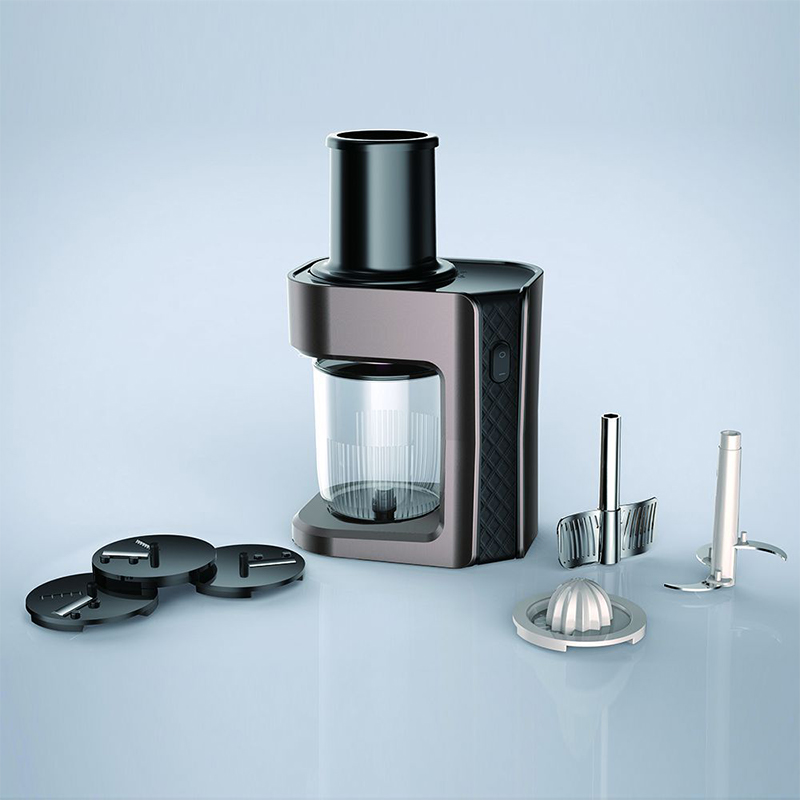
Electric Slicer Shredder Chopper Juicer Mixer in one
One Appliance for Several Food-Preparation Tasks
The defining advantage of this product is its four-in-one structure. Instead of requiring separate equipment for slicing, shredding, chopping, juicing, and blending, the appliance brings several functions together in a single body. This can make a meaningful difference in kitchens where storage space is limited or where users prepare a variety of ingredients throughout the day.
A dedicated slicer may be useful for one task, while a shredder or chopper may be needed for another. A juicer and mixer can add further convenience, but purchasing all of these appliances separately often increases cost, storage requirements, cleaning time, and the number of electrical cords on the worktop. A multifunctional appliance reduces the number of individual devices that need to be purchased and maintained.
The product is especially suited to common preparation jobs such as slicing vegetables, shredding ingredients for salads or fillings, chopping food into smaller pieces, extracting juice, and mixing ingredients. The exact result depends on the selected head, the type and quantity of ingredients, and the way the user feeds the food into the inlet. Nevertheless, the multiple-head configuration allows the appliance to adapt to different recipes more easily than a single-function device.
For retailers, this versatility creates a clear selling point. A product presented as a compact four-in-one food processor can appeal to customers who want more functionality without moving into the higher price and larger footprint often associated with premium commercial processors. For distributors, the same feature can make product education simpler because one appliance addresses multiple familiar kitchen needs.
Reduced Kitchen Clutter
Kitchen worktops are often crowded with appliances that are used only occasionally. A separate slicer, grater, chopper, mixer, and juicer can occupy considerable cabinet and counter space. A combined appliance offers a more organized alternative, particularly for apartments, small homes, dormitories, office kitchens, and compact hospitality operations.
The product’s relatively straightforward structure also helps users keep the preparation area more manageable. Instead of moving among several appliances, the user can select the appropriate head and continue working with the same base unit. This can improve the flow of meal preparation and reduce the time spent locating accessories.
Convenience for Daily Cooking
Many food-preparation tasks are repetitive. Slicing vegetables, chopping ingredients, and mixing components can take substantial time when performed entirely by hand. The motorized design assists with these activities and can be particularly helpful when preparing ingredients for several people.
The appliance is not intended to replace every type of professional food processor, nor should users exceed the recommended operating conditions. Its strength is everyday versatility. It is a practical tool for routine kitchen preparation rather than a specialized industrial machine.
Material Selection for Food Preparation
The product uses a combination of ABS, stainless steel 304, and PS. Each material contributes a different function to the overall design.
Stainless steel 304 is used for food-contact cutting or processing components where strength, corrosion resistance, and a cleanable surface are important. In food-preparation equipment, stainless steel is commonly valued because it is durable and suitable for repeated contact with many common ingredients when properly cleaned and maintained.
ABS is used in structural and housing components. This engineering plastic is widely used in consumer appliances because it can provide a balance of impact resistance, rigidity, appearance, and manufacturing flexibility. A well-designed ABS housing can protect internal components while keeping the appliance relatively light and easy to handle.
PS, or polystyrene, is used in selected product components where rigidity and transparent or molded construction may be required. The transparent sections of the appliance allow users to observe ingredients as they move through the preparation process. This visibility can make operation easier because users can monitor the approximate quantity and movement of food without opening the appliance repeatedly.
The combination of these materials reflects a practical approach to appliance development. Instead of relying on one material for every component, the design uses metal and plastics according to their functional strengths. The result is intended to be durable, user-friendly, and suitable for regular household use.
Food-Contact Awareness
Any appliance used for food preparation must be cleaned promptly after use. Food residue should not be allowed to remain around the cutting heads, inlet, catch port, or cover. Users should follow the supplied operating and cleaning instructions, disconnect the appliance from power before cleaning, and handle sharp components carefully.
The use of stainless steel 304 in the relevant food-processing components is a positive feature, but material selection alone does not eliminate the need for proper hygiene. Safe operation depends on the complete system, including correct assembly, appropriate cleaning, careful storage, and responsible handling.
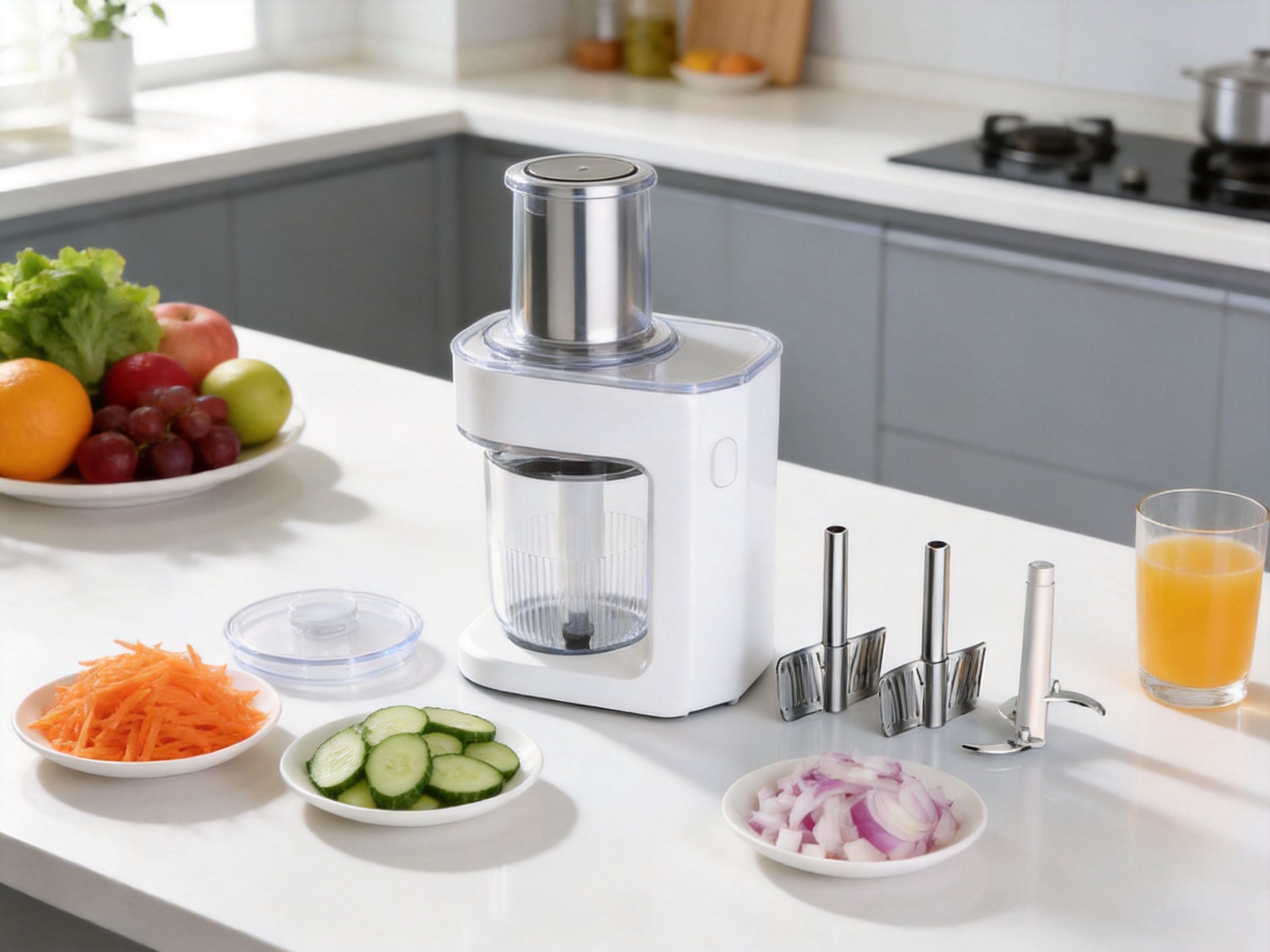
70W Motor Designed for Everyday Processing
The appliance is equipped with a 70W motor. For a compact household food processor, this provides powered assistance for common slicing, shredding, chopping, juicing, and mixing tasks. Compared with manual tools, the motor reduces the physical effort required from the user and helps maintain a more consistent operating rhythm during preparation.
Motor power should always be considered together with the appliance’s cutting system, feeding design, operating time, ingredient type, and capacity. A higher wattage number does not automatically make one appliance better than another. An effective food processor requires a suitable balance between motor output, head design, airflow, mechanical transmission, and user controls.
This product is designed around that balance. The 70W motor supports a compact multifunctional body while keeping the appliance appropriate for daily domestic preparation. It is intended to handle a large amount of ingredients at one time within its design limits, helping users reduce repeated manual batches.
Performance Benefits Compared with Manual Tools
Manual slicers and graters can be useful, but they require continuous hand movement and close contact with the cutting surface. Over time, this can become tiring, particularly when preparing large quantities. The powered appliance transfers much of the repetitive work to the motor, allowing the user to focus on feeding ingredients and selecting the desired function.
Compared with basic single-function electric tools, the product offers a broader range of uses. A single-purpose appliance may perform one task effectively but still require another device for chopping, mixing, or juicing. The four-in-one approach gives buyers more functionality from one purchase and can improve the overall value of the appliance.
Compared with larger food processors, the product may be more suitable for customers who do not need a large bowl or industrial-level capacity. Its appeal lies in convenient everyday processing, manageable size, and a relatively simple accessory system.
Three Interchangeable Chopping Heads
The product is equipped with three chopping heads that can be replaced according to the desired preparation result. Interchangeable heads are important in a multifunctional appliance because different ingredients and recipes require different cutting patterns.
A slicing head can be used for producing thin or even pieces of suitable vegetables and other ingredients. A shredding head can help create fine strips for salads, garnishes, fillings, or cooking preparations. A chopping or related processing head can reduce ingredients into smaller pieces, supporting tasks that would otherwise require repeated knife work.
The interchangeable system also improves product flexibility. Rather than purchasing separate electric machines for different cutting styles, the user can work with one base unit and select the appropriate attachment. For retail packaging and product demonstrations, the three-head structure provides a clear visual explanation of the appliance’s functions.
Head Replacement and Maintenance
Accessory replacement should be performed only when the appliance is switched off and unplugged. Users should ensure that each head is correctly seated before operation. A secure connection is essential for smooth performance and for reducing the possibility of vibration or improper movement.
After use, the heads should be cleaned according to the product instructions and dried thoroughly before storage. Cutting surfaces should be handled carefully, and users should avoid placing fingers near sharp edges during installation or removal.
From a manufacturing perspective, interchangeable components require consistent dimensional control. The head must fit the drive system securely, while the cover and feed structure must align with the cutting area. This makes mold accuracy, assembly control, and inspection important parts of production.
Safety-Oriented Feeding Design
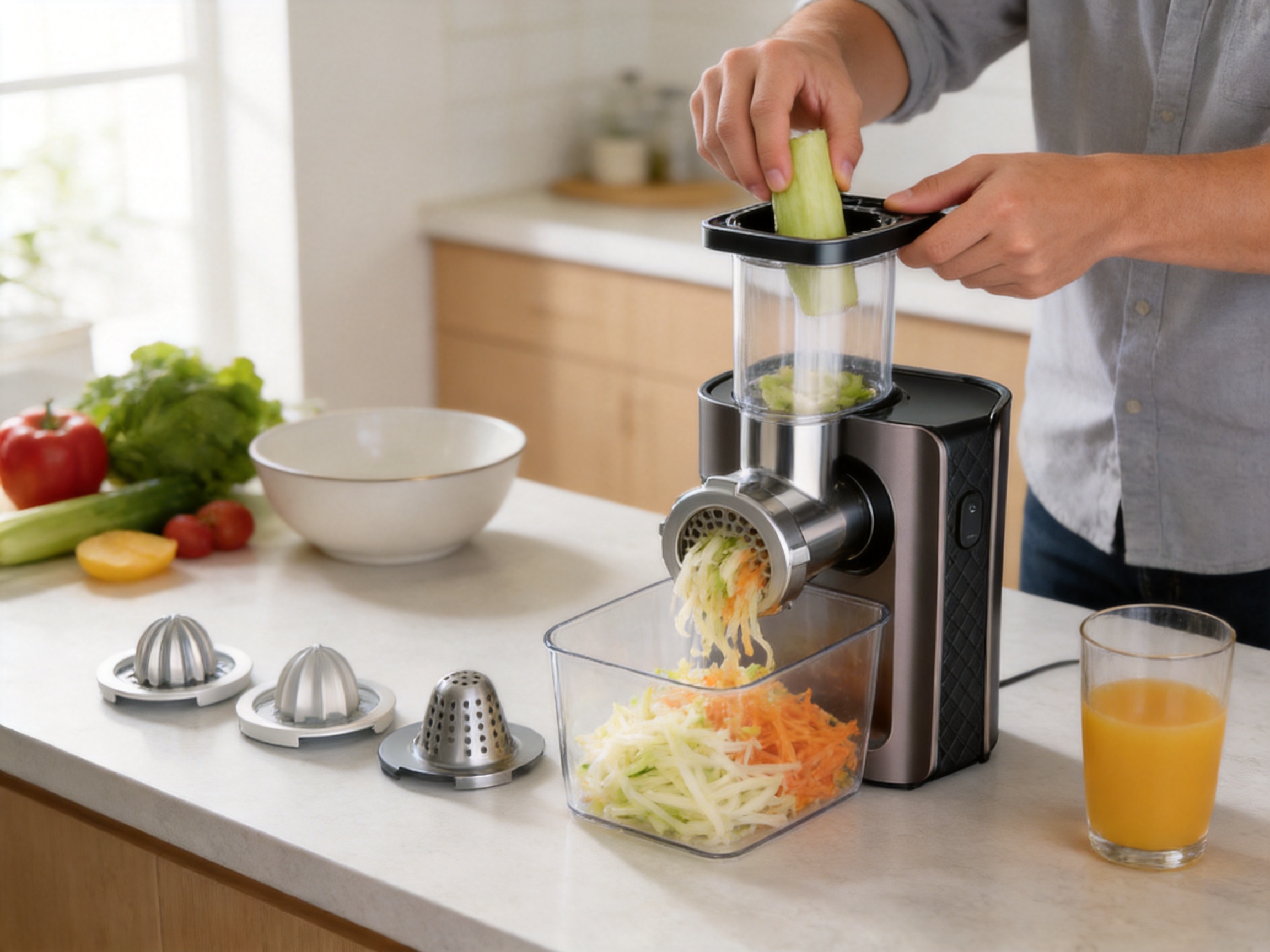
The appliance includes a pin-like vegetable press that pushes food into the cutter while helping keep the user’s hands away from the cutting area. This is a meaningful design advantage over manual cutting methods, where fingers may be close to blades during repetitive preparation.
The press also supports more consistent feeding. Ingredients can be guided toward the processing head without requiring the user to push them directly with a hand. Consistent feeding may help the appliance operate more smoothly and can contribute to more even results when ingredients are prepared in appropriate sizes.
A pin-like tip is also described as helping hold food in place. This can be useful when ingredients need to remain stable as they enter the cutting or processing area. By assisting with positioning, the design supports more efficient preparation and reduces unnecessary movement inside the inlet.
These features do not remove the need for caution. Users should never place hands, utensils, or other objects into the inlet while the motor is running. The press should be used for its intended purpose, and children should not operate the appliance without appropriate supervision.
Snap-On Top Cover
The snap-on top cover is designed for convenient assembly and cleaning. A cover that can be removed without complicated tools makes it easier for users to access areas where food residue may collect. It also supports a simpler daily routine because the user can separate the upper structure after disconnecting the appliance from power.
Easy access is an important advantage in food appliances. If cleaning is difficult, users may postpone it or clean only the most visible parts. A removable cover encourages more complete maintenance and helps the appliance remain attractive and hygienic over time.
The cover also contributes to the product’s overall operating structure by helping guide ingredients and contain food during processing. Its fit and closure are therefore important not only for convenience but also for stable operation.
Transparent Inlet and Catch Ports
The transparent inlet and catch ports allow users to observe the processing area more easily. Visibility helps users understand how much food has entered the appliance, whether the catch container is approaching capacity, and whether additional ingredients should be added gradually.
Opaque appliances can make users rely entirely on sound or guesswork. A transparent structure provides a more direct visual reference. This is particularly useful for first-time users who are learning how to feed different ingredients or select the appropriate head.
The large-capacity inlet is another practical feature. A wider opening can reduce the need to cut every ingredient into very small pieces before processing. Users should still follow the recommended ingredient size and never force oversized food into the inlet, but a generous opening can make preparation more convenient.
The catch port is designed to receive processed ingredients in an organized manner. A dedicated collection area can reduce mess on the worktop and make it easier to transfer prepared food into a bowl, pan, container, or serving dish.
Design Advantages over Single-Function Competitors
The most obvious competitive advantage is multifunctionality. A single-function slicer may be simple to understand, but it cannot provide the broader preparation options offered by a four-in-one appliance. Consumers who regularly prepare salads, sauces, chopped vegetables, fresh juice, or mixed ingredients may prefer one flexible device instead of several specialized machines.
The appliance also offers an advantage over purely manual tools. Manual equipment can be inexpensive and does not require electricity, but it depends on greater physical effort and may produce slower results when processing larger quantities. The 70W motor provides powered assistance for everyday tasks while keeping the product in a compact category.
Another competitive advantage is the balance between functionality and user guidance. The transparent inlet, visible collection area, food press, and replaceable heads make the product easier to understand during operation. These elements can be especially helpful for customers who want practical features without the complexity of a large commercial processor.
Compared with some highly complicated multifunctional appliances, this product is based on a relatively direct mechanical concept. The core idea is clear: choose a head, load ingredients, use the press, and collect the processed food. A simpler user experience may improve customer satisfaction and reduce the learning period after purchase.
Value for Retail and Distribution
For wholesalers and retailers, a product with several visible functions can be easier to merchandise. Packaging, demonstrations, catalog descriptions, and online listings can highlight the same central message: one compact appliance can support multiple kitchen tasks.
The product’s specification also provides useful information for commercial planning. The listed carton measurement is 57 × 45 × 43.5 centimeters, with four pieces per carton. The stated net and gross weights are 9.5 kilograms and 10.5 kilograms respectively. These details help buyers estimate warehousing, shipping, shelf replenishment, and container utilization.
The listed container quantities are 1,004 pieces for a 20-foot container and 2,439 pieces for a 40HQ container. Such figures are subject to final packing configuration and logistics confirmation, but they provide an initial reference for procurement planning.
| Specification | Product Information |
|---|---|
| Item number | GSE001 |
| Product type | Electric slicer, shredder, chopper, juicer, and mixer |
| Motor power | 70W |
| Primary materials | ABS, stainless steel 304, and PS |
| Processing heads | Three interchangeable chopping heads |
| Carton measurement | 57 × 45 × 43.5 cm |
| Pieces per carton | 4 pieces |
| Net/gross weight | 9.5 kg / 10.5 kg |
| Minimum order quantity | 2,000 pieces |
| Stated delivery time | 45–60 days |
| Packaging | PE bag, EPE, mail box, and carton box |
| Stated trade term | FOB Ningbo |
Packaging and International Shipment Readiness
The listed packaging structure includes a PE bag, EPE protection, a mail box, and a carton box. This layered approach is intended to protect the appliance during handling and transportation. EPE can help cushion the product against impacts, while the carton provides an external shipping enclosure suitable for warehouse and export logistics.
Packaging is an important part of appliance quality. A well-designed product can still arrive with cosmetic damage if it is not properly protected during loading, unloading, stacking, and long-distance transportation. For an item containing molded plastic components, transparent sections, cutting heads, and a motor assembly, appropriate internal protection is especially important.
Export buyers can work with the manufacturer to confirm carton artwork, language requirements, labeling, barcodes, manuals, plug specifications, and destination-market packaging rules. These details may vary by country and sales channel. The listed FOB Ningbo arrangement provides a basis for commercial discussion, while final terms should be confirmed in the purchase agreement.
The stated minimum order quantity is 2,000 pieces, making the product suitable for importers, chain retailers, private-label programs, regional distributors, and established online sellers. Larger-volume programs may also discuss customized packaging, colors, markings, electrical configurations, or other product requirements, subject to engineering and production approval.
Manufacturing Experience and Product Development
The manufacturer behind the appliance has a history of developing small kitchen appliances and non-electric household products. According to the supplied company information, the business was established in 2009 after its founder gained experience in sales, sourcing, buying-agent services, product development, and international retail cooperation.
This background is relevant because successful appliance manufacturing requires more than assembly. A supplier must understand how a product is designed, costed, tested, packed, shipped, introduced to the market, and supported after delivery. Experience with different product categories can help an engineering team identify common customer requirements and improve the practical usability of new designs.
The company initially developed non-electric innovative products, including spiralizer and grater products, iced pitchers, and iced bowls. It later expanded into electric appliances, including food processors, air ovens, and air fryers. This progression from manual kitchen tools to powered products provides useful category knowledge. The manufacturer can draw on experience with cutting, grating, ingredient handling, molded parts, and kitchen ergonomics when developing electric models.
Engineering and Research Capability
The supplied company profile states that the organization has engineers in its research and development department and dedicated personnel in quality control. It also reports a manufacturing workforce of more than 150 people in one description and more than 200 experienced workers in another later description. These figures may reflect different periods or operating arrangements, so buyers should confirm current staffing during qualification.
The presence of a dedicated R&D function is important for a multifunctional appliance. Product development must coordinate motor performance, head geometry, plastic housing design, cover fit, feed-port dimensions, electrical layout, noise considerations, assembly sequence, and cleaning access.
For a product such as this, engineering work may include developing the cutter heads, checking the connection between the head and motor transmission, refining the snap-on cover, evaluating the food press, and improving the transparency and capacity of the inlet and catch areas. Each change can affect usability, cost, durability, and production efficiency.
Manufacturing Infrastructure
The company information describes a wholly owned plant with a production area of approximately 15,000 square meters and more than 200 experienced workers. It also refers to a facility occupying 10,000 square meters with a building area of 18,000 square meters during an earlier stage. These descriptions indicate an established manufacturing base, although current facility details should be verified directly for a specific order.
A dedicated factory can provide stronger coordination between product engineering, production planning, quality control, assembly, packaging, and shipment preparation. This coordination is valuable for export customers because product changes and quality concerns can be communicated more directly across departments.
Manufacturing strength is not measured only by factory size. It also depends on process discipline, supplier management, inspection standards, traceability, worker training, equipment maintenance, and the ability to repeat the same quality level across large production runs. The company’s long experience in international product development suggests familiarity with these commercial requirements.
Quality Control Considerations
Quality control for a multifunctional food appliance should cover incoming materials, molded components, metal parts, electrical assemblies, motor performance, accessory fit, appearance, functionality, packaging, and final shipment quantity.
Incoming inspection can verify that ABS, PS, stainless steel components, motors, wiring, switches, and other parts meet approved specifications. During production, assembly checks can confirm that the motor, drive system, housing, cover, and catch structure are installed correctly. Finished-product testing can include power operation, head rotation, fit of accessories, cover installation, and visual inspection.
Cutting heads should be checked for correct dimensions, surface condition, alignment, and secure connection. Transparent components should be inspected for cracks, excessive marks, distortion, or other defects that could affect appearance or usability. The food press should be checked for proper movement and compatibility with the inlet.
Packaging inspection is equally important. The factory should verify that each unit includes the correct heads, press, cover, instructions, and other specified parts. Carton quantity, labeling, gross weight, and packing orientation should be confirmed before shipment.
Buyers may request pre-production samples, approved reference samples, inspection standards, production photographs, test reports, or third-party inspection arrangements. The manufacturer’s stated quality-control resources provide a starting point, but quality requirements should always be documented in the purchase order and technical specification.
Production Process from Concept to Shipment
A strong appliance manufacturing process generally begins with market and customer requirements. For this product, the requirements include multiple food-processing functions, compact size, user protection, simple cleaning, interchangeable heads, and efficient export packaging.
The design team then develops the product structure and determines how the motor, cutter heads, cover, inlet, press, and catch port will interact. Materials are selected according to strength, appearance, food-contact use, transparency, molding requirements, and cost targets.
Prototypes can be used to evaluate operation and identify improvements. Engineers may check whether ingredients enter smoothly, whether the selected heads deliver the expected preparation effect, whether the cover is easy to remove, and whether the appliance is stable during use.
Once the design is approved, tooling and production preparation begin. Plastic housings and transparent parts require suitable molds, while stainless steel heads require controlled forming, cutting, or stamping processes. Electrical and motor components must be sourced according to the approved specification.
Assembly brings these elements together. Operators install internal components, connect electrical parts, fit the motor system, attach the housing, and verify the accessory structure. Quality-control personnel can inspect samples or production batches at key stages instead of waiting until the entire order is finished.
Final inspection and packaging complete the process. Finished units are tested, cleaned, packed with protective materials, placed into cartons, labeled, and prepared for shipment from Ningbo. This end-to-end structure helps transform a product concept into a repeatable commercial item.

Applications in Homes, Retail, and Food Service
For household users, the appliance can assist with everyday preparation of vegetables, fruits, salads, sauces, garnishes, fillings, and mixed ingredients. It may be particularly useful for families that prepare fresh food regularly and want to reduce manual chopping and slicing.
For small cafés, juice counters, snack shops, and light food-service operations, the appliance may provide useful support for lower-volume preparation. It can help process ingredients without requiring several separate machines. Operators should evaluate their expected workload carefully and confirm that the product’s capacity and operating limitations match their needs.
For hotels, restaurants, and catering businesses, the appliance can be positioned as a supplementary preparation tool. Its compact format may be useful in auxiliary kitchens, breakfast areas, service stations, or locations where counter space is limited. Commercial operators should establish cleaning procedures, staff training, and safe storage practices before placing the appliance into routine service.
For retail buyers, the product can fit into the small kitchen appliance category alongside blenders, choppers, graters, and food processors. Its four-in-one positioning can help create a clear shelf message and support promotional demonstrations. Product listings should accurately explain the functions, materials, power rating, included heads, packaging, and operating instructions.
Energy and Practicality
The 70W rating places the appliance within a relatively modest power range for small kitchen equipment. Lower power consumption can be attractive to households that want powered assistance without adding a high-energy appliance to the kitchen. Actual energy use depends on operating time, ingredient resistance, duty cycle, and local electrical conditions.
Practicality also comes from the reduced need for separate appliances. Consolidating several functions into one unit can lower the amount of space used for storage and reduce the number of products that must be cleaned, maintained, and replaced.
However, multifunctionality should not be confused with unlimited capacity. Users should process ingredients in appropriate quantities, avoid forcing food into the inlet, and allow the motor to operate according to the instructions. Responsible use helps preserve performance and extend product life.
Cleaning and Long-Term Care
Cleaning should begin by switching off and unplugging the appliance. Removable heads, the press, and the cover should be separated as instructed. Food residue should be removed with suitable cleaning methods, and components should be dried before reassembly or storage.
The motor base and electrical components should not be immersed in water unless the manual specifically permits it. A damp cloth may be appropriate for external surfaces, but users should prevent water from entering electrical openings.
Sharp heads require special attention. They should be handled by safe edges where possible and stored so that they cannot injure users or become damaged. Children should not handle the heads as toys or use the appliance without supervision.
Regular cleaning can also preserve transparency and appearance. Food oils, pigments, and moisture may cause staining or odors if left on surfaces. Prompt maintenance helps keep the appliance presentable and supports hygienic food preparation.
Commercial Partnership Advantages
For international buyers, the supplier’s experience in wholesale and export-oriented product development is a significant consideration. The company has worked with customers and markets across multiple regions and has experience developing products for supermarkets, home-shopping channels, and other retail environments, according to the supplied information.
This background can help with practical commercial matters such as packaging coordination, product positioning, order planning, engineering communication, shipment preparation, and after-sales support. The company states that it aims to provide innovative products, competitive pricing, quick delivery, and after-sales service.
The listed delivery time for this product is 45–60 days. Actual lead time may depend on order quantity, material availability, tooling status, packaging approval, production scheduling, inspection requirements, and shipping arrangements. Buyers should establish a confirmed production schedule before placing an order.
The stated MOQ is 2,000 pieces. This quantity can support a regional launch or retail program while still allowing the manufacturer to organize a stable production run. Buyers should discuss whether the MOQ applies equally to standard and customized versions.
Communication is another important strength. The supplier provides a Ningbo, China address and direct sales contact details for business inquiries. Buyers can use these channels to request samples, quotations, technical documents, packaging information, compliance materials, and current production capabilities.
How Buyers Should Evaluate the Product
Before purchasing, buyers should review the product sample and confirm the actual functions of each included head. Testing should cover the ingredients most relevant to the intended market. For example, a distributor targeting salad preparation may focus on slicing and shredding, while a juice-oriented retailer may place greater emphasis on liquid handling and cleaning.
Electrical specifications must be confirmed for the destination market, including voltage, frequency, plug type, cord configuration, labeling, and applicable regulatory requirements. The supplied information includes the notation “14ETL FDA,” but the precise meaning, scope, and validity of any certification or compliance reference should be confirmed through official documents before marketing the product.
Buyers should also confirm the instruction manual language, warranty terms, spare-part availability, replacement-head supply, carton markings, and acceptable defect rate. If the product will be sold under a private label, artwork approval and ownership of customized tooling should be documented.
A pre-shipment inspection can verify appearance, operation, accessories, packing, carton quantity, and labeling. For larger orders, buyers may also establish a quality agreement describing inspection methods, sampling levels, performance requirements, and corrective-action procedures.
Why Manufacturing Strength Matters to Product Value
A product’s market value depends on more than its advertised features. A four-in-one appliance must deliver consistent assembly, reliable accessory fit, acceptable appearance, stable motor operation, and effective packaging. These results depend on the manufacturer’s ability to control the entire production chain.
GSTAR’s reported combination of product development experience, engineering resources, quality-control personnel, factory infrastructure, and international market knowledge supports the commercial potential of this appliance. Its history across both manual and electric kitchen products provides useful insight into consumer expectations and food-preparation behavior.
The company’s expansion into electric products also demonstrates a willingness to invest in powered appliance categories. Its portfolio covers several product types rather than relying on one model, which can help create shared knowledge in motors, molded parts, electrical assemblies, kitchen ergonomics, and export packaging.
For buyers, this means the product can be evaluated not only as an individual item but also as part of a broader supplier relationship. A successful order may create opportunities for related kitchen appliances, coordinated product collections, seasonal promotions, or future custom development.
Conclusion
The electric slicer, shredder, chopper, juicer, and mixer is designed to address a clear modern-kitchen demand: more preparation functions in one manageable appliance. Its four-in-one structure, 70W motor, three interchangeable heads, stainless steel 304 processing components, transparent inlet and catch ports, snap-on cover, and food press combine to create a practical daily-use product.
Compared with manual tools, it can reduce repetitive effort. Compared with single-function appliances, it offers broader utility. Compared with larger and more complex processors, it may provide a simpler and more space-conscious option for households, retailers, and selected food-service environments.
The product’s commercial strength is reinforced by the manufacturer’s experience in small kitchen appliances, product innovation, engineering, factory production, quality control, and international business. With a stated MOQ of 2,000 pieces, a 45–60 day delivery estimate, export packaging, and FOB Ningbo availability, it is positioned for wholesale and distribution programs.
As with any electrical food appliance, success depends on correct use, regular cleaning, appropriate ingredient quantities, and compliance with the requirements of the destination market. Buyers should verify current specifications, certifications, packaging, electrical configurations, and quality standards before finalizing an order.
When these considerations are managed properly, the appliance offers a convincing combination of convenience, versatility, practical safety features, and manufacturing support. It is a useful example of how compact kitchen equipment can combine several everyday functions while remaining accessible to modern consumers and international retail channels.
Questions and Answers
What functions does the appliance provide?
The appliance is designed to combine electric slicing, shredding, chopping, juicing, and mixing in one product. The supplied product title describes it as a four-in-one appliance, while the detailed description lists these related processing functions. The exact result depends on the selected head and the ingredient being processed.
How powerful is the motor?
The listed motor power is 70W. This is intended for everyday household food-processing tasks within the product’s design limits. Users should follow the instructions regarding ingredient quantity, operating time, and suitable foods.
What materials are used?
The stated materials are ABS, stainless steel 304, and PS. Stainless steel 304 is used for relevant food-processing components, while ABS and PS are used in structural, housing, and transparent parts according to the product design.
How many processing heads are included?
The product is equipped with three interchangeable chopping heads. Users can select the appropriate head for different preparation requirements and should replace heads only when the appliance is switched off and unplugged.
Does the product include a safety press?
Yes. The appliance includes a pin-like vegetable press that helps move food toward the cutter while keeping the user’s hands farther away from the cutting area. It also includes a pin-like tip intended to help hold food in place.
Is the top cover removable?
The product uses a snap-on top cover designed for easier removal and cleaning. Users should disconnect the appliance from power before removing the cover or any processing head.
Why are the transparent inlet and catch ports useful?
They allow users to observe ingredients and processed food more easily. The visibility can help users monitor feeding, understand the remaining capacity, and reduce unnecessary opening of the appliance during operation.
What is the carton size?
The listed carton measurement is 57 × 45 × 43.5 centimeters. The stated packing quantity is four pieces per carton.
What are the net and gross weights?
The supplied product information lists a net weight of 9.5 kilograms and a gross weight of 10.5 kilograms. Buyers should confirm whether these figures apply to the final approved packaging configuration.
What is the minimum order quantity?
The listed minimum order quantity is 2,000 pieces. Customized orders may require separate discussion regarding quantity, artwork, colors, electrical versions, and tooling.
What is the stated delivery period?
The stated delivery time is 45–60 days. The actual schedule may vary according to order details, material availability, production planning, packaging approval, inspections, and shipping arrangements.
Where is the product shipped from?
The listed trade term is FOB Ningbo. The exact shipping arrangement, port procedures, documentation, and final commercial terms should be confirmed with the supplier for each order.
Can the appliance be used in restaurants or hotels?
It may be suitable as a supplementary preparation appliance in restaurants, hotels, cafés, bars, and other food-service settings, particularly for lower-volume tasks. Commercial users should confirm that its capacity, duty cycle, cleaning process, and electrical configuration match their operational requirements.
What should buyers confirm before ordering?
Buyers should confirm the final product specification, electrical version, included accessories, packaging, instruction manual, warranty, compliance documentation, inspection requirements, delivery schedule, and replacement-head availability. Any certification reference should be verified through official documentation before being used in marketing materials.
What makes the manufacturer suitable for wholesale cooperation?
The supplied company information describes experience in small kitchen appliances, product development, engineering, manufacturing, quality control, international retail, and export business. It also reports a dedicated factory, production workers, R&D personnel, and QC personnel. Buyers should conduct their own supplier verification and confirm current capabilities before placing an order.
References
1. Supplied product specification for item GSE001, including motor power, materials, packaging, carton dimensions, order quantity, and delivery information.
2. Supplied manufacturer profile for CIXI GSTAR ELECTRIC APPLIANCE CO., LTD., including company history, product categories, factory information, R&D resources, quality-control resources, and international market experience.
3. General food-appliance handling principles concerning safe feeding, cleaning, removal of cutting components, electrical disconnection, and storage.
4. General materials reference for ABS, PS, and stainless steel 304 in small consumer appliance construction.
5. General export purchasing guidance concerning product sampling, packaging approval, inspection, electrical-market requirements, and shipment documentation.