
 English
 中文简体
中文简体 Español
 English
 中文简体
中文简体 Español
Vegetable preparation is an important part of everyday cooking, food-service operations, and healthy meal planning. As more consumers look for attractive, low-carbohydrate, vegetable-based meals, spiralized vegetables have become increasingly popular. Zucchini noodles, carrot ribbons, cucumber spirals, sweet potato strands, and other creative vegetable shapes can make ordinary ingredients more appealing while supporting a varied diet.
The self-pressure vertical spiralizer is designed to make this type of preparation faster, cleaner, and more consistent. With a vertical operating structure and a self-pressure mechanism, the product helps users process vegetables with less manual pushing than many conventional handheld slicers. It is a manual kitchen tool rather than an electrically powered appliance, so it does not require a power socket, battery, or motor. This makes it suitable for home kitchens, outdoor cooking, catering preparation, retail gift sets, and professional food-service environments where straightforward operation and easy handling are valued.
Item GS067 combines a practical vertical design with a selection of durable materials, including ABS, PP, TPE, polyamide, and stainless steel. Its construction is intended to balance rigidity, comfort, food-preparation performance, and resistance to regular kitchen use. The product is also suited to wholesale distribution, with carton packaging of six pieces and a stated minimum order quantity of 2,000 pieces.
This article examines the product’s structure, operating advantages, materials, manufacturing support, commercial value, and suitability for different markets. It also explains how the manufacturer’s experience in product development, engineering, quality control, and international supply can support customers seeking innovative small kitchen appliances and manual food-preparation tools.
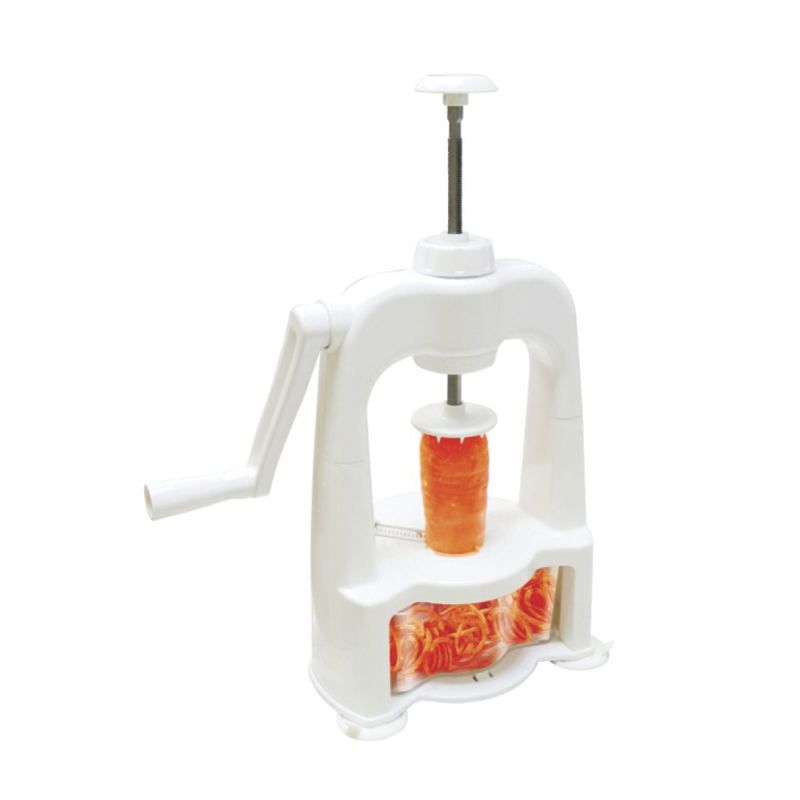
Self Pressure Vertical Spiralizer
Understanding the Self-Pressure Vertical Spiralizer
A spiralizer is a kitchen utensil that cuts firm vegetables into long, narrow, spiral-shaped strands or decorative ribbons. The resulting pieces can be used as alternatives to pasta, salad ingredients, garnishes, stir-fry components, side dishes, or visually appealing food-service presentations.
The GS067 self-pressure vertical spiralizer uses a vertical arrangement rather than requiring the user to hold a vegetable horizontally against a cutting surface. In a vertical configuration, gravity naturally assists the preparation process. The ingredient is positioned above or within the cutting area, and the self-pressure structure helps maintain contact between the vegetable and the blade assembly as the user operates the unit.
This operating concept addresses several common challenges found in basic manual slicers. With a conventional handheld slicer, the user may need to press the vegetable downward with one hand while moving it repeatedly across a blade. That method can be tiring, inconsistent, and difficult to control when processing multiple portions. A self-pressure vertical design can reduce the amount of direct force required from the user and help maintain a more stable cutting action.
The product is especially useful for firm vegetables with suitable cylindrical or elongated shapes. Depending on the ingredient and the selected cutting configuration, users may prepare zucchini, carrots, cucumbers, radishes, potatoes, sweet potatoes, beets, and similar produce. The actual result depends on vegetable freshness, size, firmness, trimming, and the operator’s technique.
Manual operation without electrical dependence
One of the product’s most important characteristics is its manual operating principle. Unlike electric food processors, the spiralizer does not require a motor, power cord, charging system, or electronic control panel. This provides several practical benefits.
First, the product can be used in kitchens with limited electrical access. It is also suitable for outdoor cooking, temporary food stalls, camping, demonstrations, and emergency or backup food preparation. Second, manual construction can help reduce the number of electrical components that require inspection, replacement, or repair. Third, a manual tool generally produces less operating noise than a motorized appliance.
Manual operation also gives users direct control over preparation speed. A cook can process a small quantity without setting up a large appliance, and there is no need to connect, program, or clean a motor base. This can make the tool convenient for quick meal preparation and small-batch use.
Vertical design and self-pressure performance
The vertical format is intended to improve the relationship between the ingredient, the cutting surface, and the user’s hand position. Instead of applying continuous horizontal pressure, the user can work with a more natural downward orientation. The self-pressure feature supports contact with the cutting components and may help reduce interruptions caused by the vegetable moving away from the blade.
For commercial users, this operating style can be valuable when preparing repeated portions. Consistent pressure can support more uniform strands and reduce the amount of time spent adjusting the ingredient. For household users, it can make spiralizing more approachable, particularly for people who find traditional handheld slicers physically demanding.
As with all manual cutting tools, safe handling remains essential. Users should follow the supplied instructions, keep fingers away from cutting surfaces, use suitable produce, and stop operating the tool when the remaining piece becomes too small to handle safely. The self-pressure system is designed to assist preparation, but it does not eliminate the need for responsible use.
Product Details and Technical Profile
The following information summarizes the principal specifications supplied for the GS067 self-pressure vertical spiralizer.
| Product Attribute | Specification |
| Item Number | GS067 |
| Product Name | Self-pressure vertical spiralizer |
| Product Category | Manual vegetable slicer |
| Primary Material Composition | ABS, PP, TPE, polyamide, and stainless steel |
| Carton Quantity | 6 pieces per carton |
| Carton Measurement | 46 x 58.5 x 36.5 cm |
| Net Weight | 5.3 kg |
| Gross Weight | 6 kg |
| Estimated 20-Foot Container Quantity | 2,100 pieces |
| Estimated 40-Foot High-Cube Container Quantity | 5,100 pieces |
| Estimated Standard 40-Foot Container Quantity | Not specified |
| Minimum Order Quantity | 2,000 pieces |
| Stated Delivery Time | 30 days |
The combination of six-piece carton packing and container-loading information is useful for importers, distributors, retailers, and private-label buyers planning their purchasing schedules. The net and gross weights also assist with preliminary freight calculations and warehouse planning. Final shipping arrangements should be confirmed according to packaging configuration, destination, shipping method, and current production conditions.
Materials and Construction Advantages
ABS structural components
ABS, or acrylonitrile butadiene styrene, is widely used in consumer products that require a balance of strength, dimensional stability, and attractive surface finish. In a kitchen tool, ABS can be used for structural housings, support elements, handles, or other components that benefit from rigidity and impact resistance.
For a vertical spiralizer, a stable structural body is important because the cutting process creates repeated pressure and movement. A rigid housing can help maintain the alignment of the working parts during operation. ABS can also support precise molded details, which is useful when designing joints, guides, supports, and ergonomic surfaces.
Polypropylene components
PP, or polypropylene, is a lightweight thermoplastic commonly used in food-contact products, storage items, kitchen utensils, and household goods. It offers useful resistance to moisture and many common household substances. Its relatively low weight can help make a manual appliance easier to move, store, and handle.
Polypropylene is also well suited to injection molding. This allows manufacturers to produce repeated components with consistent dimensions when the tooling, material control, and production parameters are properly managed. Such consistency is important for parts that must fit together during assembly.
TPE comfort and grip elements
TPE, or thermoplastic elastomer, can provide a softer touch and improved friction in areas where the user holds or stabilizes the product. A TPE element may help reduce slipping on a work surface or make the user interface more comfortable during repeated operation.
The combination of rigid plastics and softer elastomeric materials reflects a practical design approach. Structural parts can remain firm while grip zones provide a more pleasant tactile experience. This type of material combination is commonly used in products where stability, comfort, and visual appeal must work together.
Polyamide support and engineering applications
Polyamide, often referred to as nylon, is used in many engineered components because of its strength, wear resistance, and ability to perform in moving or load-bearing applications. In a spiralizer, polyamide may be suitable for selected internal or functional parts that require additional mechanical performance.
The exact application of each material depends on the product’s detailed engineering design. Nevertheless, the listed material combination indicates that the product is not based on a single low-cost plastic. Instead, it uses different material characteristics for different functional requirements.
Stainless steel cutting elements
Stainless steel is an appropriate material for cutting components in kitchen preparation tools. It is valued for corrosion resistance, durability, and compatibility with food-preparation environments. A stainless steel blade can provide a reliable cutting edge when it is properly formed, finished, assembled, and maintained.
Blade performance is influenced by more than the steel specification alone. Edge geometry, thickness, surface finishing, assembly accuracy, ingredient selection, cleaning practices, and storage conditions all contribute to the user experience. A well-designed stainless steel cutting component can help the product deliver attractive vegetable strands over repeated use.
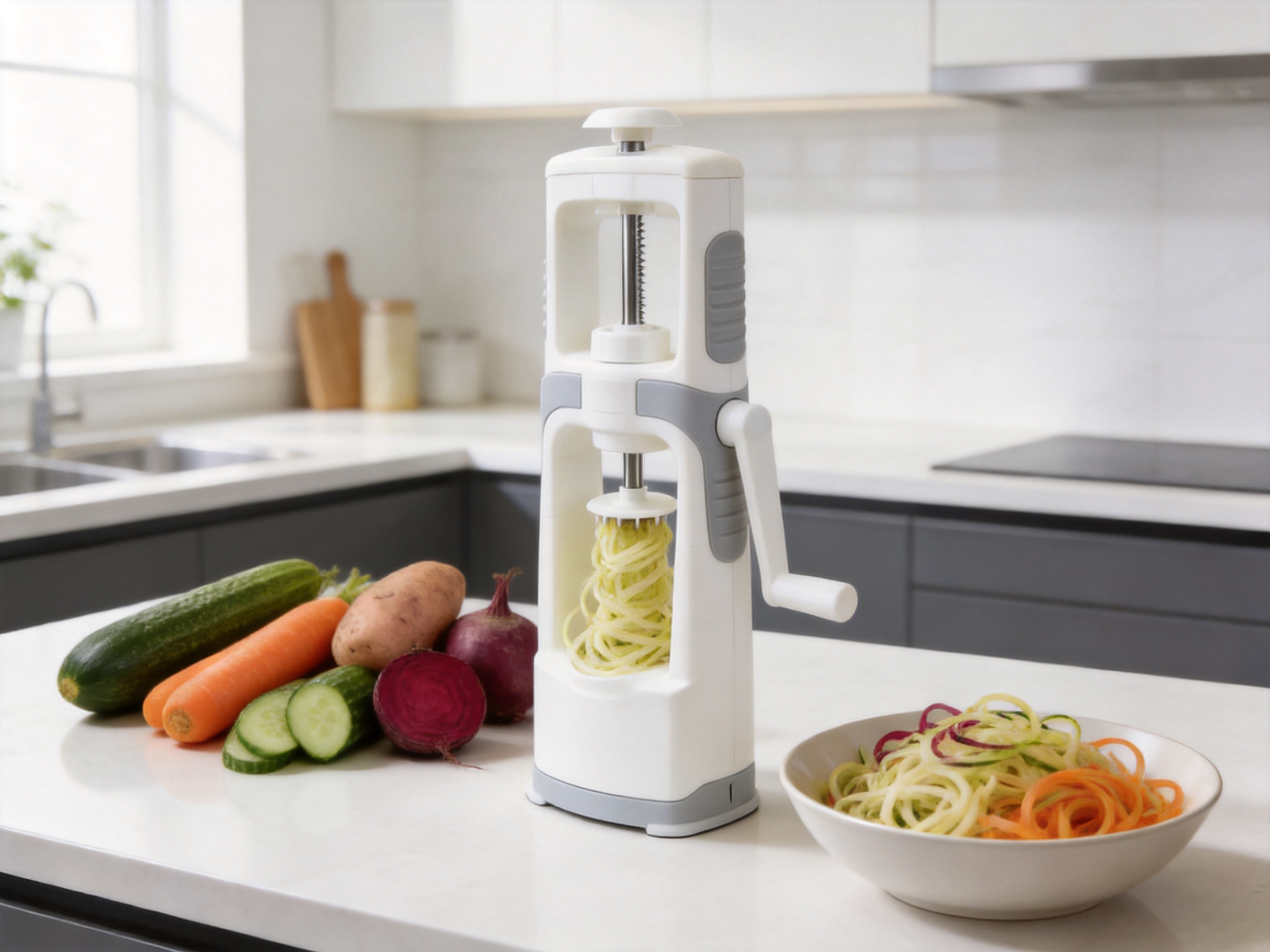
Advantages Compared with Conventional Vegetable Slicers
Reduced dependence on direct pushing force
Many simple handheld slicers require the operator to push vegetables continuously against a blade. This can be acceptable for one small portion, but it may become uncomfortable when preparing meals for a family, restaurant, event, or retail demonstration. The self-pressure mechanism is intended to reduce this burden by helping maintain contact between the produce and the cutting area.
Less direct force can make the product more accessible to a wider group of users. It may also reduce fatigue during repeated preparation. For wholesalers and retailers, this feature provides a clear product story that is easy to explain: the tool is designed to assist the user rather than relying entirely on manual downward pressure.
More controlled vertical workflow
The vertical arrangement can provide a more organized operating sequence. Ingredients can be prepared, positioned, spiralized, and collected in a container or bowl below the cutting area. This arrangement may help keep the worktop clearer than some flat handheld tools, especially when the product is used with a suitable receiving container.
A vertical workflow can also make the cutting action easier to observe. Users can monitor the direction of the vegetable and the shape of the strands as they are produced. This may support better control over portion preparation and presentation.
Less setup than an electric processor
Electric food processors can be powerful and versatile, but they often include a motor base, electrical cord, bowls, lids, switches, and multiple attachments. These components can take up storage space and require assembly before use. The manual spiralizer offers a more focused solution for users whose primary need is vegetable spiralizing.
The absence of a motor can also make the product easier to transport. Retailers may position it as a compact alternative for customers who want creative vegetable preparation without purchasing a full food processor.
Lower operating noise
Because the product is manually operated, it avoids the motor noise associated with electric slicers and processors. This may be beneficial in open-plan kitchens, small cafés, cooking demonstrations, shared accommodation, or environments where quiet operation is preferred.
Potentially simpler maintenance
Without electrical circuitry or a motor, the product has fewer electronic elements exposed to cleaning, moisture, or wear. The principal maintenance requirements are likely to involve cleaning the food-contact surfaces, inspecting the blade area, drying the product thoroughly, and storing it safely. Buyers should always follow the manufacturer’s care instructions and confirm which components are dishwasher-safe, if applicable.
Strong visual appeal for retail and demonstration
Spiralized vegetables create an immediate visual result. This makes the product suitable for in-store demonstrations, cooking content, seasonal promotions, healthy-eating campaigns, and kitchenware displays. Consumers can understand the benefit quickly when they see a carrot or zucchini transformed into a long decorative shape.
Compared with less visually distinctive vegetable tools, the spiralizer can therefore offer stronger merchandising potential. Retailers may present it alongside salad bowls, meal-preparation containers, healthy cooking accessories, or recipe cards.
Food Preparation Applications
Vegetable noodles
Zucchini noodles are one of the best-known uses for a spiralizer. They can be served raw, lightly sautéed, steamed, or combined with sauces and other ingredients. Carrot noodles and cucumber noodles can also add color and texture to salads and cold dishes.
The product can support consumers who want to reduce reliance on conventional pasta or increase their vegetable intake. It can also help restaurants create menu items that appeal to customers seeking vegetarian, low-carbohydrate, or visually creative meals.
Salads and cold dishes
Long vegetable spirals can give salads a different texture and appearance from ordinary slices or cubes. Cucumber, carrot, radish, and beet spirals can be combined with leafy greens, herbs, seeds, dressings, and proteins. In food-service environments, decorative preparation can improve the presentation of buffet trays and plated dishes.
Garnishes and plate decoration
Chefs and catering teams often use vegetable shapes as decorative elements. Spiralized produce can be arranged around main dishes, placed on appetizer plates, or used to add height and movement to a presentation. Because the tool is manual and relatively focused, it can be kept ready for finishing tasks without starting a larger machine.
Meal preparation and portion planning
Consumers who prepare meals in advance may use spiralized vegetables as ingredients for several meals. The product can support batch preparation of salad components, lunch boxes, side dishes, and vegetable-based snacks. Since the tool is not limited to one cooking method, the prepared vegetables can be eaten raw or incorporated into cooked recipes.
Food-service and hospitality use
Restaurants, hotels, cafés, catering companies, and culinary schools can use spiralizers for menu development, garnish preparation, demonstration, and special events. The tool’s manual format may be useful in locations where staff need a compact backup utensil or where an electric machine would be unnecessarily large for the required task.
Before adopting the product for high-volume commercial use, operators should evaluate throughput, cleaning routines, food-safety procedures, staff training, and replacement-part availability. The product is a practical manual tool, but every commercial kitchen should match equipment capacity to its actual workload.
Design Considerations for Users and Buyers
Ergonomic handling
A kitchen product is more successful when its form supports the user’s natural movements. Vertical operation can reduce awkward sideways pressure, while TPE elements may improve grip and handling comfort. The position of the operating controls, ingredient support, base, and collection area should allow the user to maintain a stable posture.
For buyers evaluating samples, important points include the ease of holding the unit, the stability of the base, the smoothness of the operating movement, the accessibility of the food-contact areas, and the clarity of the instructions. These practical details can have a significant effect on customer satisfaction.
Countertop stability
Stability is essential for any slicer. A product that moves excessively during operation can be difficult to use and may create safety concerns. The combination of the body shape, base design, TPE contact points, and overall weight distribution contributes to stability.
The listed gross weight of the six-piece carton is approximately 6 kg, while the net carton weight is approximately 5.3 kg. These figures describe packaged quantities rather than the weight of one individual unit, but they may help buyers plan storage and shipping. Product-level dimensions and weight should be confirmed through technical drawings or sample inspection.
Cleaning and hygiene
Vegetable residue can collect around blades, supports, and joints if the tool is not cleaned soon after use. Users should disassemble only the parts permitted by the instructions, rinse away food particles, wash suitable components with an appropriate kitchen detergent, and dry the product before storage.
For commercial buyers, cleaning instructions should be integrated into staff procedures. The product should be inspected regularly for trapped food, damaged components, dull cutting edges, or signs of wear. A clear user manual and suitable packaging information can help reduce misuse and improve the long-term customer experience.
Storage and blade protection
Cutting components should be stored in a way that protects the edge and prevents accidental contact. The product should not be placed loosely in a drawer with heavy utensils that could damage the blade or scratch the housing. Retail packaging should also protect the product from impact during transportation and warehouse handling.
Manufacturing and Product Development Strengths
The manufacturer behind the product is CIXI GSTAR ELECTRIC APPLIANCE CO., LTD., located in Cixi, Ningbo, China. The company describes itself as a designer, developer, and manufacturer of small kitchen appliances, household products, and food-service accessories. Its product experience includes blenders, slicers, choppers, food processors, smokeless grills, hot pots, air fryers, air ovens, ice buckets, beverage dispensers, pitchers, and graters.
This range is relevant to the development of a manual spiralizer because successful kitchen products require knowledge of food preparation, plastic components, cutting functions, ergonomic design, packaging, and user expectations. Experience across several product categories can support cross-functional design decisions and help identify opportunities for improvement.
Long-term development history
According to the company information supplied, the business was founded in 2009 after its founder had gained experience in sales, sourcing, international trade, and product quality control. The company initially focused on non-electric innovative products, including spiralizers, drum graters, iced pitchers, and iced bowls. This background is particularly relevant to the GS067 because the product belongs to the type of manually operated kitchen innovation that formed part of the company’s earlier product-development activity.
The company later expanded into electric kitchen appliances. This development created additional experience in motors, heating systems, electrical assembly, product testing, and appliance engineering. Although the GS067 is a manual slicer, the broader technical environment can still support disciplined development practices, tooling coordination, and quality management.
Engineering and research resources
The supplied company profile states that the manufacturer has engineers in its research and development department and personnel dedicated to quality control. It also describes a factory with substantial production and building space, experienced workers, and dedicated manufacturing facilities.
A capable engineering team can contribute to product improvement in areas such as blade alignment, pressure transmission, part tolerances, assembly efficiency, material selection, packaging protection, and user safety. Engineering support is also valuable when customers request private-label packaging, color changes, updated instructions, market-specific labeling, or modifications for a particular sales channel.
Tooling and injection-molding coordination
Products using ABS, PP, and TPE components generally require carefully prepared molds and controlled injection-molding processes. Tool design affects part dimensions, surface quality, assembly fit, cycle time, and production repeatability. The use of multiple materials may also require different molding conditions or a coordinated assembly process.
For a vertical spiralizer, molding accuracy is important because the body, guides, holders, supports, and pressure elements must work together. Poor dimensional control could result in excessive looseness, difficult assembly, unwanted friction, or uneven pressure. A structured manufacturing process should therefore include mold inspection, first-article evaluation, dimensional checks, and production monitoring.
Assembly and functional inspection
Assembly quality influences the operating feel of the finished product. Components should be correctly positioned, securely fitted, and inspected for visible defects. The cutting assembly should be checked for alignment and safe installation. Moving parts should be tested for appropriate motion, while the self-pressure structure should be evaluated for consistent engagement.
Functional inspection can include sample operation with suitable vegetables, checks for stability, examination of blade placement, review of the pressure mechanism, and confirmation that packaging protects the product. A combination of visual, dimensional, and functional checks is more effective than relying on only one inspection method.
Quality control throughout production
The supplied company profile emphasizes quality control and customer service as important elements of its business approach. In practical terms, a quality system for this product should address incoming materials, molded parts, stainless steel components, assembly processes, finished-product inspection, carton packing, and shipment preparation.
Incoming inspection may verify resin appearance, metal component condition, packaging materials, and supplier conformity. During production, operators can monitor molding quality, assembly fit, pressure performance, and cutting-component installation. Finished-product inspection can confirm appearance, function, cleanliness, labeling, and carton quantity.
For international buyers, quality documentation and inspection procedures should be discussed before an order is placed. Buyers may request approved samples, pre-production samples, production inspection, loading records, product photographs, or third-party inspection according to their internal requirements.
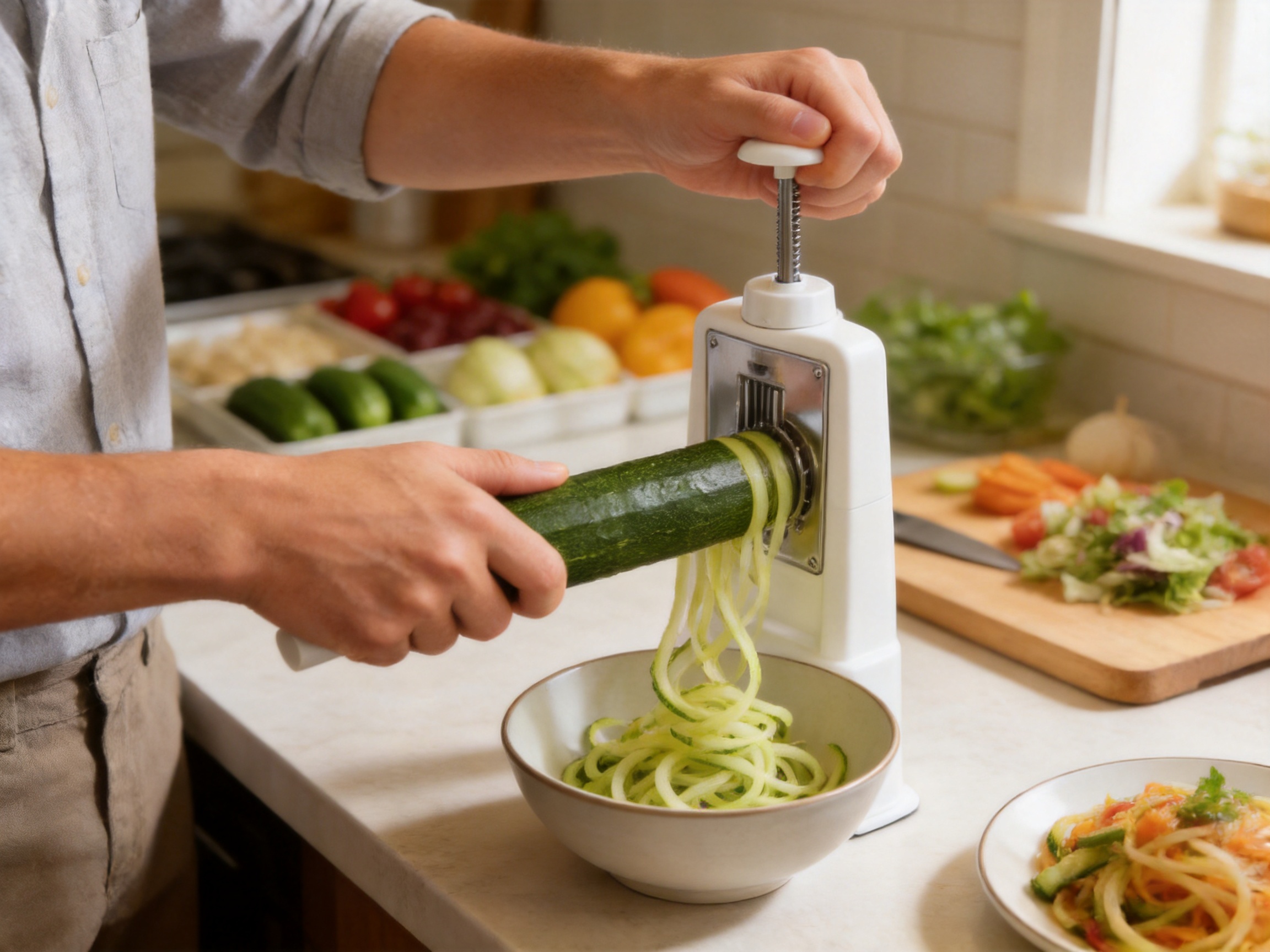
Supply Capacity and International Business Value
The stated production and packing information makes the GS067 suitable for wholesale programs rather than only small local purchases. A minimum order quantity of 2,000 pieces can support retail launches, regional distribution, promotional campaigns, and private-label projects. The listed delivery time of 30 days provides a preliminary planning reference, although actual timing should be confirmed according to order details, packaging requirements, production schedules, and shipping conditions.
The carton quantity of six pieces may simplify warehouse handling and order fulfillment. It allows distributors to receive compact master cartons while maintaining enough units for retail or customer orders. Container-loading estimates of approximately 2,100 pieces for a 20-foot container and approximately 5,100 pieces for a 40-foot high-cube container can help importers begin calculating purchasing volume and freight efficiency.
These figures should be treated as planning estimates. Final quantities can change because of packaging dimensions, pallet arrangements, shipping restrictions, product revisions, and the use of additional protective materials. A commercial quotation should include confirmed carton dimensions, gross and net weights, loading quantities, packaging details, and delivery terms.
Private-label and distribution opportunities
A spiralizer can be marketed through several channels. Retailers may sell it as a kitchen utensil, healthy-cooking accessory, meal-preparation product, or gift item. Supermarkets and department stores can include it in seasonal homeware promotions. E-commerce sellers can demonstrate the product through recipe photographs and short videos. Food-service suppliers can offer it to restaurants, catering businesses, hotels, and culinary schools.
Private-label customers may focus on packaging design, color coordination, language requirements, instruction manuals, barcode management, and retail presentation. The manufacturer’s experience in product development and international supply can be valuable when coordinating these details. Buyers should discuss artwork approval, sample confirmation, trademark use, packaging materials, carton markings, and inspection standards before mass production.
Product positioning
The product can be positioned between basic handheld slicers and larger electric food processors. Its value lies in focused functionality, manual independence, assisted pressure, and a distinctive visual result. It is not intended to replace every function of a multi-purpose processor. Instead, it provides a dedicated solution for spiralizing and vegetable shaping.
This focused positioning can make it easier for retailers to communicate the product’s purpose. Customers do not need to learn a complicated control system or choose from numerous attachments. They can understand that the tool is designed to turn suitable vegetables into spiral strands and decorative cuts with a manual, assisted operation.
Competitive Differentiation
Competition in the kitchen-tool market includes handheld slicers, horizontal spiralizers, crank-operated units, electric spiralizing attachments, and multifunction food processors. The self-pressure vertical spiralizer has several points that can distinguish it from these alternatives.
| Comparison Factor | Self-Pressure Vertical Spiralizer | Basic Handheld Slicer | Electric Food Processor |
| Power Requirement | Manual; no electricity required | Manual; no electricity required | Requires electrical power or charging |
| Operating Orientation | Vertical | Often flat or handheld | Depends on appliance design |
| Pressure Assistance | Self-pressure structure | Usually relies on direct hand pressure | Motor-driven cutting action |
| Operating Noise | Low manual operating noise | Low manual operating noise | Motor noise during operation |
| Primary Function | Vegetable spiralizing and shaping | Basic slicing or cutting | Multiple food-processing functions |
| Setup Complexity | Focused and relatively simple | Simple | May require bowl, lid, attachments, and power connection |
| Portability | Suitable for locations without outlets | Highly portable | Less convenient for transport |
| Retail Demonstration Appeal | Strong visual transformation | Moderate | Strong but more complex to demonstrate |
The table is a general comparison rather than a substitute for testing individual competing products. Performance varies according to design, ingredient type, blade configuration, and user technique. However, it illustrates the product’s intended market position: more assisted and structured than a simple handheld slicer, while more focused and power-independent than an electric processor.
Compared with handheld slicers
Handheld slicers are often inexpensive and compact, but they may require continuous pressure and careful hand positioning. The self-pressure vertical design is intended to improve ease of operation and reduce repetitive pushing. It may therefore appeal to customers who want a more stable and guided preparation experience.
Compared with electric spiralizers
Electric spiralizers can provide rapid processing, but they require a power source and include electrical components that may increase cost, weight, noise, and maintenance considerations. The manual GS067 offers an alternative for users who prioritize simplicity, portability, quiet operation, and independence from electricity.
Compared with multifunction processors
Multifunction food processors provide flexibility but can be larger, more expensive, and more complicated to assemble and clean. A dedicated spiralizer may be preferable for customers who already own other kitchen appliances and need a specific tool for vegetable noodles and decorative cuts.
Responsible Use and Maintenance
Before use, inspect the spiralizer for damaged parts, loose components, or packaging debris. Place the unit on a stable, clean work surface. Select firm, fresh vegetables of an appropriate size and shape, and trim irregular ends if necessary. Very soft, hollow, excessively large, or irregular produce may not process evenly.
Users should read the operating instructions carefully and keep hands away from the cutting area. A food holder or pressure component should be used as intended rather than replaced with bare fingers. When the remaining vegetable piece becomes too small to handle safely, operation should stop. Children should use the product only under appropriate adult supervision.
After preparation, remove vegetable residue promptly. Wash and dry the product according to the care instructions. Stainless steel components should be kept clean and dry, while plastic and elastomer parts should be inspected for staining, cracking, or deformation. Do not use abrasive materials or cleaning chemicals that could damage the surface unless specifically recommended.
Regular inspection is especially important in commercial kitchens. Staff should check that the self-pressure mechanism operates correctly, that the base remains stable, and that cutting elements are securely installed. Any damaged or worn part should be removed from service until it has been assessed and replaced or repaired as appropriate.
Why Manufacturing Partnership Matters
For importers and distributors, product quality is only one part of a successful purchasing program. Reliable communication, sample approval, production scheduling, packaging coordination, quality inspection, documentation, and after-sales support are equally important.
The manufacturer’s stated experience includes international customers, product innovation, engineering cooperation, and long-term business relationships. These capabilities can help buyers move from product selection to commercial launch more efficiently. A supplier that understands both product development and export requirements can help reduce misunderstandings related to specifications, packaging, and delivery.
The company’s history of working with different types of kitchen and household products also supports a broad understanding of market trends. Its product range covers manual tools, electric appliances, food-service accessories, and cooking equipment. This breadth may be useful for distributors that want to develop a coordinated product portfolio instead of sourcing one item at a time.
In addition, the company reports having an established factory, experienced production workers, research and development personnel, and quality control staff. These resources can support product improvement, manufacturing continuity, and order management. Buyers should still conduct their own due diligence, review samples, clarify applicable compliance requirements, and establish written quality standards for every project.
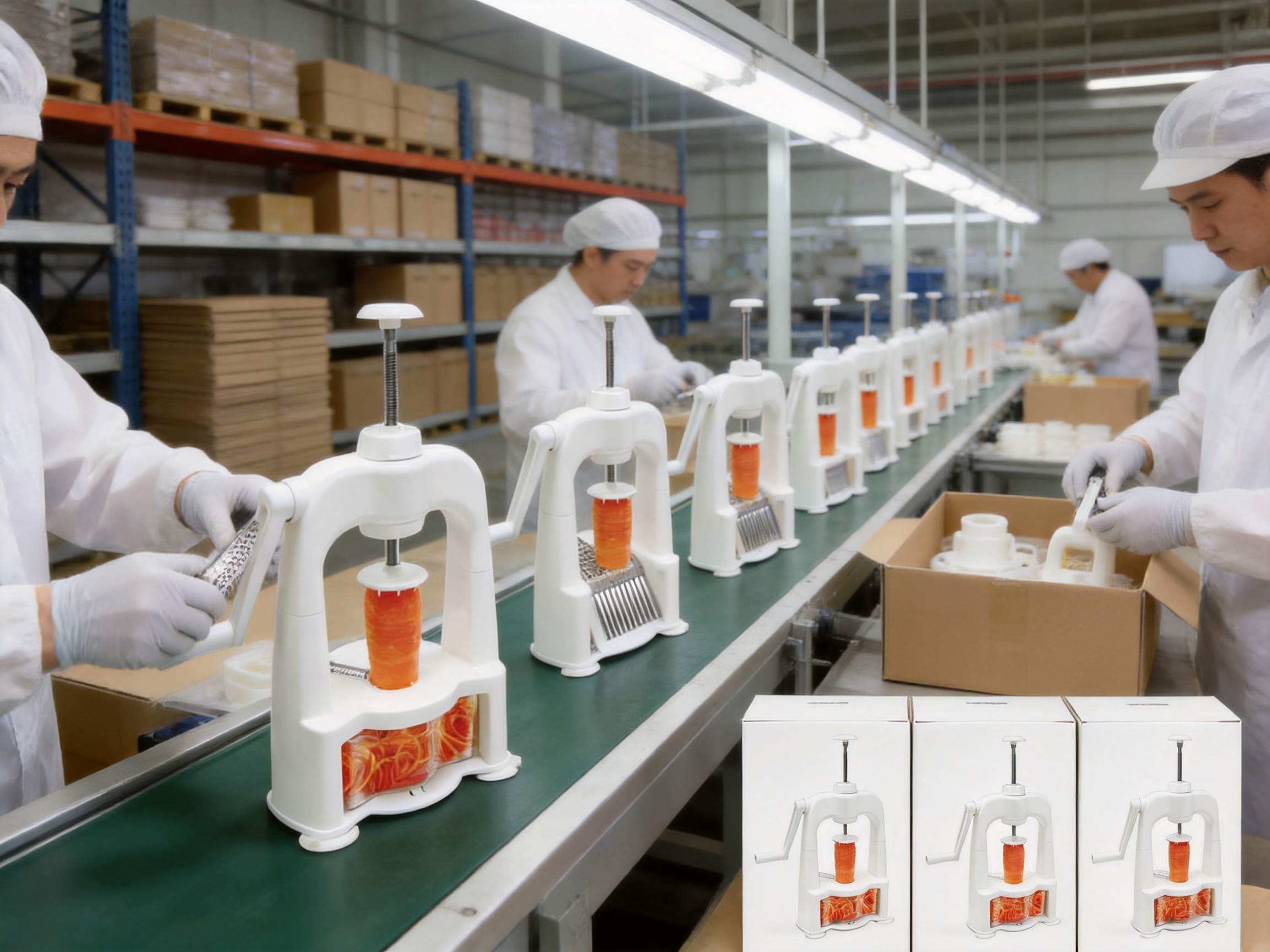
Purchasing Checklist for Wholesale Buyers
Wholesale customers considering the self-pressure vertical spiralizer should first define the intended sales market. Requirements may differ between supermarkets, online channels, professional food-service distributors, promotional programs, and private-label retail.
Confirm the final product name, item number, color, and configuration.
Request a sample for evaluation before approving mass production.
Check operating stability, pressure assistance, cutting performance, and user comfort.
Confirm all food-contact materials and applicable market requirements.
Review the blade construction, cleaning instructions, and safe-use information.
Approve packaging artwork, language versions, barcodes, and carton markings.
Confirm carton quantity, carton dimensions, weights, palletization, and container loading.
Clarify the 30-day delivery estimate and identify the production starting point.
Discuss inspection procedures, acceptable quality limits, and sample retention.
Confirm spare-part, replacement, warranty, and after-sales arrangements where required.
A detailed purchasing checklist protects both the buyer and the manufacturer. It reduces the risk that an approved sample, production batch, or retail package will differ from expectations. Clear specifications are particularly important when products are sold under a private label or distributed across multiple countries.
Q&A
What is the GS067 self-pressure vertical spiralizer?
The GS067 is a manual vegetable slicer designed to create spiral-shaped strands and decorative cuts from suitable firm vegetables. Its vertical structure and self-pressure mechanism are intended to assist the user during preparation.
Does the product require electricity?
No. The product is manually operated and does not require a power cord, battery, motor, or electrical outlet.
What vegetables can be used with the spiralizer?
Suitable examples may include zucchini, carrots, cucumbers, radishes, potatoes, sweet potatoes, and beets. Results depend on the vegetable’s firmness, size, freshness, and shape. Users should consult the product instructions for recommended ingredients and preparation methods.
What are the primary materials?
The listed material composition is ABS, PP, TPE, polyamide, and stainless steel. These materials are selected for different roles involving structure, grip, mechanical support, and cutting performance.
What is the main advantage of the vertical design?
The vertical arrangement is intended to create a more natural downward workflow and support stable contact between the vegetable and the cutting area. It may reduce the direct pushing effort required compared with some handheld slicers.
Is the product suitable for restaurants and hotels?
It can be considered for restaurants, hotels, catering businesses, cafés, and culinary schools that need manual vegetable spiralizing or decorative preparation. Commercial users should evaluate the product’s throughput, cleaning requirements, staff training, and suitability for their expected workload.
How is the product different from an electric spiralizer?
The GS067 does not use electricity. It offers quiet, portable, manually controlled operation and may have fewer electrical maintenance concerns. An electric model may be better for users who prioritize automated high-speed processing, while the manual spiralizer may be better for simplicity and power independence.
How many pieces are packed in one carton?
The supplied specification states six pieces per carton.
What are the carton dimensions and weights?
The stated carton measurement is 46 x 58.5 x 36.5 cm. The listed net weight is 5.3 kg, and the gross weight is 6 kg. Buyers should confirm final packaging details before shipment.
What is the minimum order quantity?
The stated minimum order quantity is 2,000 pieces.
What is the stated delivery time?
The stated delivery time is 30 days. Actual timing should be confirmed based on the order quantity, packaging requirements, production schedule, inspection arrangements, and shipping terms.
Can the product be offered under a private label?
Private-label possibilities should be discussed directly with the manufacturer. Buyers should clarify branding, packaging artwork, color options, instruction manuals, barcodes, trademarks, minimum quantities, and approval procedures before placing an order.
How should the product be cleaned?
The product should be cleaned according to the manufacturer’s instructions. Food residue should be removed promptly, suitable components should be washed with an appropriate detergent, and the product should be dried before storage. Users should take particular care around the cutting components.
Is the product a replacement for a food processor?
It is better understood as a dedicated vegetable spiralizing tool. A food processor offers more functions, while the GS067 focuses on vegetable shaping and manual convenience. The right choice depends on the user’s preparation needs, available space, budget, and preferred operating method.
Conclusion
The self-pressure vertical spiralizer provides a focused solution for consumers and professional users who want attractive vegetable strands without relying on an electric appliance. Its vertical format, assisted pressure concept, manual operation, stainless steel cutting elements, and combination of engineered plastic materials give it a distinctive position within the vegetable slicer market.
Compared with basic handheld slicers, the product is designed to offer a more guided and less tiring workflow. Compared with electric spiralizers and multifunction processors, it offers power independence, quiet operation, portability, and a simpler product concept. These characteristics can support retail merchandising, online demonstrations, healthy-cooking campaigns, food-service preparation, and private-label distribution.
The manufacturer’s experience in manual kitchen innovations, small electric appliances, food-service products, engineering, production, and quality control provides a foundation for wholesale cooperation. Its stated factory resources, research and development capabilities, experienced workforce, and international business background may help customers develop a reliable supply program.
For buyers, the best approach is to combine product evaluation with careful commercial planning. Samples should be tested for stability, operating comfort, pressure assistance, cutting results, cleaning, and packaging quality. Specifications, inspection standards, delivery schedules, and customization requirements should be confirmed in writing. When these steps are completed, the GS067 can serve as a practical and visually appealing addition to a modern kitchenware portfolio.
References
1. Product specification sheet for item GS067, Self-Pressure Vertical Spiralizer.
2. Manufacturer-provided company profile and product-category information for CIXI GSTAR ELECTRIC APPLIANCE CO., LTD.
3. General principles of manual vegetable slicing, spiralizing, food preparation, and kitchen-tool handling.
4. General material information relating to ABS, polypropylene, thermoplastic elastomer, polyamide, and stainless steel applications in household products.
5. General wholesale planning considerations for carton quantities, container loading, product inspection, packaging, and international shipment preparation.