
 English
 中文简体
中文简体 Español
 English
 中文简体
中文简体 Español
Introduction
Air frying has become one of the most practical ways to prepare crisp, flavorful food with less oil than traditional deep-frying. As consumers look for healthier cooking methods, compact appliances, and more convenient kitchen routines, air fryers have evolved from simple countertop products into multifunctional cooking solutions. The GSE72 Glass Air Fryer, also identified as model GSE072, reflects this development through a combination of visible cooking, digital control, powerful hot-air circulation, and integrated safety features.
Unlike conventional air fryers that use an opaque metal or plastic basket, this appliance is designed with a glass cooking chamber. The transparent chamber allows users to monitor the cooking process without opening the appliance repeatedly. This improves convenience and can help preserve cooking temperature during operation. The product also uses a plastic chamber structure together with stainless steel, galvanised sheet metal, plastic, and glass components, creating a balance between durability, weight control, appearance, and manufacturing flexibility.
The appliance provides adjustable temperature control from 80°C to 200°C and has a rated power of 1500 W. This range supports many common cooking tasks, including reheating, roasting, baking-style preparation, crisping, and air frying. Its digital display enables independent adjustment of temperature and cooking time, making the unit easier to operate than air fryers that rely only on fixed mechanical presets.
For importers, retailers, hospitality buyers, and private-label customers, the product also represents a manufacturing opportunity. It is developed by CIXI GSTAR ELECTRIC APPLIANCE CO., LTD., a Chinese manufacturer with experience in small electric kitchen appliances, product development, engineering cooperation, quality control, and international sales. The company’s broader product portfolio includes blenders, slicers, choppers, food processors, smokeless grills, hot pots, air ovens, beverage dispensers, and related kitchen and food-service products.
This article examines the GSE72 Glass Air Fryer in detail. It explains the product’s operating concept, design advantages, functional features, safety systems, manufacturing considerations, quality strengths, and potential applications in different sales channels.
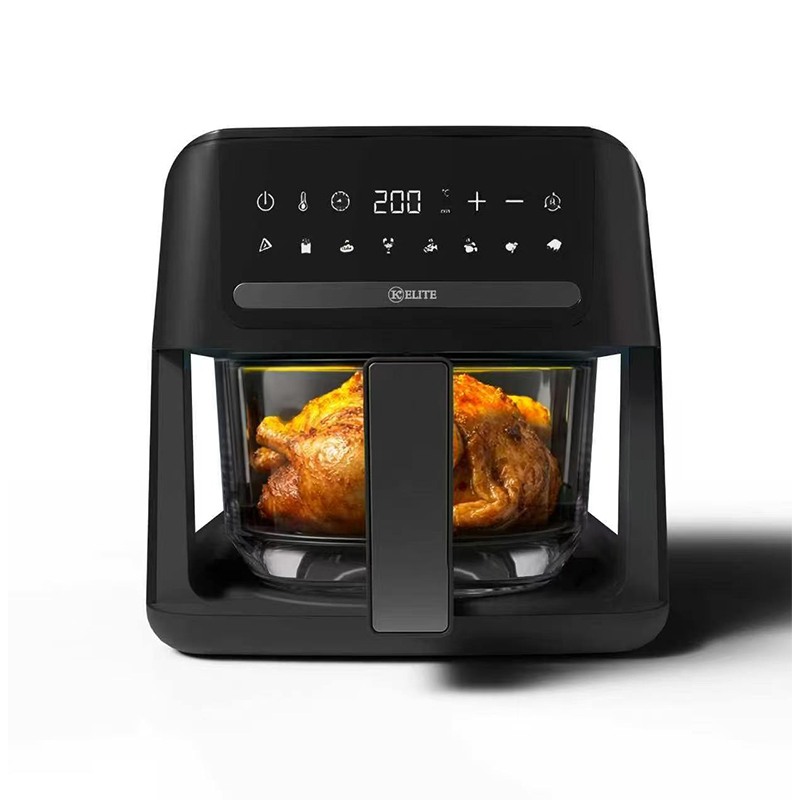
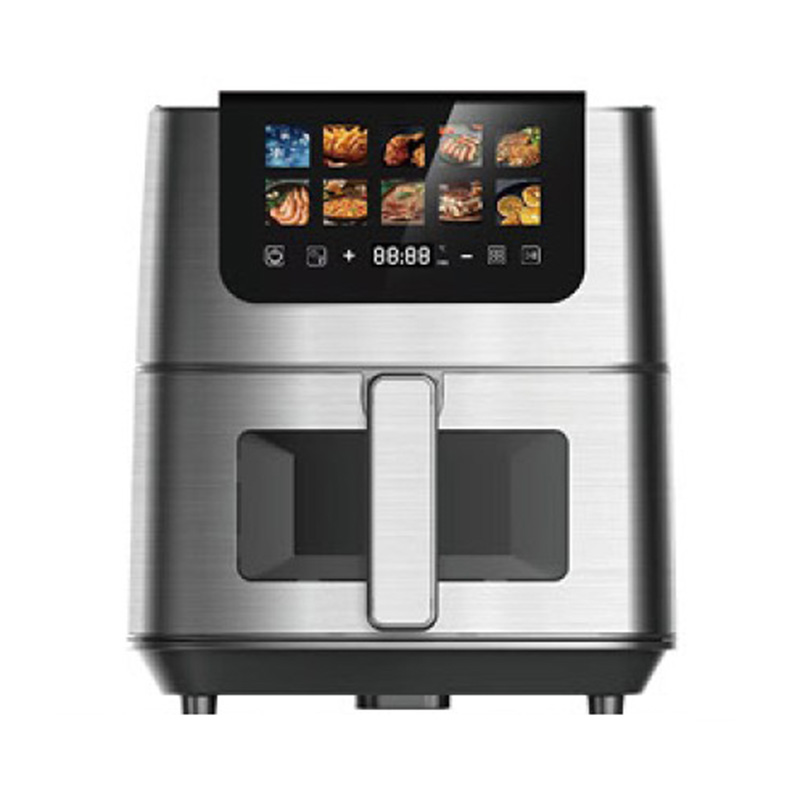
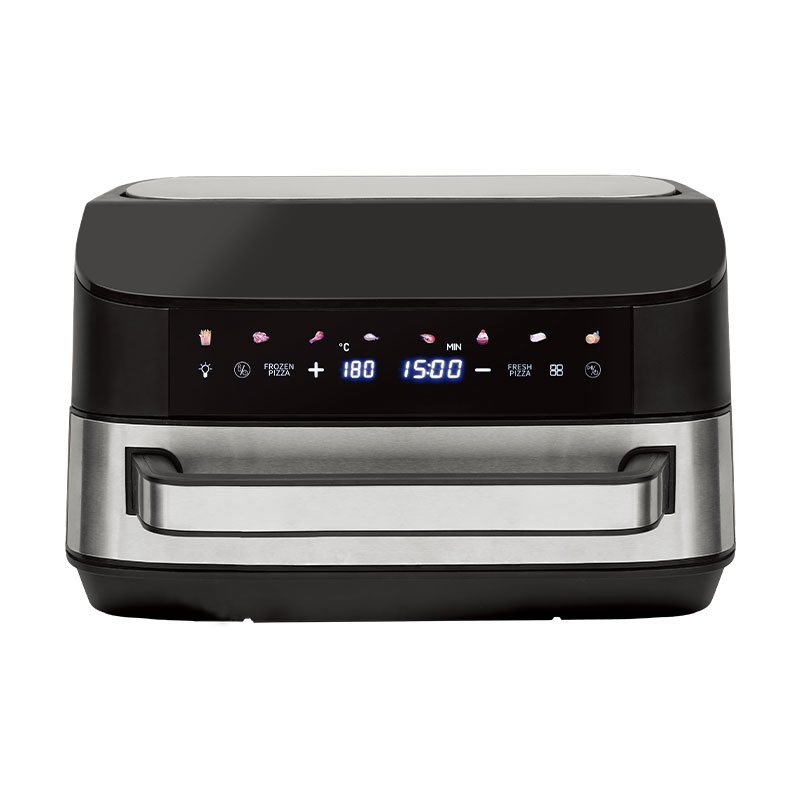
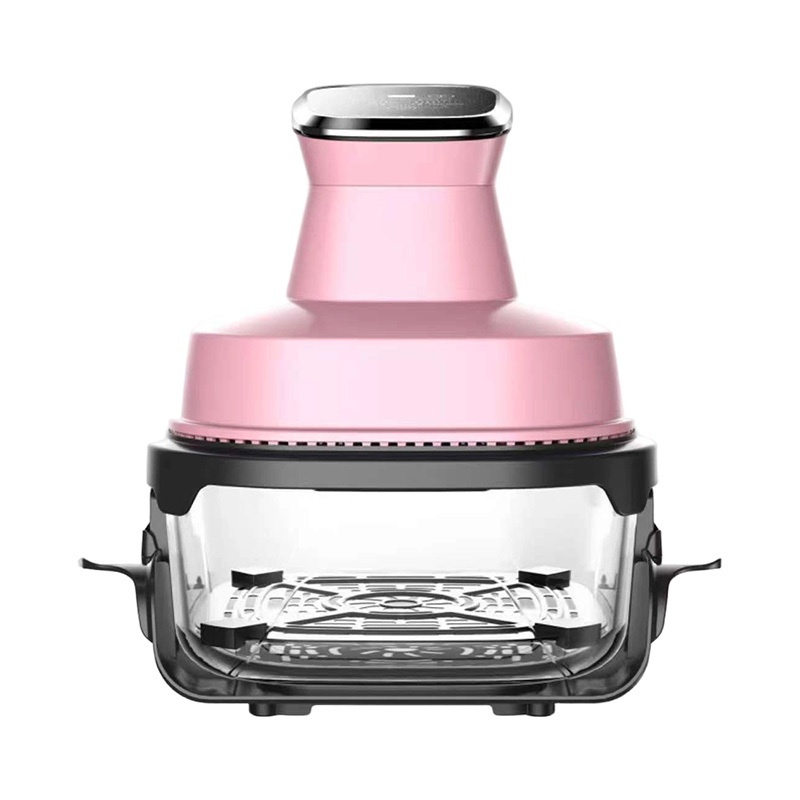
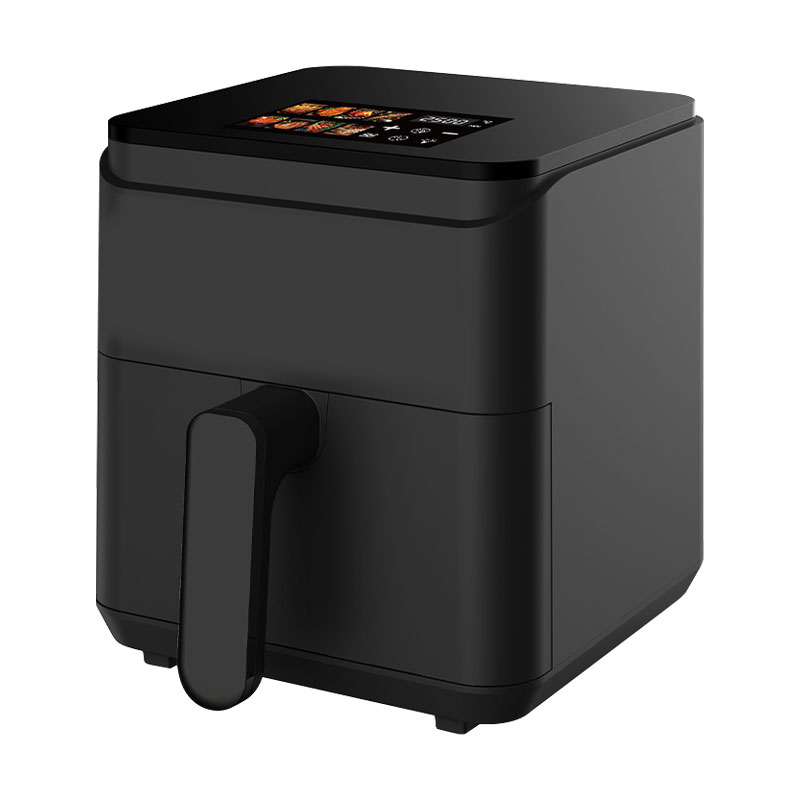
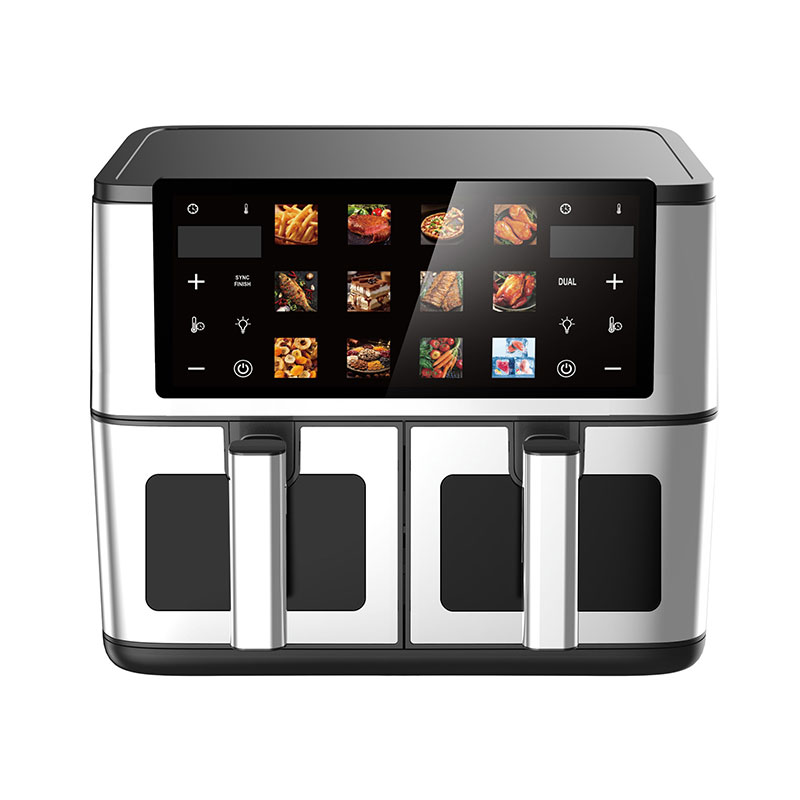
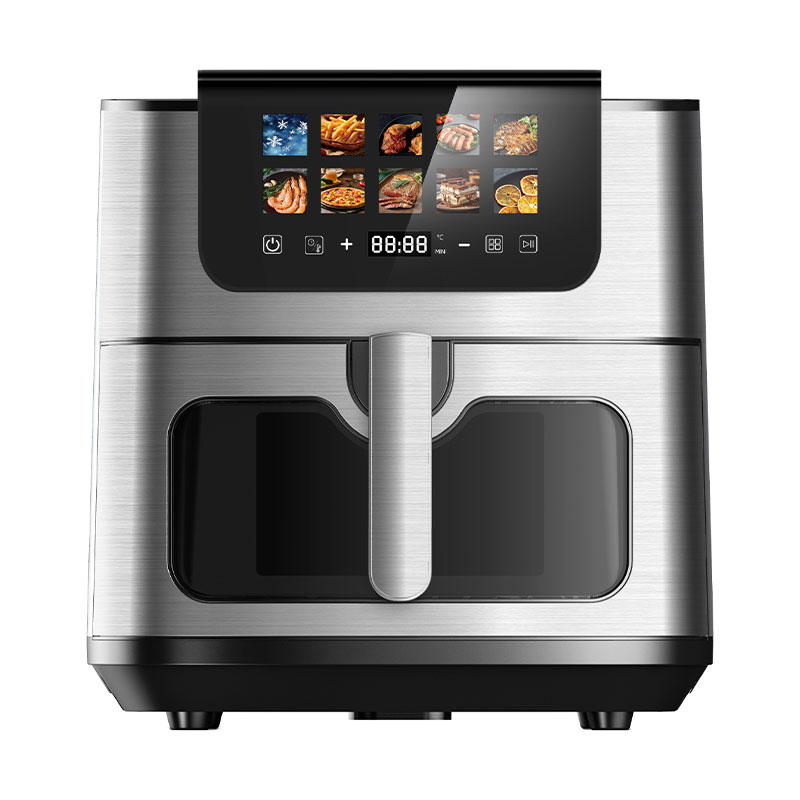
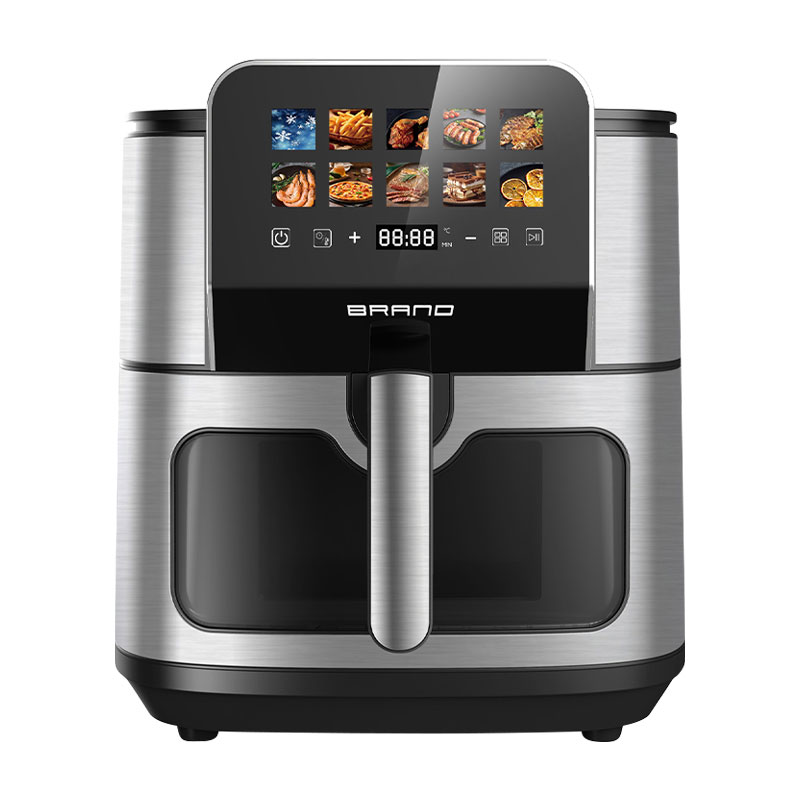
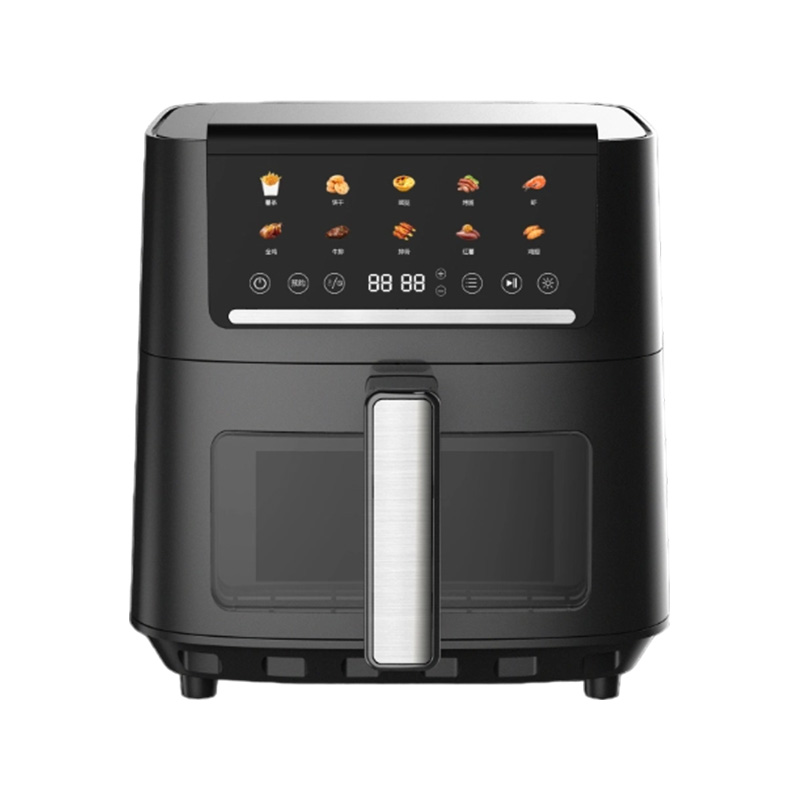
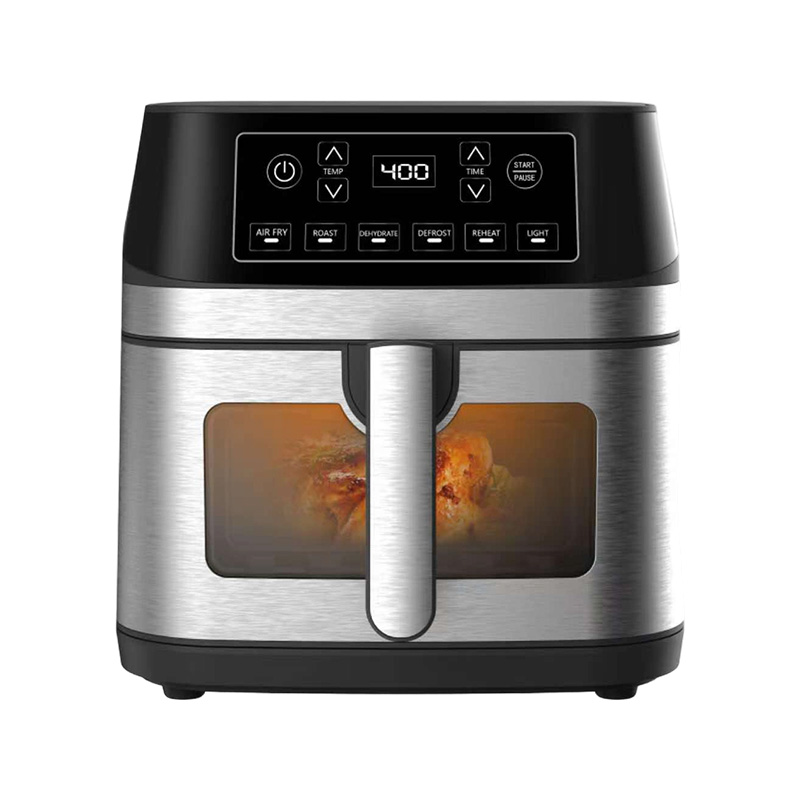
GSE72 Glass Air Fryer (Plastic Chamber)
Product Overview
The GSE72 is a countertop air fryer designed for modern household kitchens and other environments where fast, low-oil cooking is required. Its primary cooking principle is omnidirectional dynamic airflow heating. Instead of immersing food in oil, the appliance circulates heated air around the food. This creates a hot cooking environment capable of producing a browned and crisp outer surface while reducing the need for large quantities of oil.
The temperature control range extends from 80°C to 200°C. Lower temperatures are useful for gentle reheating and controlled warming, while higher temperatures support browning, crisping, and roasting-style cooking. The 1500 W rated power provides the heating capacity necessary for a compact appliance intended for regular household use.
A key feature is the glass cooking chamber. The chamber gives the appliance a visible cooking area, allowing users to observe changes in color, texture, and cooking progress. This is particularly useful when preparing food that can change quickly at higher temperatures. Users can check whether food is sufficiently browned without necessarily interrupting the cooking cycle.
The product includes a digital display with independent temperature and time adjustment. This arrangement gives users greater control than a basic air fryer with only a small number of automatic selections. Cooking can be adapted according to food type, portion size, starting temperature, and desired crispness.
The appliance also includes automatic power-off protection when the unit is detached. This function is an important safety and usability feature because it helps prevent continued operation when the relevant component has been removed or separated. A one-touch shut-off function provides a direct way to stop operation, while power-off memory helps preserve selected settings or operating information when power is interrupted or the appliance is switched off.
The non-slip base supports stability on the countertop. This is especially important for an appliance containing hot air, hot surfaces, and a cooking chamber that may be moved or accessed during normal use. A stable base can improve user confidence and reduce unwanted movement during cooking.
| Product Item | Specification or Feature |
|---|---|
| Product name | GSE72 Glass Air Fryer |
| Model description | GSE072 |
| Product category | Air fryer |
| Temperature range | 80–200°C |
| Rated power | 1500 W |
| Cooking chamber | Glass chamber with plastic structural elements |
| Heating method | Omnidirectional dynamic airflow heating |
| Controls | Digital display with independent temperature and time adjustment |
| Safety features | Automatic power-off when detached and one-touch shut-off |
| Convenience features | Power-off memory function and non-slip base |
| Main materials | Stainless steel, galvanised sheet metal, plastic, and glass |
Transparent Cooking as a Practical Advantage
The most distinctive feature of the GSE72 is its transparent glass cooking chamber. Traditional air fryers often require users to pull out a basket or open a drawer to inspect food. Each opening may release hot air and interrupt the cooking environment. A visible chamber offers a different user experience: the cooking process can be monitored continuously from the outside.
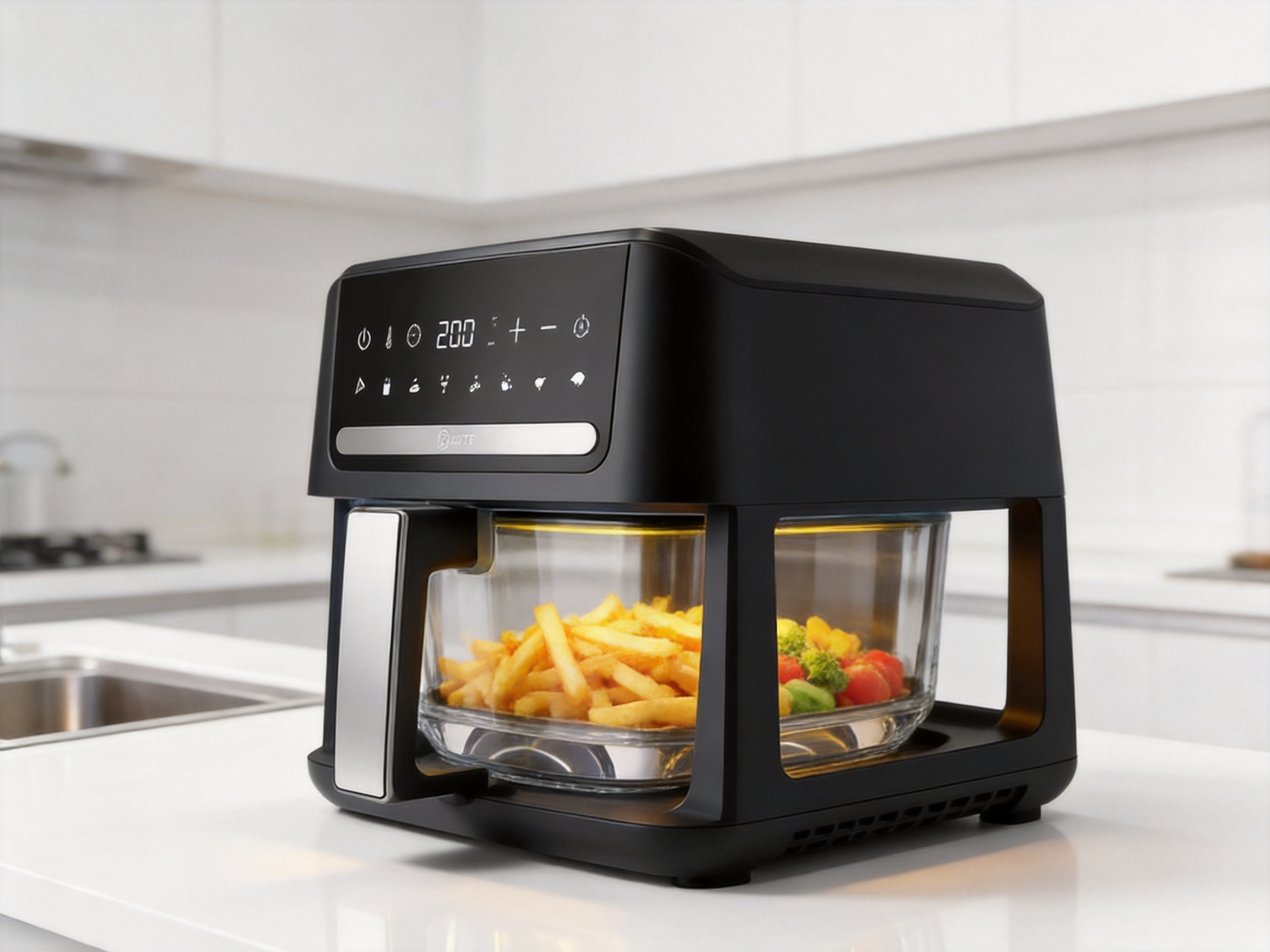
Visibility is useful for foods that require close attention. Thin potato products, snacks, vegetables, seafood, pastries, and breaded items can move from lightly browned to over-browned in a short period at high temperature. With a glass chamber, the user can judge the appearance of the food and stop or adjust the cycle when necessary.
The glass design can also improve consumer engagement. A visible cooking process makes the appliance easier to understand for first-time users. Instead of relying exclusively on a preset program or a written guide, users can observe the food and develop their own cooking preferences. This feature may be particularly attractive in retail demonstrations, showroom displays, product videos, and social-media content.
From a merchandising perspective, transparent cooking creates an immediate visual distinction. Many countertop air fryers have a similar external appearance, usually featuring a dark plastic body and an opaque cooking drawer. A glass chamber can make a product more noticeable on a retail shelf or online product page. It can also support a premium positioning when combined with a digital interface and integrated design.
Glass offers another functional benefit: it does not visually conceal food residue or cooking progress. Users can see the chamber and may be more likely to clean it regularly. Cleanability remains dependent on the exact removable-part design and care instructions, but the transparent structure makes the condition of the cooking area easier to assess.
Because glass is used in a heated appliance, material selection, forming, inspection, and assembly quality are important. A responsible manufacturing process must consider dimensional consistency, surface quality, resistance to normal operating temperature, and correct integration with surrounding plastic and metal components. These considerations are central to the product’s reliability and provide an important area for factory-level quality control.
Hot-Air Performance and Reduced-Oil Cooking
The GSE72 uses omnidirectional dynamic airflow heating to distribute heated air around the cooking chamber. Effective air circulation helps reduce cold spots and supports more consistent surface heating. While food arrangement, portion size, moisture content, and cooking time still influence results, a dynamic airflow system is an important foundation for crisp and evenly cooked food.
The appliance is designed to create a crispy, golden exterior without requiring the large amounts of oil associated with deep frying. A small quantity of oil may still be used for flavor, browning, or coating, depending on the recipe. However, the cooking method does not depend on a deep bath of oil, which can make meal preparation cleaner and more economical.
Lower-oil cooking has several practical advantages. It can reduce the amount of oil consumed in everyday meals, decrease splashing, and simplify kitchen cleanup. It also allows consumers to prepare familiar fried-style foods using a countertop appliance rather than a deep fryer or large cooking vessel.
The 1500 W heating system is suitable for a product of this type because it supports relatively rapid heating and strong hot-air circulation in a compact format. Actual cooking results depend on the quantity and type of food placed inside the chamber. Users should avoid overcrowding because excessive food volume can limit airflow and reduce crispness.
The 80–200°C temperature range provides flexibility beyond a single high-temperature frying mode. At the lower end, the appliance can be used for warming or gentler cooking. At the upper end, it can support browning and crisping. The adjustable digital control enables users to make incremental changes instead of being limited to one factory-defined temperature.
Independent time and temperature adjustment is especially useful for households with varied cooking habits. Frozen snacks, fresh vegetables, chicken portions, seafood, pastries, and reheated leftovers may require different combinations of heat and duration. The user can select the temperature first and then set the time according to the recipe or preferred result.
Although an air fryer does not replace every kitchen appliance, it can complement an oven, microwave, frying pan, or grill. Its countertop format is convenient for smaller portions, quick meals, and reheating food that may become soft in a microwave. This versatility increases the product’s value in households where convenience and portion control are important.
Digital Operation and User Convenience
The digital display is designed to make operation more direct and understandable. Users can view the selected settings and adjust the cooking temperature and time independently. This is an important improvement over basic controls that combine time and temperature into a limited set of fixed options.
Independent adjustment allows users to correct a cooking cycle without changing every other setting. For example, a user may choose a higher temperature for a shorter crisping stage or a lower temperature for a longer reheating period. This flexibility also helps retailers present the product as a practical appliance rather than a single-purpose fryer.
The one-touch shut-off function provides a simple method to stop the appliance. A direct shut-off control is useful when food has reached the desired appearance before the end of the selected time. It may also be used if the user needs to interrupt cooking to check or rearrange food.
The power-off memory function adds convenience in situations where power is interrupted or the appliance is temporarily switched off. Retaining operating information can reduce the need to re-enter settings and helps make the control experience more user-friendly. The exact behavior of the memory function should be explained in the final user manual and confirmed through product testing for each market version.
Clear controls are important for both younger and older users. A digital interface can be supported by well-positioned buttons, readable symbols, and an instruction manual that explains temperature, time, food arrangement, cleaning, and safe handling. For export markets, interface labeling and documentation can be adapted to local requirements and consumer expectations.
Safety-Oriented Design
Safety is a major consideration in any appliance that combines electrical power, heat, moving air, glass, and food. The GSE72 includes automatic power-off protection when the unit is detached. This feature is designed to help prevent operation when the appliance is not correctly assembled or when a relevant component has been removed.
The detachment protection can be valuable during ordinary use. Consumers may open, remove, or reposition a cooking component when checking food. Automatic interruption of power in such circumstances provides an additional layer of protection. It also helps reduce the possibility of the heating system continuing to operate while the appliance is not in its intended configuration.
The one-touch shut-off function gives users immediate manual control. Safety features are most effective when they are supported by intuitive operation. A clearly accessible shut-off function can help consumers respond quickly when food is finished, when smoke or unusual odor is noticed, or when the appliance needs to be checked.
The non-slip base contributes to physical stability. Countertop appliances can be exposed to pulling forces when users open a chamber, move a control, or handle food. A base designed to resist unwanted sliding helps the appliance remain positioned during operation.
The product’s materials also influence safety and durability. Stainless steel can provide strength and resistance in selected structural or internal applications. Galvanised sheet metal may be used for formed components that require rigidity and protective surface treatment. Plastic can support insulation, housing design, and weight reduction, while glass provides the transparent cooking chamber.
Safe use also depends on proper ventilation, electrical protection, thermal testing, component compatibility, and user instructions. Buyers should request market-specific compliance documentation, test reports, labeling, and manuals before commercial launch. These documents should correspond to the final production version rather than an earlier sample.
Materials and Integrated Construction
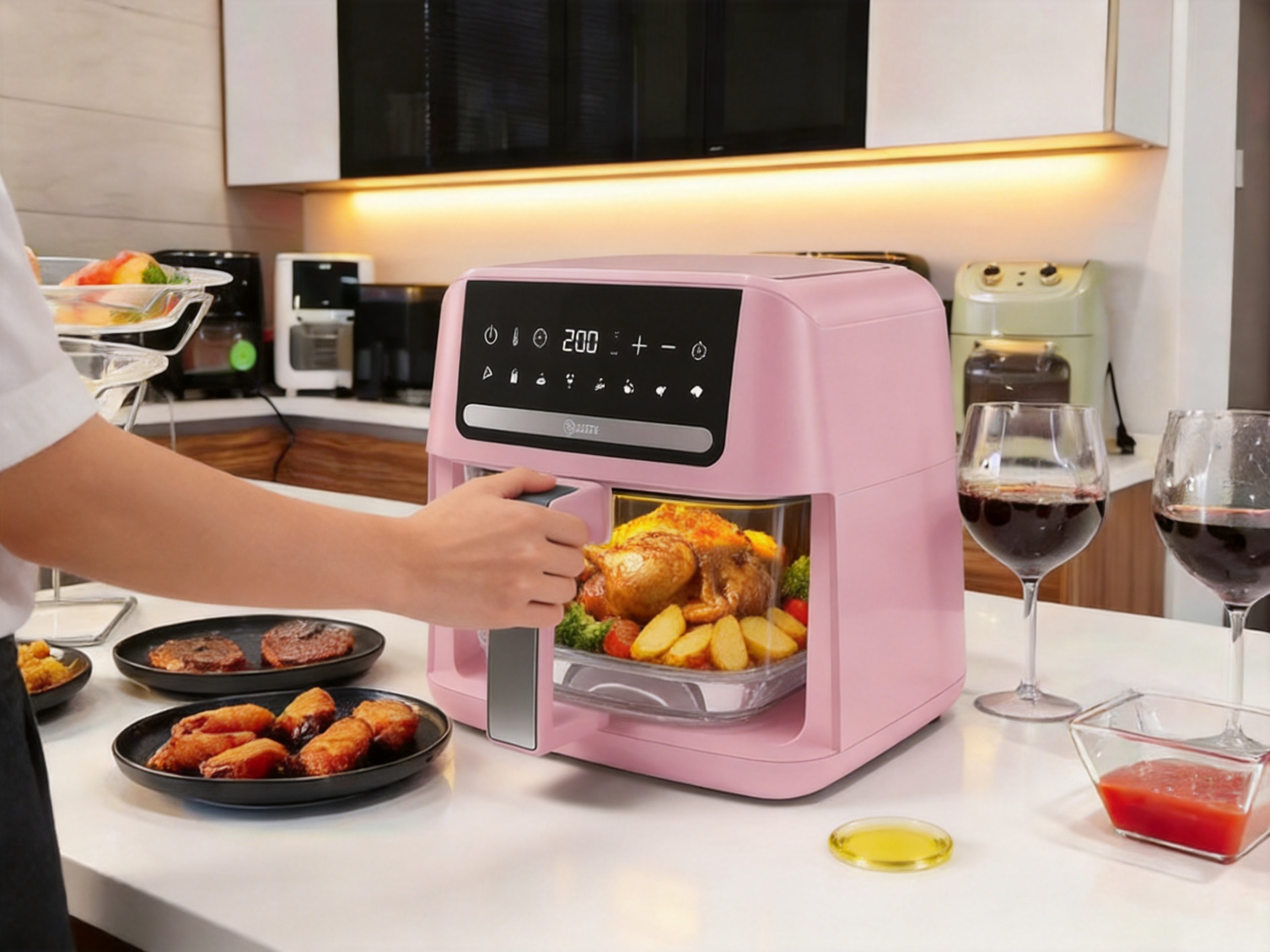
The product combines stainless steel, galvanised sheet metal, plastic, and glass. Using several materials allows the design team to assign each material to areas where its properties are most useful. Metal can provide structural support and heat-related durability. Plastic can create a lightweight external housing and support ergonomic styling. Glass creates visibility and contributes to the product’s visual identity.
An integrated design can reduce visual clutter by bringing the housing, control area, chamber, and base into a coherent form. Consumers increasingly expect kitchen appliances to fit into modern interiors, especially when appliances remain visible on countertops. The GSE72 is described as having a sleek, integrated design, which supports a contemporary retail presentation.
Material coordination is also important for assembly. Glass, plastic, and metal have different expansion characteristics when exposed to heat. Engineering teams must consider spacing, fastening, sealing, insulation, and component alignment. Quality control should verify that parts fit correctly and remain stable through repeated heating and cooling cycles.
For purchasers, the combination of materials can support several market positions. The product may be offered as a practical family appliance, a design-focused countertop product, or a private-label item for retailers seeking an alternative to standard opaque air fryers. Its transparent chamber provides an identifiable feature that can be used in packaging, product photography, and sales training.
Manufacturing and Engineering Capabilities
The manufacturer behind the product has developed from a trading and sourcing background into a producer of small electric appliances. This history is relevant because experience in sourcing, quality control, customer communication, and international sales can support the development of export-oriented products.
The company began its factory operation in 2009, initially focusing on non-electric innovative products and patented designs. It later expanded into electric products and developed appliances such as food processors, air ovens, and air fryers. This transition indicates a broader understanding of both product design and manufacturing execution.
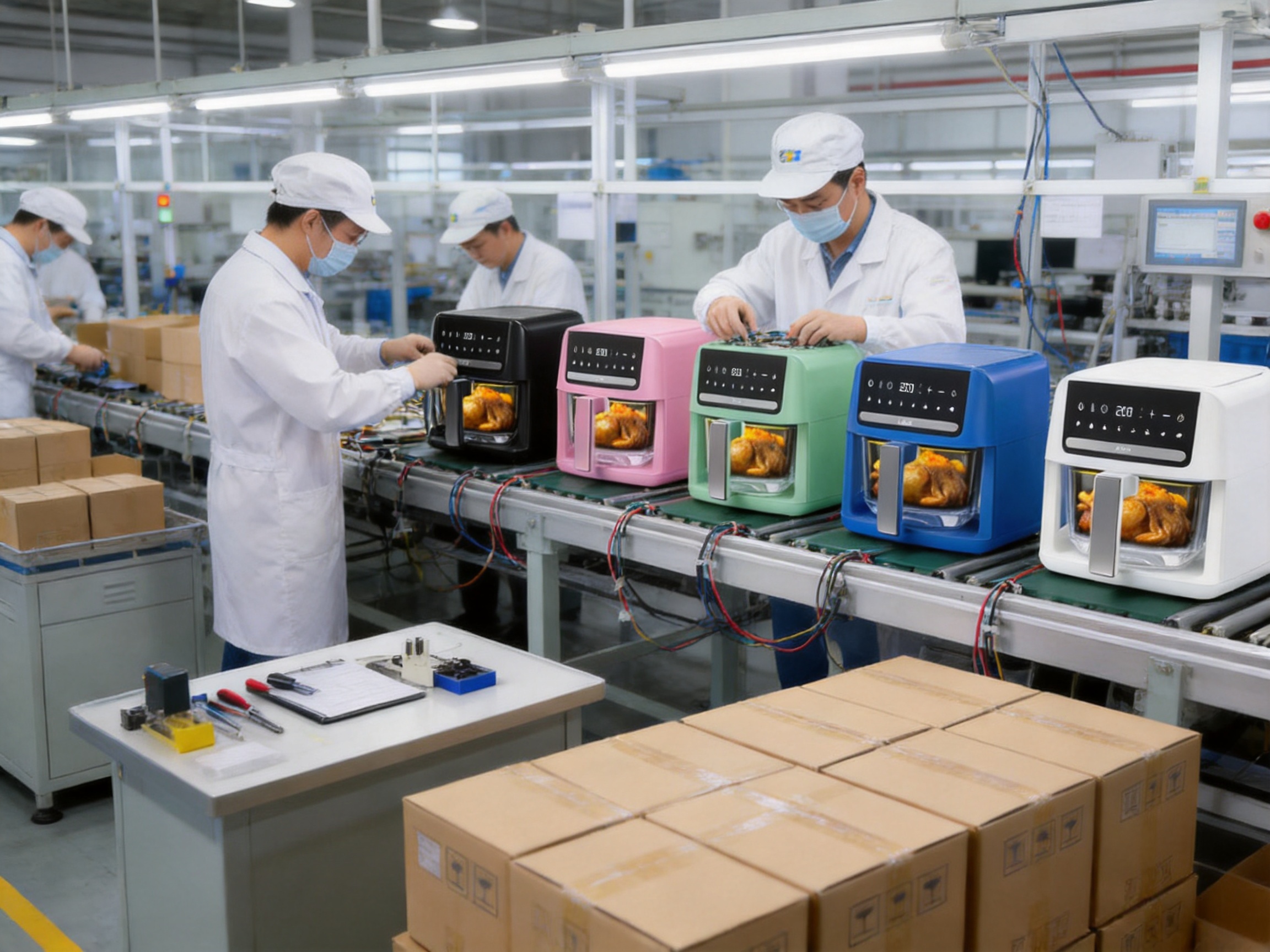
The company reports a dedicated facility, engineering resources, and quality-control personnel. Its stated production infrastructure includes a wholly owned plant, a substantial production area, more than 200 experienced workers, and an engineering and quality-control organization. Such resources can support coordination between product design, tooling, assembly, testing, packaging, and shipment preparation.
An experienced manufacturer can add value at several stages of an appliance project. During product development, engineers can review component availability, assembly requirements, electrical layout, thermal management, and production cost. During sample evaluation, the factory can identify issues involving fit, appearance, operation, and packaging. During mass production, quality personnel can monitor incoming materials, assembly steps, finished products, and loading procedures.
The company also describes itself as an engineering partner for customers. This is particularly relevant to importers and private-label buyers. A buyer may require customized colors, packaging, labels, manuals, control-panel language, accessories, or minor design changes. Cooperation between the customer’s commercial team and the factory’s engineering department can help ensure that the final product remains manufacturable and compliant.
Manufacturing strength should not be judged only by factory size. It also involves process discipline, traceability, test capability, production planning, supplier control, and responsiveness to corrective actions. A suitable supplier should be able to explain how it handles incoming inspection, assembly verification, electrical testing, aging tests, appearance inspection, and final sampling.
Quality Control Considerations
For a glass-chamber air fryer, quality control should address both electrical performance and physical construction. The heating system must provide stable output, the airflow system must operate correctly, and the digital controls must respond consistently. At the same time, the glass chamber and its surrounding components must remain correctly aligned and secure.
Incoming material inspection can verify the quality of glass, metal, plastic parts, heating elements, fans, control boards, cables, switches, and packaging components. Dimensional checks are useful for ensuring that parts fit correctly during assembly. Visual inspection can identify scratches, discoloration, molding defects, sharp edges, contamination, or surface damage.
Assembly-line inspections can focus on wiring, fasteners, insulation, component placement, display installation, control response, and chamber attachment. A production worker or quality inspector can confirm that the detachment protection functions as intended and that the appliance stops when the relevant component is removed.
Finished-product testing may include power consumption checks, temperature operation, timer response, display function, fan operation, shut-off performance, stability, and general appearance. Repeated operation tests can help identify problems that are not visible during a brief inspection.
Thermal cycling is particularly relevant to a product that uses glass, plastic, sheet metal, and heating components together. Repeated heating and cooling can reveal issues such as deformation, loosening, discoloration, poor fit, or stress at connection points. The exact test conditions should be established according to the intended market, product design, and applicable standards.
Packaging inspection is also important. Glass components require suitable protection against impact and vibration during inland transport, container loading, and international shipping. Packaging should hold the product firmly, reduce movement, protect control surfaces, and provide clear handling information when required.
Reliable quality control benefits both the manufacturer and the buyer. It can reduce returns, protect retailer reputation, support consistent customer reviews, and help maintain long-term cooperation. For wholesale customers, quality consistency is often as important as the initial purchase price.
Advantages for Retailers and Wholesale Buyers
The GSE72 offers several features that can help retailers create a clear product story. The glass chamber provides an immediate visual point of difference. The digital display communicates ease of use. The 1500 W power rating and 80–200°C temperature range present the appliance as capable of handling a broad selection of cooking tasks. The safety and memory functions add practical value beyond basic heating.
In a competitive market, a product needs more than a familiar category name. Retailers may use the transparent chamber to attract attention in physical stores and online listings. Product demonstrations can show food browning inside the appliance, helping consumers understand how the product works. Images and videos can emphasize the visible cooking process without relying solely on technical explanations.
The appliance can be suitable for mass-market, mid-range, and selected premium channels depending on configuration, packaging, and sales strategy. A basic retail package might focus on everyday convenience and healthy cooking. A premium package could emphasize the integrated design, digital control, transparent chamber, and engineering quality.
For private-label programs, the factory’s experience with international customers can be valuable. Buyers may request customized branding, carton artwork, instruction manuals, labels, color schemes, and product inserts. The feasibility of each customization should be discussed with the supplier before tooling or production approval.
Wholesale buyers should also consider after-sales support. A successful appliance program requires spare-part planning, troubleshooting guidance, warranty procedures, and clear communication between the factory, distributor, retailer, and end customer. A manufacturer with engineering and quality-control resources may be better positioned to support these activities than a supplier that only handles trading and order coordination.
| Buyer Requirement | Relevant Product or Supplier Strength |
|---|---|
| Product differentiation | Transparent glass cooking chamber and integrated appearance |
| Cooking flexibility | 80–200°C temperature adjustment and independent time control |
| Consumer convenience | Digital display, one-touch shut-off, and power-off memory |
| Operational safety | Automatic power-off when the unit is detached and non-slip base |
| Retail presentation | Visible cooking process suitable for demonstrations and digital content |
| Product development | Factory engineering and research-and-development experience |
| Quality management | Dedicated quality-control personnel and production inspection processes |
| Product range expansion | Manufacturer experience across multiple small kitchen appliance categories |
| Private-label potential | Customer cooperation in packaging, documentation, and product requirements |
Applications in the Home and Food-Service Environment
The primary application is household cooking. The appliance can support breakfast preparation, quick lunches, evening meals, snacks, reheating, and small-batch cooking. Its countertop format is suitable for kitchens where users want an alternative to a full-size oven or deep fryer.
Students, single-person households, couples, and small families may appreciate the ability to prepare modest portions without heating a large oven. The glass chamber can also be useful for users who prefer to observe food closely rather than depend on fixed cooking programs.
The product may also be considered for guest rooms, serviced apartments, offices, and small hospitality environments, subject to the relevant usage conditions and commercial requirements. In these applications, ease of operation, cleaning procedures, electrical compatibility, and durability should be carefully reviewed.
Food-service buyers may use compact air fryers for limited menu preparation, side dishes, staff meals, or demonstration purposes. However, commercial kitchens typically require equipment rated for their operating volume, so the product should be matched to the intended duty cycle. Commercial deployment should be based on appropriate testing and the manufacturer’s recommendations.
Responsible Product Positioning
Marketing should present the GSE72 accurately. It is appropriate to emphasize reduced-oil cooking, visible food preparation, adjustable heat, digital control, and practical safety functions. Marketing materials should avoid promising results that depend on food type, portion size, preparation method, or user technique.
The phrase “healthy cooking” should be used responsibly. Air frying can reduce the amount of oil used compared with deep frying, but the nutritional value of the final meal also depends on the ingredients and recipe. A clear product description can explain that the appliance supports lower-oil preparation rather than suggesting that every food cooked in it is automatically healthy.
Likewise, claims about crispness and even cooking should recognize that airflow, food arrangement, moisture, and cooking duration influence results. Providing practical guidance in the manual can help users achieve more consistent outcomes and reduce dissatisfaction.
Retail content should explain the glass chamber, digital controls, temperature range, power rating, safety functions, and cleaning requirements in straightforward language. Demonstration recipes can help customers understand the product’s capabilities, while diagrams can show how to place food without blocking airflow.
Using the Product Effectively
Users should place the appliance on a stable, heat-resistant, and well-ventilated countertop. The non-slip base helps maintain position, but the appliance should still be handled carefully. Adequate clearance around ventilation areas is important for safe operation and proper airflow.
Food should be arranged so that hot air can circulate around it. Overfilling the cooking chamber may reduce browning and extend cooking time. When appropriate, food can be turned or rearranged during the cooking cycle, using suitable heat-resistant tools and following the product instructions.
The temperature should be selected according to the food being prepared. Lower settings may be appropriate for warming or gentle cooking, while higher settings can be selected for crisping and browning. The independent time adjustment allows users to fine-tune cooking according to portion size and desired results.
Users should monitor food during the first few cooking attempts because different ingredients and starting temperatures produce different results. The transparent chamber makes this monitoring easier. Once a preferred combination of temperature and time has been identified, the power-off memory function may improve repeat use, depending on the stored settings and operating behavior of the final model.
After cooking, users should allow hot components to cool before cleaning. The glass and other removable parts should be handled according to the instruction manual. Abrasive tools, unsuitable chemicals, or sudden temperature changes may damage surfaces or create unnecessary stress. Electrical components should not be immersed in water unless specifically designed for that purpose.
Product Development and Customization Potential
Manufacturers serving international buyers must balance innovation with production practicality. The GSE72’s design includes several features that can be maintained across different market versions: the visible chamber, digital display, adjustable temperature, airflow heating, safety shut-off, and integrated housing.
Potential customization may include exterior color, control-panel language, packaging artwork, plug type, labeling, user manuals, recipe materials, and accessory configurations. Any customization involving electrical components, software, heating performance, or structural parts should be evaluated by the engineering team before approval.
Packaging customization can help retailers position the product for different consumer groups. One package may focus on family meals and lower-oil cooking, while another may emphasize modern kitchen design and visible food preparation. Clear product photography should show the appliance from multiple angles and include the digital display, glass chamber, controls, and base.
For larger programs, buyers may explore product line extensions. A transparent-chamber air fryer could be positioned alongside air ovens, food processors, blenders, or other countertop appliances from the same supplier. A consistent visual identity across several products can help retailers build a broader small-appliance collection.
Development schedules should include time for sample approval, testing, packaging design, compliance review, pilot production, and final inspection. Early communication about target markets and required documentation can help reduce delays later in the project.
Why Factory Experience Matters
Small kitchen appliances may appear simple from the outside, but reliable production requires coordination among mechanical, electrical, thermal, plastic, glass, packaging, and quality-control functions. A factory with experience in multiple appliance categories can draw on established knowledge when solving these challenges.
The manufacturer’s history includes the development of innovative non-electric household products before its expansion into electric appliances. This background may support a product-development culture that values practical design and market-oriented innovation. Experience with international supermarkets, distributors, and retail programs also provides exposure to packaging expectations, inspection requirements, delivery schedules, and customer service needs.
The company reports a research-and-development team and a quality-control team within its manufacturing organization. These groups can contribute to product refinement, testing, production supervision, and corrective action. Engineering cooperation is particularly important when customers require changes that affect tooling, materials, controls, or documentation.
The factory’s reported product history includes successful sales of food processors, air ovens, and air fryers in several international markets. Past sales performance does not automatically guarantee future results, but it demonstrates familiarity with product categories that require electrical assembly, heat management, user controls, and export packaging.
A manufacturer with a broad product range may also be able to support buyers who want to consolidate sourcing. Instead of managing separate suppliers for every kitchen appliance category, a buyer may explore a coordinated relationship covering air fryers, food processors, blenders, grills, hot pots, and related products. Such consolidation can simplify communication and support a more consistent quality and packaging strategy.
Competitive Positioning Without Overstatement
The GSE72 should be compared with competing air fryers according to meaningful features rather than unsupported performance claims. Its strongest differentiators are the glass chamber, independently adjustable digital controls, omnidirectional airflow heating, automatic detachment protection, one-touch shut-off, power-off memory, and integrated design.
Compared with an opaque air fryer, the glass chamber provides better visibility during cooking. Compared with a basic mechanical model, the digital display offers more precise and flexible control. Compared with a product lacking assembly protection, automatic power-off when detached adds a useful safety-oriented function.
These advantages should be presented as design and usability benefits. Actual cooking speed, energy consumption, noise level, durability, and food capacity should be confirmed through product-specific testing rather than assumed from general specifications. Buyers can request test data and samples when these factors are important to a purchasing decision.
The product’s competitive appeal also depends on total ownership value. Retailers and distributors may consider purchase cost, packaging, replacement rates, warranty support, spare parts, delivery reliability, customization capability, and communication quality. A supplier that supports the entire product lifecycle can offer greater value than a supplier competing only on initial price.
Quality, Compliance, and Import Preparation
Before placing a commercial order, buyers should identify the electrical and safety requirements of the destination market. These may include requirements related to voltage, frequency, plugs, electromagnetic compatibility, material safety, thermal performance, labeling, manuals, and packaging. The final product configuration should be tested and documented for the intended market.
Buyers should confirm the rated voltage and frequency, plug configuration, power rating, operating instructions, warranty terms, carton dimensions, net weight, gross weight, and loading quantity. They should also clarify whether accessories are included and how the glass chamber is protected during shipment.
A pre-production sample should be approved before mass manufacturing. The approved sample should define appearance, color, display layout, control symbols, materials, assembly quality, packaging, and included documentation. Any changes after approval should be recorded and accepted by the relevant parties.
Final inspection can be arranged according to the buyer’s quality plan. Typical checks may include appearance, dimensions, function, electrical safety, display response, heating operation, fan operation, shut-off protection, packaging, and random sampling. Clear inspection criteria help avoid disputes and promote consistent expectations.
Q&A
What is the GSE72 Glass Air Fryer?
The GSE72, also described as model GSE072, is a countertop air fryer with a glass cooking chamber, digital controls, adjustable temperature from 80°C to 200°C, and a rated power of 1500 W. It uses omnidirectional dynamic airflow heating to prepare food with less oil than traditional deep frying.
What is the main advantage of the glass cooking chamber?
The transparent chamber allows users to observe food while it is cooking. This makes it easier to monitor color, browning, and progress without repeatedly opening the appliance and releasing hot air.
Does the air fryer require oil?
The appliance is designed to cook food without the large amount of oil required for deep frying. Depending on the ingredients and desired result, users may apply a small amount of oil, but deep immersion is not necessary.
What temperature range does the product provide?
The temperature can be adjusted from 80°C to 200°C. This range supports lower-temperature warming and cooking as well as high-temperature crisping and browning.
Can the temperature and cooking time be adjusted separately?
Yes. The digital display allows independent adjustment of temperature and cooking time, giving users greater control over different ingredients, portion sizes, and cooking preferences.
What heating method does the product use?
The GSE72 uses omnidirectional dynamic airflow heating. Heated air circulates around the food to support surface browning and crisping.
What safety functions are included?
The product includes automatic power-off protection when the unit is detached and a one-touch shut-off function. It also has a non-slip base to support countertop stability.
What is the power-off memory function?
The power-off memory function is designed to retain operating information or selected settings after power interruption or shut-off, depending on the final control configuration. The user manual should explain the exact memory behavior.
Which materials are used in the appliance?
The listed materials are stainless steel, galvanised sheet metal, plastic, and glass. These materials support different requirements involving structure, appearance, insulation, weight, heat management, and visibility.
Who manufactures the product?
The product is manufactured by CIXI GSTAR ELECTRIC APPLIANCE CO., LTD., a Chinese producer of small electric kitchen appliances and related food-service products.
What other products does the manufacturer produce?
The company’s product range includes blenders, slicers, choppers, food processors, smokeless grills, hot pots, air fryers, air ovens, ice buckets, beverage dispensers, pitchers, slicers, and graters.
Can the product be considered for private-label sales?
Potentially, yes. Private-label buyers should discuss packaging, branding, manuals, labels, plug configuration, color, accessories, compliance documentation, minimum order quantities, and customization feasibility with the manufacturer.
Is the product suitable for commercial kitchens?
It may be suitable for selected light-duty or supplementary applications, but buyers must match the appliance to the expected operating frequency and volume. Commercial users should confirm the manufacturer’s recommendations and applicable local requirements before deployment.
What should buyers check before ordering?
Buyers should confirm the final electrical specification, market compliance requirements, product sample, packaging, accessories, warranty terms, inspection standards, production schedule, shipping information, and after-sales support process.
How does the product compare with a conventional deep fryer?
The air fryer uses circulating hot air rather than a large volume of hot oil. This can reduce oil consumption and simplify certain cooking and cleaning tasks. It produces a different cooking environment from deep frying, so results vary according to food type and preparation.
Why is the manufacturer’s engineering capability important?
Engineering capability helps coordinate heating, airflow, controls, electrical safety, glass integration, plastics, metal components, packaging, and production requirements. It is also valuable when a buyer requests customization or needs support during product development.
Conclusion
The GSE72 Glass Air Fryer combines visible cooking, flexible digital control, powerful hot-air circulation, and practical safety functions in a modern countertop format. Its glass chamber is the clearest point of differentiation, allowing users to watch food develop while reducing the need to interrupt the cooking cycle. The 80–200°C temperature range and 1500 W rated power support a broad variety of everyday cooking tasks.
The product’s value is supported by features such as independent time and temperature adjustment, automatic power-off when detached, one-touch shut-off, power-off memory, and a non-slip base. Together, these functions make the appliance accessible to consumers who want a convenient alternative to traditional frying and a more visible, controllable cooking process.
For wholesale buyers, the product also benefits from the manufacturer’s experience in small kitchen appliances, research and development, quality control, international customer cooperation, and factory production. The combination of product differentiation and manufacturing capability can support retail, private-label, distribution, and selected hospitality opportunities.
As with any heated electrical appliance, final purchasing decisions should be based on product samples, market-specific compliance documentation, test results, packaging evaluation, and clearly defined quality standards. With appropriate validation and positioning, the GSE72 can serve as a compelling addition to a modern small-appliance range.
References
1. Product specification materials for the GSE72 Glass Air Fryer, including rated power, temperature range, materials, controls, and safety functions.
2. Manufacturer-provided company information concerning product development, factory history, engineering resources, quality-control organization, and small kitchen appliance production.
3. General principles of hot-air cooking, convection heating, reduced-oil food preparation, and countertop appliance operation.
4. General guidance for electrical appliance quality inspection, thermal testing, functional testing, packaging evaluation, and export preparation.
5. General consumer product safety principles concerning heated surfaces, electrical components, detachable assemblies, ventilation, stability, and safe cleaning.