
 English
 中文简体
中文简体 Español
 English
 中文简体
中文简体 Español

Iced Eggs is a distinctive chilled-serving product designed for practical use in homes, bars, restaurants, hotels, supermarkets, and promotional gift programs. Listed under the ice bucket category, this product combines a PS outer structure with stainless steel components to create a reusable accessory for presenting and maintaining chilled items. Its unusual egg-inspired form gives it strong visual appeal, while its compact shipping format, straightforward material construction, and adaptable commercial applications make it suitable for both retail and hospitality markets.
In today’s food-service and home-entertaining sectors, buyers increasingly look for products that do more than perform a basic function. They want attractive designs, dependable materials, easy handling, efficient packaging, and a reasonable balance between cost and perceived value. Iced Eggs responds to these requirements by bringing together a recognizable decorative shape and the practical benefits expected from a reusable ice-related serving product.
The product is manufactured by CIXI GSTAR ELECTRIC APPLIANCE CO., LTD., a Chinese manufacturer with experience in small kitchen appliances, non-electric kitchen innovations, and bar and hotel accessories. The company’s product development background includes ice buckets, iced pitchers, iced bowls, beverage dispensers, slicers, graters, blenders, air fryers, food processors, and other household and commercial products. This combination of appliance engineering and hospitality-product experience supports a manufacturing approach focused on functional design, production consistency, quality control, and export-oriented customer service.
Product Overview
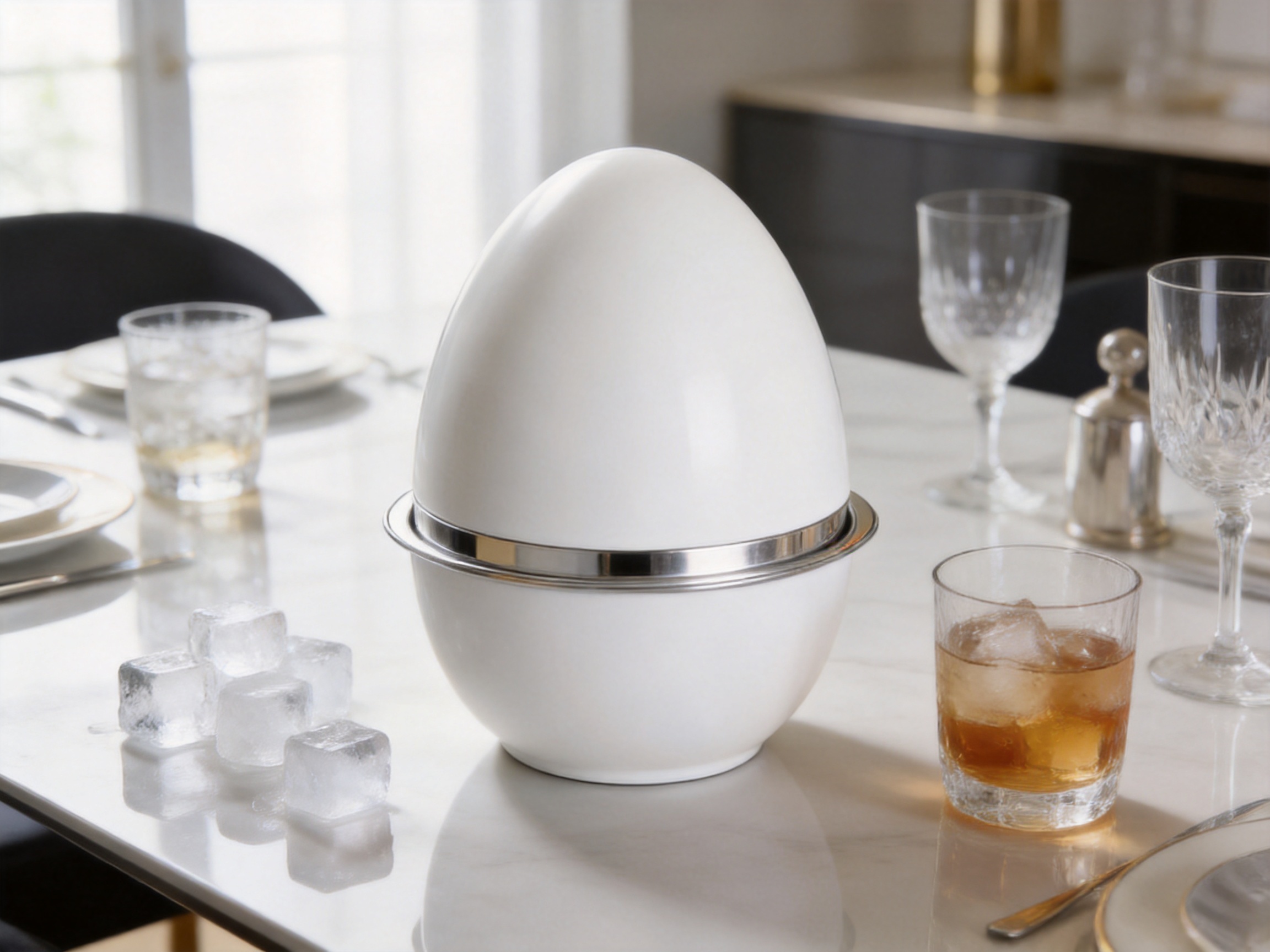
Iced Eggs carries the item number GS036 and is identified in the product information as a reusable chilled-serving item made from PS and stainless steel. The product name suggests an egg-shaped or egg-inspired appearance, giving it a more memorable presentation than a conventional cylindrical ice bucket. In a retail environment, shape is especially important because unusual products are easier for customers to notice on shelves, in catalogues, and in online product listings.
The PS and stainless steel combination offers a practical balance between appearance, structure, and production efficiency. PS, or polystyrene, is commonly used in consumer products that require a formed outer body, clean surface finish, and relatively light weight. Stainless steel is widely valued for its strength, corrosion resistance, and suitability for food-service environments when properly selected and processed. Used together, these materials can create a product that is visually distinctive while remaining practical for repeated handling.
Although Iced Eggs is classified as an ice bucket, its potential use is broader than a simple container. It may be positioned as a tabletop chilled-serving accessory, a decorative barware product, a hospitality amenity, or a seasonal entertaining item. Depending on the customer’s merchandising strategy and the final product configuration, it can be used around chilled beverages, ice presentation, event tables, hospitality counters, and home dining settings.
The product is supplied under the item number GS036, with eight pieces packed per carton. The listed carton measurement is 45.5 by 28.5 by 63 centimeters. The net weight per carton is 10 kilograms, while the gross weight is 12 kilograms. The standard minimum order quantity is 2,000 pieces, and the stated delivery time is 30 days. These specifications make the product suitable for importers, distributors, hospitality suppliers, supermarket buyers, and private-label customers planning medium or large purchasing programs.
| Specification | Details |
| Item number | GS036 |
| Product name | Iced Eggs |
| Product category | Ice buckets and chilled-serving accessories |
| Material | PS and stainless steel |
| Pieces per carton | 8 pieces |
| Carton measurement | 45.5 × 28.5 × 63 cm |
| Net weight | 10 kg per carton |
| Gross weight | 12 kg per carton |
| 20-foot container loading reference | 2,800 pieces |
| 40-foot high-cube container loading reference | 6,800 pieces |
| Minimum order quantity | 2,000 pieces |
| Stated delivery time | 30 days |
Design Appeal and Product Differentiation
The most immediate advantage of Iced Eggs is its distinctive visual identity. Traditional ice buckets often use familiar round, cylindrical, or rectangular shapes. While these formats can be functional, they may look similar across competing brands and suppliers. An egg-inspired product creates a different visual experience and can become a conversation piece at a table, bar, party, hotel room, or retail display.
Distinctive design is valuable because it can help a product compete in crowded categories. In a supermarket, a product with an unusual silhouette may attract attention more quickly than a standard container. In an online catalogue, an unconventional form can make product images more memorable. In hospitality settings, decorative serving accessories help operators create an atmosphere that is more carefully considered than a purely utilitarian arrangement.
The shape also creates opportunities for themed merchandising. Iced Eggs can be promoted for spring entertaining, brunch service, Easter displays, wedding receptions, garden parties, hotel breakfast areas, or novelty barware collections. It may also be included in gift sets alongside beverage accessories, reusable ice products, cocktail tools, or tabletop items. A recognizable form gives distributors more flexibility when developing campaigns and seasonal assortments.
Another design advantage is the potential combination of decorative appearance and practical service. The product is not merely an ornament. As an ice-bucket-category product, it is intended to support the presentation and handling of chilled contents. The ability to serve a functional purpose while contributing to tabletop decoration can make it more attractive than products that provide only storage or only visual interest.
For private-label customers, a distinctive product can support a stronger brand identity. Buyers may add branded packaging, printed sleeves, inserts, or coordinated product collections without changing the basic function of the item. This allows the product to be positioned as a premium home accessory, an entertaining essential, a hotel amenity, or a seasonal gift rather than as an ordinary commodity.
Material Structure and Practical Benefits
The listed construction uses PS and stainless steel. Each material can contribute different characteristics to the finished product. PS is often selected for molded or shaped components because it can support consistent forms, smooth surfaces, and efficient mass production. It also allows designers to create product silhouettes that would be more difficult or expensive to achieve entirely in metal.
The stainless steel component provides a durable material presence and can contribute to the product’s visual quality. Stainless steel is associated with cleanliness, strength, and professional food-service equipment. Its metallic finish may also create a contrast with the shaped PS body, helping the product appear more refined and giving it a modern decorative character.
Using a mixed-material design can also support cost control. A product made entirely from thick stainless steel may be heavier, more expensive, and more demanding to ship. A product made entirely from a single plastic material may not provide the same perceived durability or premium appearance. The PS and stainless steel combination offers a middle path: a formed outer structure with a metal component where it adds value to the product’s appearance or use.
Material selection must always be considered together with production standards, intended use, and customer requirements. For professional procurement, buyers should confirm the exact stainless steel grade, food-contact suitability where applicable, cleaning instructions, temperature limitations, and any regulatory documentation required in the destination market. These details should be verified during the product approval process and before mass production.
From a user perspective, a reusable product can be more appealing than disposable serving containers. Reusability may help reduce the need for repeated purchases during routine entertaining and can improve the product’s long-term value. For hotels and restaurants, reusable accessories can also contribute to a more consistent service presentation across multiple events and operating periods.
Advantages Over Conventional Ice Buckets
Conventional ice buckets remain useful, but many are visually interchangeable. Their primary selling point is often capacity or basic durability. Iced Eggs offers an additional value proposition through design differentiation. It can be marketed not only as a container or chilled-serving accessory but also as a decorative tabletop product.
The first competitive advantage is shelf recognition. A distinctive form makes the product easier to identify in a crowded display. Buyers who are searching for unusual housewares or entertaining accessories may respond positively to an item that looks different from ordinary barware. Retailers may also use the shape to build themed displays that attract attention during seasonal selling periods.
The second advantage is hospitality presentation. Restaurants, hotels, lounges, and event venues often use tabletop accessories to strengthen their visual concept. A standard bucket may be adequate for holding ice, but an attractive design can improve the appearance of the entire service area. Iced Eggs may be suitable for venues that want a playful, elegant, seasonal, or conversation-oriented presentation.
The third advantage is product versatility. Its design can support several market positions, including home entertaining, bar accessories, hotel supplies, restaurant service, giftware, and promotional merchandise. A product that can move across several channels gives distributors more opportunities to sell through inventory and respond to different customer needs.
The fourth advantage is the balance between appearance and shipment efficiency. The product is packed eight pieces per carton, with a documented carton size and weight. Buyers can use these details for warehouse planning, freight calculations, container planning, and import documentation. The listed loading references of 2,800 pieces for a 20-foot container and 6,800 pieces for a 40-foot high-cube container provide an initial basis for logistics planning, subject to final packing confirmation.
The fifth advantage is compatibility with customized business programs. The minimum order quantity of 2,000 pieces is suitable for distributors and retailers that require a meaningful quantity for a launch or seasonal campaign. It may also support private-label packaging and regional distribution. Custom requirements should be discussed with the manufacturer in advance, particularly when they affect tooling, colors, labels, packaging, testing, or delivery schedules.
Applications in Homes and Hospitality
In domestic settings, Iced Eggs can be positioned as a tabletop accessory for entertaining. It may be used during family meals, weekend gatherings, cocktail evenings, celebrations, outdoor dining, and seasonal parties. Its decorative shape can make it appropriate for open display rather than being stored away after use.
Home users often appreciate products that combine storage, presentation, and decoration. A visually interesting ice-related accessory can contribute to the atmosphere of a meal or party, especially when coordinated with glassware, plates, napkins, and serving trays. Its unusual form may also appeal to customers who enjoy novelty kitchenware or who want entertaining products that reflect individual taste.
Restaurants may use products in this category for table service, beverage service, private dining rooms, themed promotions, and special events. A visually distinctive ice presentation can be useful in restaurants that emphasize design, hospitality, and social-media-friendly presentation. The product may also be included in a broader barware collection to create consistency across the dining area.
Hotels can consider Iced Eggs for lounges, banquet service, event spaces, suites, and seasonal displays. Hotel purchasing teams often need accessories that can be repeated across multiple rooms or service areas. The product’s carton packing and commercial order quantity may support centralized procurement, while its decorative appearance can help reinforce a hotel’s hospitality concept.
Event planners and catering companies may find the design suitable for weddings, birthday celebrations, corporate receptions, brunches, garden parties, and holiday events. A product that functions as a serving accessory while also enhancing table decoration can reduce the need for separate decorative items. It can be used as part of a coordinated theme, subject to the event operator’s preferred handling and cleaning procedures.
Retailers may present Iced Eggs in housewares departments, seasonal entertaining sections, barware collections, gift areas, or hotel-supply catalogues. Packaging and merchandising should clearly communicate the product’s purpose, material composition, care instructions, and intended use. Clear information can help customers understand that the item is both decorative and functional.
lced Eggs
Manufacturing Experience and Engineering Capability
The manufacturer behind Iced Eggs has developed experience across two related areas: small electric kitchen appliances and non-electric innovative household and hospitality products. This combination is significant because it brings together product design, mechanical understanding, tooling coordination, assembly management, and quality-control practices.
The company’s stated product range includes blenders, slicers, choppers, food processors, smokeless grills, hot pots, air fryers, and air ovens. It also includes ice buckets, beverage dispensers, pitchers, slicers, and graters for bars, restaurants, and hotels. This broad portfolio suggests familiarity with different production requirements, including plastic molding, metal components, electrical assembly, functional testing, packaging, and export documentation.
The company reports operating its own manufacturing facility, with a production area described in its corporate information as approximately 15,000 square meters, and more than 200 experienced workers. Earlier company information also describes a factory of approximately 10,000 square meters and a building area of 18,000 square meters. Because facility figures may change as operations expand, buyers should confirm the current production-site details during supplier qualification. Regardless of the precise figure, the information indicates a substantial manufacturing base rather than a purely trading-oriented operation.
The company also reports an engineering and research-and-development team, as well as a dedicated quality-control department. Product development resources are particularly valuable for distinctive designs such as Iced Eggs because unusual shapes may require careful attention to mold design, wall thickness, component fit, stability, surface finish, packaging protection, and production repeatability.
A manufacturer with experience in both innovative non-electric products and electrical appliances may be able to apply structured development practices to a simple-looking household accessory. These practices can include drawing review, prototype evaluation, sample approval, mold testing, first-article inspection, production-line checks, packaging trials, and final inspection. The exact process should be confirmed for each order, but the company’s product history indicates familiarity with developing products from concept through mass production.
Advanced Manufacturing Process
The manufacturing process for a PS and stainless steel product generally begins with product definition and engineering review. At this stage, the manufacturer confirms the intended dimensions, appearance, component relationships, materials, packaging arrangement, and customer requirements. For a product with an unusual shape, the engineering team must consider how the design will be formed, released from tooling, assembled, handled, and packed without damage.
Mold design is an important step when PS components are produced through injection molding or another forming process. The mold must reproduce the intended contours consistently while supporting efficient production. Engineers consider factors such as material flow, cooling, shrinkage, draft angles, parting lines, wall thickness, and surface finish. Proper mold development helps reduce defects and improves consistency from one production batch to another.
During trial production, sample parts are reviewed for dimensions, appearance, fit, and function. If the product includes multiple components, the manufacturer checks whether they connect securely and align correctly. Any issues involving warping, flash, uneven surfaces, weak attachment points, or difficult assembly can be addressed before mass production begins.
The stainless steel component requires a different production approach. Depending on its design, it may involve cutting, stamping, forming, rolling, polishing, deburring, or other metalworking operations. The objective is to produce a clean, stable component with an appropriate finish and reliable fit. Edges should be controlled carefully, particularly where users may handle the product during everyday service.
Surface finishing can influence both appearance and perceived quality. A smooth and uniform metal surface can make the product appear more premium, while a clean molded PS surface supports a professional retail presentation. Consistent color, gloss, texture, and alignment are important because visual defects are especially noticeable in decorative household products.
Assembly follows component production. Workers or semi-automated processes combine the PS body, stainless steel parts, and any additional components required by the approved design. Assembly controls should verify that parts are positioned correctly and that the finished unit remains stable during handling. The manufacturer’s experience with varied product categories can support the development of work instructions and inspection points for this stage.
Quality control should continue throughout the production process rather than being limited to final inspection. Incoming materials can be checked against approved specifications. Molded parts can be inspected during production. Metal components can be checked for dimensions and surface quality. Assembly staff can monitor fit and appearance. Finished products can then be sampled or inspected according to the buyer’s agreed quality standard.
Packaging development is another important manufacturing activity. Iced Eggs has a distinctive shape, so packaging must protect the product from scratches, crushing, movement, and surface damage during domestic transport and international shipping. The eight-piece carton configuration provides a defined packing structure, but the inner protection method should be confirmed with the buyer. Carton strength, internal separators, protective bags, and labeling may all affect delivery condition.
Before shipment, the manufacturer can conduct final checks covering quantity, carton marking, product appearance, packing accuracy, and documentation. Buyers may also arrange third-party inspection or implement an agreed inspection protocol. Clear acceptance criteria help prevent misunderstandings and support a smoother long-term purchasing relationship.
Quality Management and Production Consistency
For products sold internationally, consistency is as important as the design itself. Retailers and hospitality suppliers need each unit to look and perform like the approved sample. Differences in shape, color, surface finish, component alignment, or packaging can create customer complaints and increase return costs.
Production consistency begins with controlled raw materials. The PS material should be purchased according to an approved specification, including the required grade, color, and processing characteristics. Stainless steel should also be supplied according to the agreed material and finish requirements. If the product is intended for contact with food or beverages, the buyer should request appropriate documentation and confirm the applicable regulations for the destination market.
Tooling maintenance contributes to stable molded-part quality. A well-maintained mold can help preserve dimensions, surface quality, and repeatability. Regular cleaning, inspection, and repair reduce the risk of progressive defects that may otherwise appear across a large production run.
Worker training is equally important. Staff should understand assembly points, appearance standards, safe handling, packing procedures, and defect classification. When a product has a decorative form, workers need clear visual samples showing acceptable and unacceptable conditions. This helps create a common quality language across the production line.
The company’s reported engineering and QC resources provide a foundation for these practices. Buyers should nevertheless define their own requirements in writing, including acceptable tolerance ranges, packaging standards, carton markings, sampling levels, and inspection procedures. A detailed purchase specification is useful for both the manufacturer and the customer.
Logistics, Packaging, and Commercial Planning
Commercial planning for Iced Eggs should begin with the carton data. Eight pieces are packed per carton, with a carton measurement of 45.5 × 28.5 × 63 centimeters. The net weight is listed as 10 kilograms and the gross weight as 12 kilograms. These figures help buyers estimate warehouse capacity, freight costs, container utilization, and handling requirements.
The stated loading reference is 2,800 pieces in a 20-foot container and 6,800 pieces in a 40-foot high-cube container. These figures are useful for preliminary planning, but final loading quantities can vary according to palletization, container restrictions, carton orientation, shipping regulations, and the final packaging design. Importers should request a confirmed packing list before booking freight.
The minimum order quantity is 2,000 pieces. Because each carton contains eight pieces, the MOQ corresponds to 250 cartons if ordered in complete cartons. This calculation helps buyers plan purchase orders and warehouse intake. Distributors may divide the shipment among several retail customers, while hospitality suppliers may allocate inventory across different projects or regions.
The stated delivery time is 30 days. Delivery schedules can depend on material availability, production capacity, tooling status, packaging approval, order quantity, inspection arrangements, and shipping-season demand. If customization is required, buyers should confirm whether the 30-day period begins after order confirmation, sample approval, artwork approval, deposit receipt, or another milestone.
Protective packaging deserves particular attention because the product combines a shaped body with a metal component. The outer carton should resist compression, while internal packing should limit movement. If the finish is sensitive to rubbing, individual protective bags or separators may be appropriate. Packaging trials before mass production can help identify problems that might not be visible during factory handling but could appear after long-distance transportation.
For export programs, carton markings should include the item number, product name, quantity, gross and net weight, carton dimensions where required, country-of-origin information, handling symbols, and customer-specific references. Accurate markings support warehouse management and reduce the possibility of receiving errors.
Private Label and Wholesale Opportunities
Iced Eggs is well suited to wholesale programs because its distinctive design can be adapted to different market positions. A distributor may sell it under a general housewares line, while a hotel-supply company may present it as a hospitality accessory. A retailer may create seasonal packaging, and a promotional-products buyer may use it for a branded event or corporate campaign.
Private-label opportunities may include customized packaging, color selection, product inserts, barcode labels, carton artwork, and coordinated collections. The feasibility of each option depends on order quantity, tooling, material availability, and the manufacturer’s production schedule. Customers should provide artwork and technical requirements early so that the supplier can review them before production begins.
The product may also be combined with related accessories. A retailer could build a chilled-entertaining assortment containing Iced Eggs, beverage dispensers, pitchers, serving utensils, cocktail accessories, and reusable ice products. A hospitality distributor could include it in a barware catalogue alongside other products manufactured by the same supplier.
Because the product has both functional and decorative qualities, marketing language should explain the use clearly without overstating performance. Product descriptions should identify it as a chilled-serving or ice-bucket-category accessory and provide care information. Buyers should avoid making technical claims about insulation duration, food-contact compliance, or temperature performance unless those claims have been tested and documented.
Responsible Product Positioning
Modern buyers increasingly consider product lifespan, reusability, packaging, and material transparency. Iced Eggs can be positioned as a reusable serving accessory rather than a disposable item. Repeated use may increase its value for households and hospitality operators, although actual service life depends on handling, cleaning, storage, and the final construction.
Material transparency is important. Product packaging should clearly identify PS and stainless steel where appropriate and provide practical care instructions. If the components are not designed to be separated, the packaging should not imply that all parts can be recycled together. Buyers may request information about packaging materials and explore opportunities to reduce unnecessary inserts or excess carton material.
Durability also contributes to responsible purchasing. A product that remains visually attractive and structurally sound through repeated use may offer better value than a low-cost item that requires frequent replacement. Quality control, appropriate material selection, careful assembly, and protective packaging all support this objective.
Responsible positioning should remain factual. The manufacturer and buyer should communicate verified product features and avoid unsupported environmental or performance claims. Clear and accurate information protects consumers and strengthens long-term trust in the product and the supplier.
Why Choose an Experienced Manufacturer?
Selecting a manufacturer for a product such as Iced Eggs involves more than comparing unit prices. Buyers need confidence that the supplier can manage design details, component production, assembly, packaging, inspection, and delivery. A supplier with experience across household appliances and hospitality accessories may understand the importance of both product function and retail presentation.
The manufacturer’s history began with trading and sourcing experience before developing into product design and factory manufacturing. Its corporate background describes work with international buyers, quality-control activities, product sourcing, and the development of proprietary or innovative household products. This commercial experience can help the company understand the communication, documentation, and delivery expectations of overseas customers.
The reported customer history includes international supermarkets, department stores, warehouse clubs, home retailers, and other large sales channels. Such experience can expose a manufacturer to demanding requirements relating to packaging, inspection, delivery scheduling, product consistency, and customer service. Individual order requirements still need to be negotiated, but this background is relevant when evaluating supplier capability.
The company also reports significant production in electric kitchen appliances, including a large sales program for a multifunction food processor and strong demand for air ovens and air fryers in several regions. These products require organized manufacturing, electrical testing, assembly coordination, and quality management. Although Iced Eggs is a non-electric product, the same organizational strengths can support its production.
Engineering partnership is another potential advantage. Buyers may need assistance with packaging, product adjustments, cost optimization, tooling changes, or market-specific requirements. A manufacturer with in-house technical personnel can often respond more effectively than a supplier that depends entirely on external factories.
Recommended Buyer Evaluation Process
Before placing a large order, buyers should request a complete product sample and compare it against the approved specification. The sample review should cover dimensions, materials, shape, stability, finish, component fit, cleaning requirements, and packaging. If the product will be used in a regulated food-service environment, the buyer should request relevant compliance documents.
Buyers should also confirm the precise intended use. If the item is intended to hold ice, chilled beverages, or food-contact materials, the supplier should clarify which surfaces are suitable for direct contact and what cleaning methods are recommended. The product title and category alone should not be treated as a substitute for technical instructions.
A written quality agreement can identify acceptable cosmetic limits, dimensional tolerances, color references, carton specifications, inspection procedures, and remedies for nonconforming goods. The agreement should also specify whether the customer or an independent inspection company will conduct pre-shipment inspection.
Order planning should include a production timeline with milestones for deposit, sample approval, packaging approval, material purchasing, production, inspection, and shipment. The stated 30-day delivery time provides a useful reference, but the buyer should obtain a schedule tailored to the actual order.
Finally, the buyer should evaluate communication quality. Prompt responses, accurate documents, transparent production updates, and practical problem-solving are important indicators of a reliable long-term supplier. A competitive price is valuable, but it should be considered together with quality, delivery, service, and total landed cost.
Care and Use Considerations
Users should follow the care instructions supplied with the final product. In general, reusable household and hospitality accessories should be cleaned after use, dried thoroughly, and stored in a way that avoids unnecessary impact or surface abrasion. Harsh chemicals, abrasive pads, or unsuitable high-temperature cleaning methods should not be used unless specifically approved.
The product should be handled according to its intended purpose. Buyers should confirm whether it is designed for direct food contact, beverage contact, or only for holding packaged or secondary containers. The manufacturer’s final instructions should define appropriate use, cleaning, storage, and temperature limitations.
For commercial operators, staff training can help preserve product appearance and service life. Employees should know how to transport the product, where to place it on tables, how to clean it, and how to report damage. Proper procedures are especially useful when products are used frequently across hotels, restaurants, catering operations, or event venues.

Frequently Asked Questions
What is Iced Eggs?
Iced Eggs is the product name for item GS036, a chilled-serving accessory listed in the ice bucket category. Its egg-inspired design gives it a decorative appearance while its intended role relates to the presentation or handling of ice and chilled service applications.
What materials are used?
The listed materials are PS and stainless steel. PS is used for the shaped structural component, while stainless steel contributes metal strength, appearance, or functional performance depending on the final configuration.
Is Iced Eggs suitable for homes?
Yes. Its design can suit home entertaining, family gatherings, parties, seasonal displays, brunches, and decorative tabletop service. Users should follow the final care and intended-use instructions supplied with the product.
Can hotels and restaurants purchase it?
Yes. The product is suitable for consideration by hotels, restaurants, bars, caterers, event companies, and hospitality distributors. Its distinctive shape can contribute to tabletop presentation while serving as a practical chilled-service accessory.
How many pieces are packed in one carton?
There are eight pieces per carton according to the supplied product information.
What are the carton dimensions and weights?
The listed carton measurement is 45.5 × 28.5 × 63 centimeters. The net weight is 10 kilograms, and the gross weight is 12 kilograms per carton.
What is the minimum order quantity?
The stated minimum order quantity is 2,000 pieces, equivalent to 250 cartons when ordered in complete cartons of eight pieces.
What is the delivery time?
The stated delivery time is 30 days. The final schedule should be confirmed according to order quantity, packaging, customization, material availability, inspection, and order-approval milestones.
Can the product be customized?
Potential customization may include packaging, labels, color, inserts, and private-label presentation. The feasibility, cost, tooling requirements, and minimum quantity for each option should be confirmed with the manufacturer before ordering.
Can the product be used directly with food or beverages?
Buyers should confirm this point with the manufacturer for the exact production version. If direct food or beverage contact is required, the buyer should request appropriate material and compliance documentation for the destination market.
What should buyers check before mass production?
Buyers should check the approved sample, dimensions, materials, finish, stability, component fit, packaging, carton markings, care instructions, and inspection criteria. A written specification and pre-shipment inspection plan can help maintain consistency.
Why is the product different from a standard ice bucket?
Its principal difference is the decorative egg-inspired form. Rather than competing only on basic storage function, it can also be marketed as a visual tabletop accessory, seasonal item, hospitality feature, or distinctive gift product.
Conclusion
Iced Eggs offers a creative approach to the ice bucket and chilled-serving category. Its PS and stainless steel construction, unusual egg-inspired form, commercial carton packing, and broad application potential make it relevant to both consumer and hospitality markets. The product can be positioned for home entertaining, restaurants, hotels, bars, catering companies, seasonal retail, and private-label programs.
Its competitive strength comes from the combination of visual distinction and practical use. Standard ice buckets may perform their basic function effectively, but Iced Eggs adds a memorable design element that can improve shelf recognition, tabletop presentation, and promotional flexibility. The product also benefits from a manufacturer experienced in small kitchen appliances, non-electric innovations, barware, hotel supplies, product engineering, production management, and quality control.
For buyers, the most important next steps are sample approval, material verification, intended-use confirmation, packaging review, quality agreement, and delivery planning. When these details are managed carefully, Iced Eggs can become more than a novelty product. It can serve as a durable, reusable, visually engaging accessory within a broader collection of home and hospitality products.
The manufacturer’s stated production resources, engineering capabilities, QC organization, international customer experience, and broad product portfolio provide a strong foundation for wholesale cooperation. With accurate specifications, clear communication, and appropriate inspection, the product has the potential to offer an attractive balance of design appeal, manufacturing practicality, and commercial versatility.
References
1. Product specification sheet for item GS036, including material, carton, weight, loading, MOQ, and delivery information.
2. Manufacturer-provided company profile covering product development, factory operations, engineering resources, quality-control activities, and export experience.
3. General principles of injection-molded PS component production, including mold design, material flow, cooling, shrinkage, and surface control.
4. General principles of stainless steel forming and finishing for household and hospitality products.
5. Standard purchasing practices for consumer housewares, including sample approval, quality agreements, packaging validation, and pre-shipment inspection.
6. General retail and hospitality merchandising principles for decorative serving accessories and reusable tabletop products.