
 English
 中文简体
中文简体 Español
 English
 中文简体
中文简体 Español
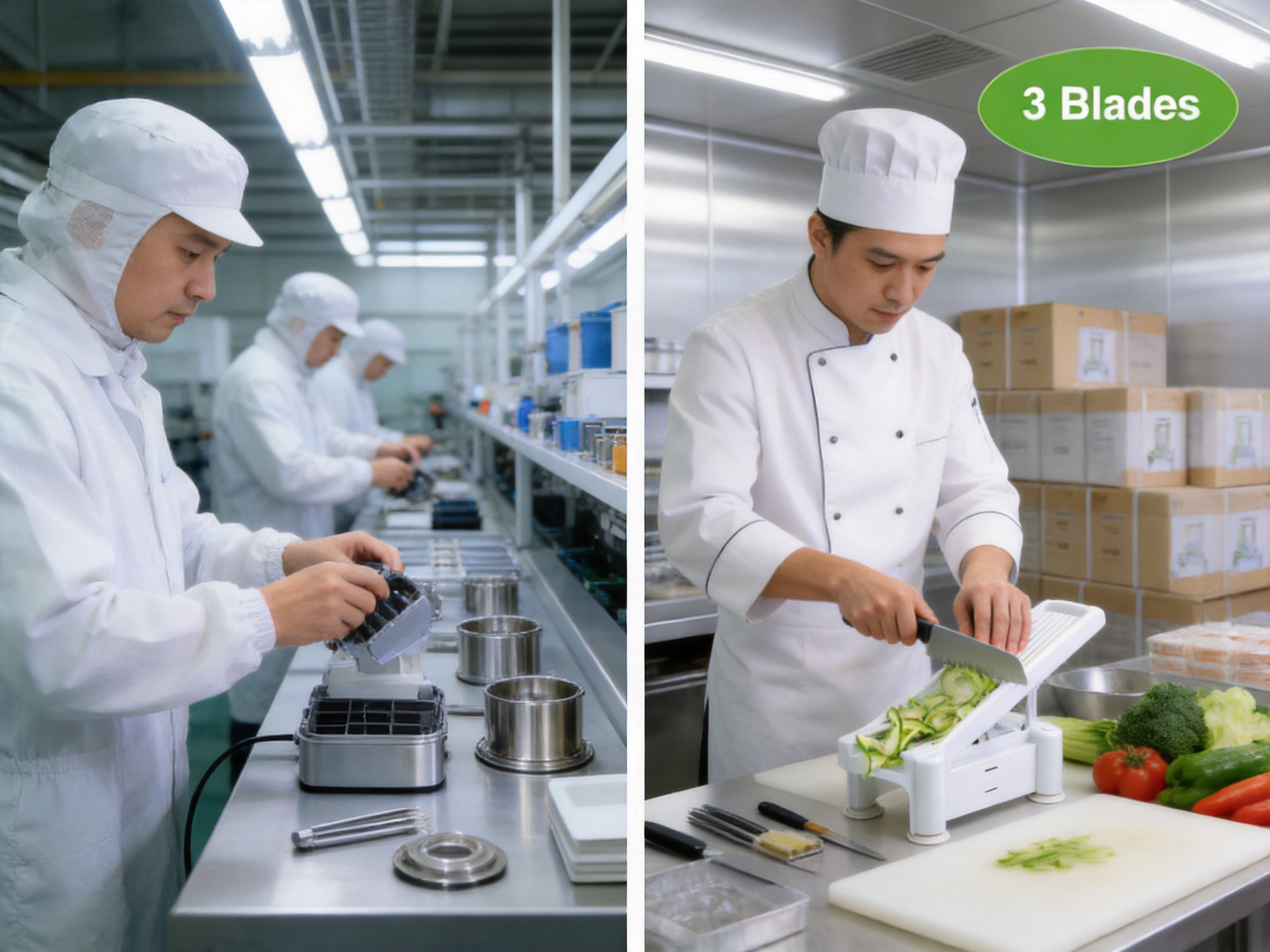
Modern kitchens increasingly require tools that save time, reduce preparation effort, and deliver reliable results without taking up excessive space. The Spiral Slicer 3 in 1 is designed to meet these needs with a compact manual structure, multiple cutting functions, and durable ABS and stainless-steel construction. It provides a practical solution for preparing vegetables, fruits, garnishes, salads, decorative dishes, and a wide variety of home-cooked meals.
Unlike many single-purpose kitchen tools, this spiral slicer combines several preparation functions in one product. Depending on the selected configuration, the product family includes 3-in-1, 5-in-1, and 7-in-1 versions. This range allows distributors, retailers, restaurant suppliers, and household users to select the model that best matches their market requirements and cooking habits.
The product is categorized as a manual vegetable slicer, but its applications extend beyond simple slicing. It can support spiral cutting, shredding, grating, and other vegetable preparation tasks depending on the model and included accessories. Its manual operation eliminates the need for a power supply, making it convenient for everyday use, outdoor cooking, temporary kitchens, small apartments, and commercial environments where a quick preparation tool is useful.
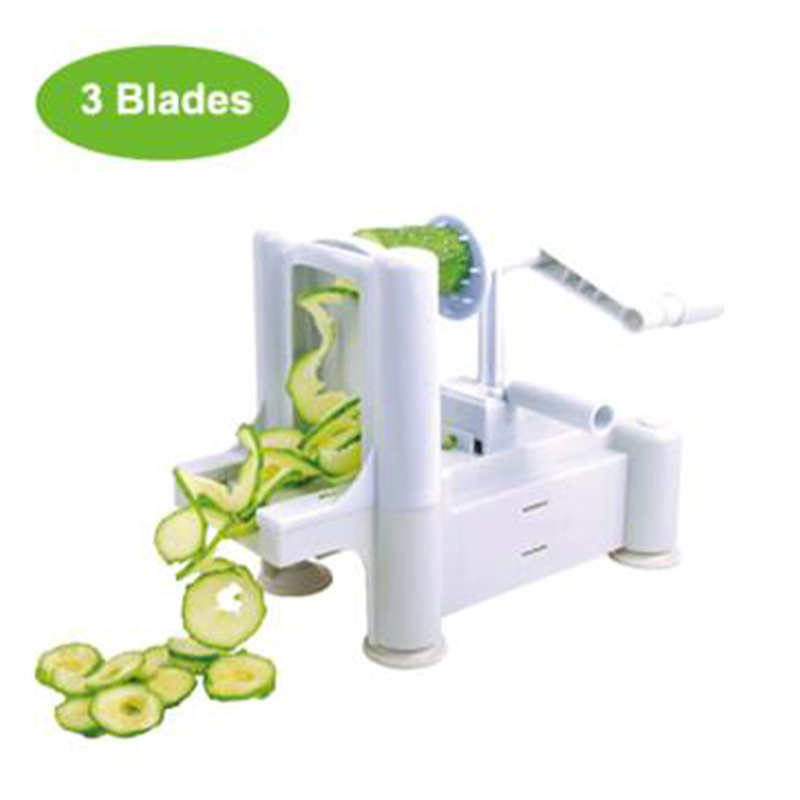
Spiral Slicer 3 in 1
Product Overview
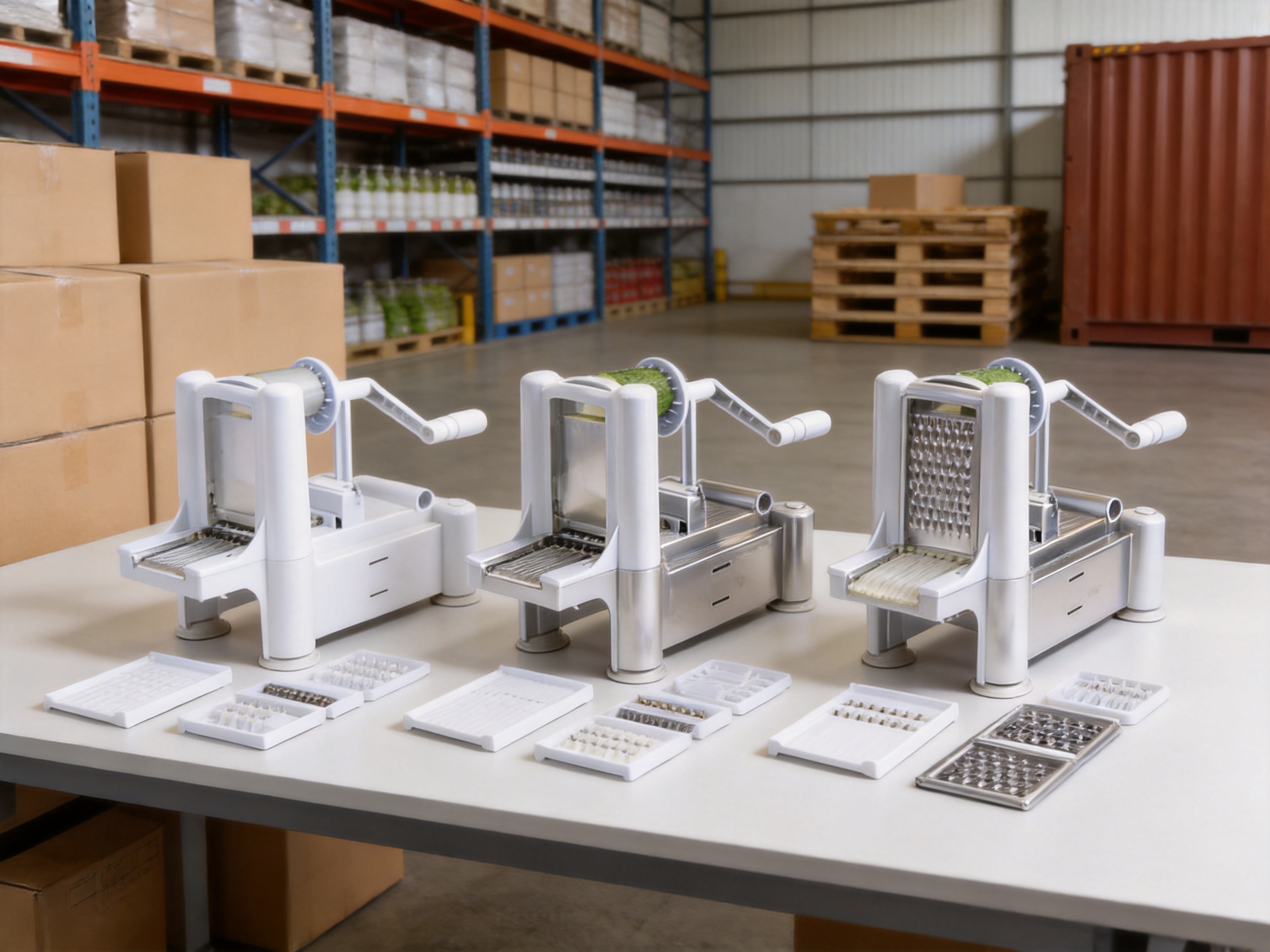
The Spiral Slicer 3 in 1 is part of a broader product series identified by the item numbers GS002, GS002-1, and GS002-2. These item numbers correspond to three configurations: the Spiral Slicer 3 in 1, the Spiral Slicer 5 in 1, and the Spiral Slicer 7 in 1.
Each version is built around the same general product concept: a manually operated kitchen preparation device that uses interchangeable or integrated stainless-steel cutting components to process vegetables and similar ingredients. The ABS body provides a lightweight and practical exterior, while stainless steel is used for the cutting elements and other areas that benefit from strength, corrosion resistance, and long-term durability.
| Product Attribute | GS002 | GS002-1 | GS002-2 |
| Product Name | Spiral Slicer 3 in 1 | Spiral Slicer 5 in 1 | Spiral Slicer 7 in 1 |
| Product Category | Manual Vegetable Slicer | Manual Vegetable Slicer | Manual Vegetable Slicer |
| Main Material | ABS and stainless steel | ABS and stainless steel | ABS and stainless steel |
| Carton Quantity | 6 pieces per carton | 6 pieces per carton | 6 pieces per carton |
| Carton Measurement | 51.5 × 32.5 × 49 cm | 51.5 × 32.5 × 49 cm | 51.5 × 32.5 × 49 cm |
| Net Weight | 6.8 kg | 7.1 kg | 6.8 kg |
| Gross Weight | 7.5 kg | 7.8 kg | 7.5 kg |
The three versions share the same carton measurement, which can simplify logistics planning for distributors handling multiple configurations. The 5-in-1 version has a slightly higher net and gross weight, reflecting its additional functions or components. Each carton contains six pieces, making the product suitable for wholesale purchasing and organized retail distribution.
Versatile Food Preparation in One Compact Tool
The primary advantage of a multifunctional slicer is that it reduces the need for multiple separate kitchen tools. A traditional kitchen may require a handheld peeler, a grater, a julienne cutter, a spiralizer, and a vegetable slicer. A multifunctional design consolidates several of these tasks into one product family, helping users save storage space and reducing the time required to select and clean different utensils.
The 3-in-1 model is suitable for consumers who want the core spiral-slicing functions without purchasing a larger accessory set. It can appeal to households, small retailers, and first-time users seeking a straightforward entry-level configuration.
The 5-in-1 model provides additional preparation options for users who regularly work with a wider range of ingredients. It may be suitable for families that prepare salads, vegetable noodles, side dishes, and garnishes frequently. The additional functions can also help retailers position the product as a higher-value kitchen accessory.
The 7-in-1 version is designed for customers who want the broadest range of preparation possibilities in the product series. It can be presented as a comprehensive manual vegetable preparation solution for enthusiastic home cooks, meal-preparation users, caterers, and food-service environments that value flexibility.
Offering three configurations also benefits wholesalers and importers. Rather than relying on one universal model, buyers can create a product range with different price points and functional levels. This supports multiple sales channels, including supermarkets, kitchenware stores, online retailers, home-shopping programs, hospitality suppliers, and promotional product distributors.
Key Product Advantages
1. Multifunctional Design
The most visible advantage is the combination of multiple functions in one device. Multifunctional kitchen products are attractive because they provide more value per unit of storage space. Users can complete several preparation tasks without filling drawers and cabinets with separate tools.
This advantage is particularly important in small kitchens, apartments, dormitories, recreational vehicles, outdoor cooking areas, and compact food-service stations. A manual product can be stored easily and used wherever a stable preparation surface is available.
2. Manual Operation Without Electricity
The slicer operates manually, so it does not require batteries, a motor, a power cord, or an electrical outlet. This simplifies daily operation and eliminates concerns related to charging, cable placement, motor noise, and electrical maintenance.
Manual operation can also make the product more accessible in areas where electricity is limited or unreliable. It is useful for picnics, camping, travel, temporary kitchens, and outdoor events. Retailers can promote this independence from electricity as a practical advantage over electric food processors that may be more expensive, heavier, or less convenient for small preparation tasks.
3. Compact Storage and Efficient Shipping
The product is supplied in cartons containing six pieces, with a carton measurement of 51.5 × 32.5 × 49 centimeters. Consistent carton dimensions across the three versions can make warehouse organization and container planning more manageable.
For wholesalers, consistent packaging supports more predictable inventory management. It can simplify pallet planning, shipping quotations, warehouse labeling, and product allocation across different retail channels. The stated loading capacity is approximately 2,100 pieces in a 20-foot container and approximately 5,100 pieces in a 40-foot high-cube container for each listed version.
These shipping quantities give importers a useful starting point when planning purchase volumes. The minimum order quantity is listed as 2,000 pieces, which is appropriate for distributors seeking a full commercial launch or a coordinated retail program rather than a small trial order.
4. Durable Material Combination
The use of ABS and stainless steel combines practical advantages from two material categories. ABS is commonly selected for kitchen-product housings because it can provide a lightweight, rigid, and formable structure. It also supports the production of smooth exterior surfaces that are easy to handle and clean.
Stainless steel is well suited to cutting and grating components because it offers strength, wear resistance, and improved resistance to corrosion compared with ordinary carbon steel. The material combination helps the product balance manageable weight with functional durability.
For a manual slicer, the relationship between body stability and blade performance is important. A body that is too flexible may reduce control during preparation, while a cutting component that loses sharpness quickly may create inconsistent results. The ABS and stainless-steel construction is intended to provide a practical balance for repeated household and commercial use.
5. Broad Consumer Appeal
Vegetable preparation tools appeal to several consumer groups. Health-conscious users may use spiralized vegetables as alternatives to conventional noodles. Families may use the product to prepare salads and side dishes. Home cooks may use it to create decorative garnishes for special meals. Food-service operators may use it for repetitive preparation tasks involving vegetables, fruit, or presentation ingredients.
The product can also appeal to consumers who enjoy homemade meals but want to reduce preparation time. Instead of manually cutting every ingredient with a kitchen knife, users can select a suitable function and process ingredients more efficiently.
Applications in Home Kitchens
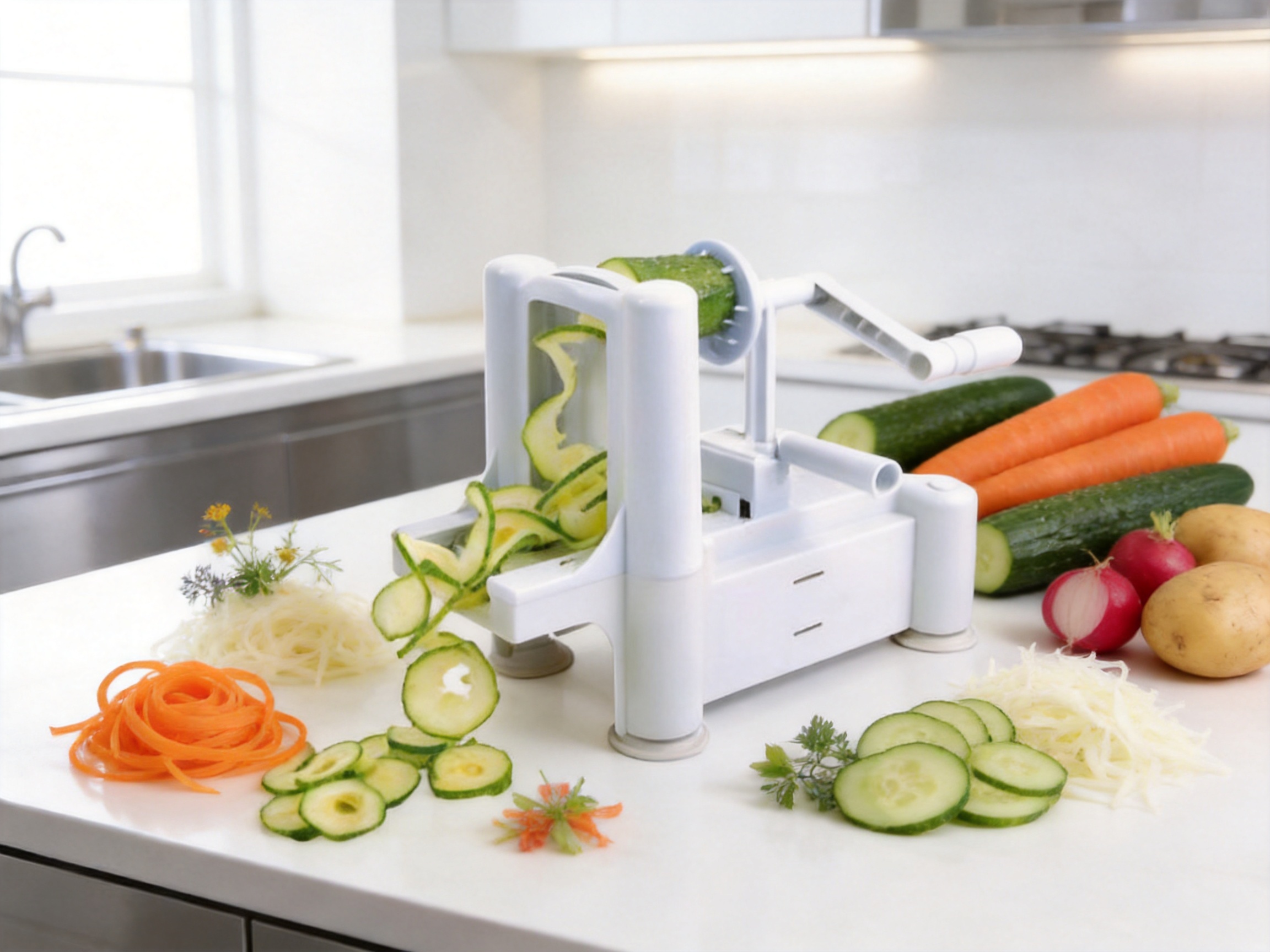
The Spiral Slicer 3 in 1 and its expanded versions can support many common kitchen activities. Vegetables such as zucchini, carrots, cucumber, radish, potato, and similar firm ingredients may be prepared in different shapes, depending on the selected cutting component and the condition of the ingredient.
Spiral-cut vegetables can be used in salads, stir-fry dishes, cold plates, vegetable bowls, and decorative meal presentations. Shredded vegetables can be added to sandwiches, wraps, soups, dumpling fillings, and mixed salads. Grated ingredients can be used in sauces, toppings, batters, and side dishes.
The product may be especially attractive to families who want to make vegetables more visually appealing to children. Different shapes and textures can add variety to meals without requiring complicated culinary equipment. It can also support meal-preparation routines by helping users prepare several vegetables in advance.
Because the product is manual, users can process a small quantity without operating a large appliance. This is useful when preparing one or two portions. An electric food processor may be unnecessarily large for a small task, while a manual slicer can be selected quickly and stored without significant setup.
Applications in Commercial and Hospitality Settings
Although the product is designed for household use, multifunctional manual slicers can also be valuable in small commercial environments. Cafés, salad bars, catering businesses, hotel kitchens, food stalls, and restaurant preparation areas may use manual tools for garnishes, small-batch vegetables, or tasks that do not justify starting a large machine.
Food-service users often value speed, consistency, and ease of cleaning. A manual slicer can support repetitive preparation while reducing dependence on knife skills for certain cutting styles. It can also be useful as a backup tool when an electric processor is occupied, being cleaned, or unavailable.
For hospitality suppliers, the 5-in-1 and 7-in-1 versions may offer a stronger value proposition because they provide more functions for professional users who need flexibility. The range can be marketed to restaurants, hotels, bars, and catering operators that prepare decorative vegetables, salad ingredients, garnishes, and side dishes.
Commercial buyers should establish their own procedures for cleaning, sanitizing, safe storage, and operator training. Cutting tools should be handled carefully, and food-service users should follow applicable local hygiene requirements.
Comparison with Single-Purpose and Electric Alternatives
The Spiral Slicer product family competes with several categories of kitchen tools, including basic handheld slicers, single-purpose spiralizers, mandoline-style slicers, and electric food processors. Each category has its own advantages, but the multifunctional manual design offers a balanced combination of flexibility, simplicity, and cost efficiency.
| Comparison Factor | Multifunctional Manual Slicer | Single-Purpose Tool | Electric Food Processor |
| Power Requirement | No electricity required | No electricity required | Electricity required |
| Functional Range | Several functions in one product | Usually one main function | Several functions, depending on accessories |
| Storage Requirement | Compact integrated product | Small individual tool | Larger appliance and attachments |
| Small-Batch Convenience | Very suitable | Suitable | May be excessive for small tasks |
| Noise Level | Minimal manual operating noise | Minimal manual operating noise | Motor noise during operation |
| Maintenance Complexity | Generally simple | Simple | More components and electrical parts |
| Portability | High | High | Limited by size and power access |
Compared with a single-purpose tool, the multifunctional slicer provides more preparation options without requiring users to buy and store several separate products. Compared with an electric processor, it offers simpler operation, easier portability, and no motor-related maintenance.
Electric appliances may process large quantities faster, but they are not always the most convenient choice for small portions. They can also be more expensive and may require additional cleaning of motor bases, bowls, lids, and electrical interfaces. A manual slicer fills the space between a basic handheld utensil and a full-size electric food processor.
For retailers, this positioning is important. The product should not be marketed solely as a replacement for high-capacity commercial machinery. Instead, it should be presented as a practical, flexible, and space-saving tool for everyday preparation and small-batch processing.
Product Family and Configuration Strategy
The three configurations create opportunities for market segmentation. A 3-in-1 model can function as the core product for price-sensitive consumers or retailers seeking an accessible kitchen accessory. A 5-in-1 model can occupy a mid-range position, offering additional functions while retaining the compact concept. A 7-in-1 model can serve as the premium configuration for users who want the widest set of preparation options.
A product family approach can improve shelf presentation. Retailers may display the three versions together, allowing customers to compare functionality and select the model that matches their preferences. This approach can also encourage upgrades, with customers moving from a basic version to a more comprehensive model.
For wholesale buyers, carrying multiple versions can support different sales channels. The 3-in-1 model may be appropriate for promotional bundles and entry-level online listings. The 5-in-1 version may be suitable for general supermarket placement. The 7-in-1 version may be targeted at specialty kitchen stores, home-shopping demonstrations, and gift-oriented retail programs.
The consistent carton measurement across the models makes this range easier to coordinate from a logistics perspective. Although the product functions differ, distributors can plan storage and transportation using a consistent outer-carton footprint.
Manufacturing and Product Development Strengths
The manufacturer behind the product has experience in the design, development, and production of small kitchen appliances and manual kitchen innovations. Its product categories include blenders, slicers, choppers, food processors, smokeless grills, hot pots, air fryers, air ovens, ice buckets, beverage dispensers, pitchers, and graters.
This broad product range supports a cross-category understanding of kitchen-product engineering. Experience with different appliance types can contribute to practical knowledge in materials, user operation, component integration, packaging, quality control, and production planning.
The company began developing non-electric innovative kitchen products before expanding into electric products. This background is particularly relevant to the Spiral Slicer because the product depends on mechanical function, ergonomic use, cutting performance, and compact component design rather than a motor or electronic control system.
The company operates its own manufacturing facility with a reported production area of approximately 15,000 square meters and more than 200 experienced workers. Earlier company information also described a factory occupying approximately 10,000 square meters, with a building area of approximately 18,000 square meters, along with a workforce of engineers and quality-control personnel. These figures indicate an established manufacturing base capable of supporting product development, production coordination, and export-oriented order fulfillment.
The company reports a research and development team of engineers and a dedicated quality-control department. This organizational structure is important for kitchen products because successful development requires more than simply producing individual plastic and metal parts. It requires the integration of functional components, repeatable assembly, safe handling, packaging protection, and consistent inspection procedures.
A dedicated development team can also help the manufacturer respond to customer requirements involving product features, packaging, color, labeling, accessories, and market positioning. For wholesalers and private-label customers, this flexibility can be valuable when adapting a product for different markets.
Design and Engineering Capabilities
Product design is a central strength in the manual kitchenware sector. Consumers expect products to be functional, comfortable to use, easy to clean, and visually appealing. The company’s history of developing patented or self-designed products demonstrates a focus on creating its own product concepts rather than relying exclusively on copied designs.
For a spiral slicer, engineering considerations may include the relationship between the handle, body, blade position, food-contact surfaces, and ingredient movement. The product must allow users to apply force in a controlled manner while maintaining a stable cutting position. The cutting components should be positioned to produce consistent results when used correctly.
Material selection is another important engineering decision. ABS can support the formation of the main housing and structural components, while stainless steel is appropriate for food-contact cutting parts. Combining these materials allows designers to manage weight, durability, production efficiency, and appearance.
Production Organization
A manufacturing facility with dedicated production resources can support a more organized workflow from incoming material inspection through assembly and final packing. A typical process for a product of this type may include plastic-component preparation, stainless-steel component processing, surface inspection, assembly, functional checking, packing, carton inspection, and shipment preparation.
Although specific internal production procedures may vary by order and model, a structured workflow is essential for maintaining consistency across large quantities. This is especially important for wholesale orders, where small variations in assembly or accessory selection can affect customer satisfaction and retail returns.
The listed delivery time is approximately 30 days. This lead time provides a useful planning reference for importers, although the actual schedule may depend on order quantity, production capacity, packaging confirmation, component availability, inspection requirements, and shipping arrangements.
Quality-Control Considerations
Quality control for a manual vegetable slicer should address both appearance and function. Visual inspection may check the plastic housing, surface finish, labeling, accessory completeness, carton condition, and visible metal surfaces. Functional inspection may evaluate assembly, movement, cutting-component installation, stability, and general operation.
Food-contact products also require careful attention to cleanliness, material suitability, and packaging protection. Buyers should confirm the compliance requirements of their destination market and request the appropriate documentation where applicable. Depending on the market, requirements may concern food-contact materials, labeling, packaging, product safety, and importer responsibilities.
The existence of a dedicated quality-control team can help coordinate these checks and communicate customer requirements to the production department. For international buyers, a clear inspection agreement before production is recommended. It may define sampling standards, packaging specifications, accessory quantities, carton markings, and acceptance criteria.
Wholesale and Distribution Advantages
The product is well suited to wholesale distribution because it combines a broad consumer use case with a relatively simple product concept. Kitchen preparation tools are easy for consumers to understand, and a demonstration can quickly show the difference between ordinary cutting and spiral or specialty cutting.
The product can be sold through physical stores, online marketplaces, home-shopping channels, kitchenware distributors, supermarket programs, hotel and restaurant suppliers, and promotional campaigns. Its visual functionality can also support short-form product demonstrations and retail displays.
The minimum order quantity is listed as 2,000 pieces per model. This quantity allows buyers to plan a significant market launch, but it also requires careful forecasting. Importers should assess target-market demand, retail pricing, expected sales cycles, packaging needs, and storage capacity before placing an order.
For buyers who want to introduce several versions, order planning can be divided between the 3-in-1, 5-in-1, and 7-in-1 models according to expected demand. The right mix may depend on consumer purchasing power, retail positioning, competitive products, and the level of functionality preferred in the destination market.
| Business Use | Recommended Product Positioning | Potential Sales Channel |
| Entry-level household product | 3-in-1 basic multifunctional slicer | Supermarkets, discount retailers, online stores |
| General kitchenware product | 5-in-1 expanded preparation tool | Kitchenware stores, department stores, online retailers |
| Premium multifunctional product | 7-in-1 comprehensive preparation system | Specialty retailers, home-shopping programs, gift channels |
| Food-service supply | Model selected according to preparation tasks | Restaurant suppliers, catering distributors, hotel suppliers |
The product’s relatively simple operating concept can reduce the need for extensive consumer education. Retail packaging should nevertheless explain the included functions, safe operating practices, cleaning instructions, and suitable ingredients. Clear images and concise usage instructions can improve customer confidence and reduce incorrect operation.
Packaging, Logistics, and Order Planning
Wholesale success depends not only on product performance but also on reliable packaging and logistics. Each listed model is packed six pieces per carton, with a carton measurement of 51.5 × 32.5 × 49 centimeters. Buyers can use these specifications to estimate warehouse requirements and container utilization.
The reported loading quantities are approximately 2,100 pieces for a 20-foot container and approximately 5,100 pieces for a 40-foot high-cube container. These figures are useful for preliminary planning, but final loading quantities should be confirmed according to the final carton design, packing method, pallet use, and shipping requirements.
Net and gross weight should also be considered when planning transport. The 3-in-1 and 7-in-1 versions are listed at approximately 6.8 kilograms net weight and 7.5 kilograms gross weight per carton. The 5-in-1 version is listed at approximately 7.1 kilograms net weight and 7.8 kilograms gross weight per carton.
Accurate carton markings can help prevent errors in mixed-model shipments. Markings may include item number, product name, quantity, gross weight, net weight, carton dimensions, destination information, and handling instructions. Buyers should confirm all carton details before mass production.
Safety and Responsible Use
Because the product includes sharp stainless-steel cutting components, safe handling is essential. Users should keep hands away from the cutting edges during operation, installation, removal, and cleaning. Accessories should be stored securely, especially in households with children.
Ingredients should be prepared according to the operating instructions. Excessively hard, oversized, or unsuitable ingredients may reduce cutting performance or place unnecessary stress on the product. Users should avoid forcing ingredients through the cutting area and should stop operation if the device becomes blocked.
Cleaning should be performed after use to remove food residue. Components should be handled carefully during washing, drying, and storage. The product should be fully dry before storage to help maintain cleanliness and reduce the risk of unwanted moisture exposure.
Commercial users should establish a routine inspection schedule. Cutting components, structural parts, and securing elements should be checked for damage or excessive wear. A damaged component should not be used until it has been replaced or properly evaluated.
Maintenance and Long-Term Performance
Routine maintenance for a manual slicer is generally simpler than maintenance for an electric food processor because there is no motor, power cord, battery, or electronic control system. The main maintenance priorities are cleanliness, careful handling, correct storage, and inspection of cutting components.
Users should avoid abrasive cleaning methods that may damage the finish of plastic or metal components. After cleaning, parts should be dried thoroughly and stored in a way that protects the cutting edges. Retailers may include care instructions with the product to encourage correct use and extend product life.
For distributors, replacement-part planning may be worth considering, especially for markets with frequent commercial use. The availability of replacement cutting components or accessories can increase the product’s long-term value and support customer satisfaction. Buyers should discuss component availability and after-sales arrangements during product negotiations.
How the Product Supports Modern Consumer Trends
Several consumer trends support the market potential of multifunctional vegetable slicers. First, many consumers are interested in preparing fresh meals at home. A tool that helps produce salads, vegetable noodles, garnishes, and side dishes can make home cooking more varied.
Second, consumers increasingly value compact products that perform several tasks. Limited kitchen space makes multifunctional tools attractive, particularly when the product can replace several separate utensils.
Third, manual products appeal to users who want simple operation without electronics. Some consumers prefer tools that can be used immediately, without charging, software, power connections, or complicated settings.
Fourth, visual food presentation is important in home cooking, catering, restaurants, and social-media content. Spiral and specialty cuts can create attractive plates and make familiar vegetables appear more interesting.
Finally, retailers often prefer products that are easy to demonstrate. A manual slicer can show its value through a direct before-and-after presentation. This supports in-store demonstrations, online video content, product photography, and instructional packaging.
Recommended Retail Positioning
The product should be positioned as a practical multifunctional preparation tool rather than as a heavy-duty industrial machine. Its strongest selling points are versatility, manual convenience, compact storage, stainless-steel cutting components, and the availability of three configurations.
Retail messaging may focus on helping users prepare attractive vegetable dishes with less effort. Demonstrations should show the different functions included in the selected model and explain how users can choose the appropriate configuration.
For the 3-in-1 version, the message can emphasize essential functions, simplicity, and accessibility. For the 5-in-1 version, messaging can highlight increased versatility for everyday meal preparation. For the 7-in-1 version, the focus can be on comprehensive functionality and creative food preparation.
Retailers should avoid making unsupported claims about speed, health benefits, or professional performance. Clear and accurate communication is more likely to build long-term customer trust. Product descriptions should identify the model number, included accessories, material, operating method, cleaning guidance, and safety information.
Why Manufacturing Partnership Matters
When purchasing kitchen products internationally, buyers need more than a product photograph. They need confidence that the supplier can manage product development, manufacturing, inspection, packaging, delivery, and after-sales communication.
The manufacturer’s experience with both manual innovations and electrical kitchen appliances provides a broad foundation for product engineering. Its reported factory resources, development personnel, quality-control staff, and experience serving international customers can support larger wholesale programs.
The company has supplied products to various international markets and has experience working with major retail and supermarket customers. This background suggests familiarity with export packaging, market expectations, production coordination, and large-volume orders.
Its history also indicates a long-term emphasis on product development. The business began with non-electric innovative products and later expanded into electric kitchen appliances. This combination of mechanical-product experience and electrical-appliance capability can help support a diverse product portfolio and ongoing product improvement.
For a buyer, the ideal manufacturing partnership includes clear communication, confirmed specifications, sample approval, production updates, quality inspection, accurate documentation, and dependable delivery coordination. These processes help reduce risk when launching a kitchen product in a new market.
Suggested Buyer Checklist
Before placing an order, buyers should confirm which model is required: GS002, GS002-1, or GS002-2. They should also confirm the exact functions and accessories included in each configuration, because product names such as 3 in 1, 5 in 1, and 7 in 1 must correspond clearly to the actual package contents.
Buyers should request a pre-production sample and verify the following points:
1. Overall product appearance and color.
2. Material specifications for ABS and stainless-steel parts.
3. Included blades, drums, or cutting accessories.
4. Assembly and disassembly process.
5. Product stability during manual operation.
6. Cleaning and storage instructions.
7. Retail packaging and inner protection.
8. Carton markings and shipping labels.
9. Destination-market compliance requirements.
10. Quality-inspection standards and sampling procedures.
11. Production lead time and shipment schedule.
12. Warranty, replacement parts, and after-sales communication.
Clear confirmation of these points before production can reduce misunderstandings and help ensure that the delivered goods match the buyer’s commercial plan.
Q&A
What is the Spiral Slicer 3 in 1?
It is a manually operated multifunctional vegetable slicer designed to support spiral cutting and other food-preparation tasks. It is constructed from ABS and stainless steel and is available in 3-in-1, 5-in-1, and 7-in-1 configurations.
What are the available product models?
The product family includes GS002, GS002-1, and GS002-2. GS002 is identified as the Spiral Slicer 3 in 1, GS002-1 as the Spiral Slicer 5 in 1, and GS002-2 as the Spiral Slicer 7 in 1.
Does the slicer require electricity?
No. The product is a manual vegetable slicer and does not require a power supply, battery, charging, or an electric motor.
What materials are used?
The listed materials are ABS and stainless steel. ABS is used for the main structural and housing components, while stainless steel is used for cutting-related components and other parts requiring durability.
Which model should a retailer choose?
The choice depends on the target market. The 3-in-1 model is suitable for customers who want essential functions, the 5-in-1 model provides a broader range of preparation options, and the 7-in-1 model is intended for customers seeking the most comprehensive configuration.
Can the product be used in restaurants or hotels?
It can be useful in restaurants, hotels, catering businesses, cafés, and other food-service environments for small-batch vegetables, salads, garnishes, and presentation tasks. Commercial users should establish their own hygiene, safety, and inspection procedures.
How many pieces are packed in one carton?
Each listed model is packed at six pieces per carton.
What are the carton dimensions?
The listed carton measurement for each model is 51.5 × 32.5 × 49 centimeters.
What is the minimum order quantity?
The listed minimum order quantity is 2,000 pieces for each model. Buyers should confirm the final quantity, packaging specifications, and production schedule when placing an order.
What is the stated delivery time?
The listed delivery time is 30 days. The final schedule may depend on order confirmation, packaging approval, production capacity, inspection requirements, and shipping arrangements.
What container quantities are listed?
The supplied information lists approximately 2,100 pieces in a 20-foot container and approximately 5,100 pieces in a 40-foot high-cube container for each model. Final loading quantities should be confirmed according to the approved packaging and loading plan.
What should users consider when cleaning the slicer?
Users should remove food residue after use, handle cutting components carefully, dry all parts thoroughly, and store the product safely. Commercial users should follow applicable sanitation procedures.
What makes this product different from an electric food processor?
The manual slicer does not require electricity, produces minimal operating noise, is easy to carry, and is convenient for small quantities. An electric food processor may offer higher capacity or motorized speed, but it generally requires more space, electrical access, and component maintenance.
Why is the manufacturer suitable for wholesale cooperation?
The manufacturer has experience in small kitchen appliances and manual kitchen innovations, operates its own production facilities, maintains research and development resources, and has dedicated quality-control personnel. It also offers multiple product categories and experience serving international customers.
Conclusion
The Spiral Slicer 3 in 1 is a versatile manual kitchen tool designed for consumers and commercial users who want convenient vegetable preparation without relying on electricity. Its ABS and stainless-steel construction, compact shipping format, and range of 3-in-1, 5-in-1, and 7-in-1 configurations make it suitable for multiple market segments.
Its strongest advantages over single-purpose tools are functional variety and space efficiency. Its advantages over electric alternatives include simple operation, portability, low operating noise, and independence from a power supply. These characteristics make it relevant to households, restaurants, hotels, catering businesses, outdoor users, and retailers seeking an accessible kitchen product.
From a supply perspective, the product benefits from an established manufacturing background, product-development experience, dedicated engineering resources, quality-control capabilities, and international market knowledge. The manufacturer’s experience across manual kitchen innovations and electric appliances provides a useful foundation for continued product improvement and wholesale cooperation.
For buyers, successful commercialization will depend on selecting the right model, confirming the accessory set, approving packaging, establishing quality requirements, and preparing accurate retail communication. With proper positioning, the Spiral Slicer product family can serve as a practical addition to kitchenware portfolios and a valuable solution for modern food preparation.
References
1. Product specification sheet for GS002, GS002-1, and GS002-2 manual vegetable slicers.
2. Manufacturer-provided product information regarding materials, carton packing, shipping quantities, minimum order quantity, and delivery time.
3. Manufacturer-provided company profile covering product development, factory resources, engineering, production, and quality-control capabilities.
4. General principles of food-contact kitchenware design, manual cutting-tool safety, and hygienic food preparation.
5. General wholesale planning practices for kitchenware packaging, container loading, product inspection, and retail distribution.