
 English
 中文简体
中文简体 Español
 English
 中文简体
中文简体 Español
Modern food preparation is shaped by a simple expectation: everyday kitchen tools should save time without creating extra work. Salad shears answer that need with a compact, practical, and easy-to-use solution for preparing leafy greens, herbs, vegetables, and other soft food ingredients. Unlike powered kitchen appliances, manual shears require no electricity, produce minimal noise, and can be used immediately wherever food preparation takes place. Their compact format also makes them suitable for home kitchens, catering operations, restaurants, hotels, lunch areas, and outdoor meal preparation.
The GS023 Salad Shears are developed as a manual vegetable slicer for users who want greater control over cutting and portion preparation. Made from ABS, the product is lightweight, convenient to handle, and suitable for daily kitchen use. Its purpose is not to replace every type of knife or food processor, but to provide an efficient tool for small, repeated cutting tasks. This makes it especially practical when users need to prepare salad ingredients directly over a bowl, plate, serving dish, or food container.
Behind a successful kitchen accessory is more than a product shape. Product performance depends on material selection, design accuracy, manufacturing consistency, inspection procedures, packaging, delivery capability, and the supplier’s ability to support customers over the long term. CIXI GSTAR ELECTRIC APPLIANCE CO., LTD. combines experience in household kitchen products with engineering, production, quality control, and international supply capabilities. Although the company manufactures many electric appliances, its development background also includes non-electric innovative kitchen products and manual food preparation tools.
This article examines the product’s practical value, the characteristics that distinguish it from ordinary cutting tools, and the manufacturing strengths that support its use in wholesale, retail, hospitality, and food-service channels.

Salad shears
1. Understanding the Role of Salad Shears in the Kitchen
Salad preparation often involves several small tasks: washing leafy vegetables, removing unwanted stems, cutting large leaves into manageable pieces, chopping herbs, and arranging ingredients in a bowl. These tasks may appear simple, but they can become repetitive when preparing several servings. A conventional knife requires a cutting board and a stable work surface. A food processor may be too large or inconvenient for a small quantity. Salad shears occupy the useful space between these two options.
Manual shears allow the user to cut ingredients directly above the serving container. This can reduce the number of items that need to be transferred between preparation stages. Less transferring may also help reduce spills, scattered leaves, and unnecessary washing. For quick lunches, family meals, buffet preparation, and restaurant garnish work, this direct approach is valuable because it supports a more organized workflow.
The product is categorized as a Manual Vegetable Slicer, which reflects its main function: cutting or slicing food manually through a controlled hand movement. Because it does not depend on a motor, battery, or power cord, it can be used in kitchens of different sizes and layouts. It is also suitable for locations where power access is limited or where users prefer not to operate an electrical appliance for a small preparation task.
A manual tool is also easy to understand. Users do not need to select a speed setting, connect an attachment, charge a battery, or assemble a motorized base. This straightforward operation makes the product suitable for a broad range of consumers, including home cooks, older users who prefer simple tools, food-service employees, and retail customers looking for an accessible kitchen accessory.
2. Key Product Characteristics
Compact Construction
The GS023 Salad Shears are designed as a compact kitchen product rather than a large countertop appliance. This supports convenient storage in a kitchen drawer, utensil organizer, cupboard, or food-service preparation area. Compact storage is an important advantage in modern homes, where countertop and cabinet space is often limited.
A compact tool is also easier to display in retail environments. It can be packaged in a relatively small format, placed in kitchenware sections, included in seasonal promotions, or sold as part of a broader range of food preparation products. For distributors and importers, compact products may also simplify assortment planning and warehouse organization.
ABS Material
The stated material for the product is ABS. Acrylonitrile butadiene styrene is widely used in consumer product manufacturing because it provides a practical balance of strength, rigidity, weight, and appearance. In a kitchen accessory, ABS can support a comfortable body structure without adding unnecessary bulk.
For a product that is held repeatedly during food preparation, moderate weight is beneficial. A lightweight body can reduce hand fatigue during short preparation tasks and make the tool easier to position over a bowl. At the same time, the material must be processed accurately so that the body, grip areas, and moving components fit consistently.
Material selection alone does not determine product quality. The quality of the final result depends on the grade of ABS, mold design, injection molding parameters, cooling control, trimming, assembly, and inspection. Consistent manufacturing helps ensure that the product has a clean appearance and that its operating components function smoothly from one unit to the next.
Manual Operation
The manual design provides immediate readiness. Users can pick up the shears and begin preparation without connecting a power supply. This reduces setup time and makes the product useful in situations where speed and convenience matter, such as preparing lunch before work, assembling a children’s meal, making a quick salad, or adding herbs to a finished dish.
Manual operation also provides a direct connection between hand movement and cutting action. Users can determine the location, rhythm, and quantity of each cut. This degree of control can be helpful when working with delicate leafy ingredients, small portions, or food that needs to be distributed evenly across a dish.
Suitable for Daily Necessities
The product is positioned within the Daily Necessities Series, which reflects its role as an everyday household accessory. A daily-use product must be easy to understand, convenient to store, reliable in repeated use, and attractive enough for a wide range of household environments. It should also be suitable for straightforward retail communication, since consumers need to understand its purpose quickly.
Salad shears can be presented as a practical solution for salads, herbs, leafy vegetables, garnishing, and light food preparation. This broad application range helps the product appeal to users who want one compact tool for several common kitchen tasks.

3. Advantages Compared with Conventional Preparation Methods
Direct Cutting Over a Bowl
One of the main advantages of salad shears is the possibility of cutting ingredients directly over a bowl or serving container. With a conventional knife, ingredients are usually placed on a cutting board, cut into pieces, and then transferred. Each transfer creates another opportunity for leaves or small pieces to scatter.
Direct cutting can help maintain a cleaner preparation area. It may also reduce the number of utensils used during a simple meal. For households that value quick cleanup, this is a practical benefit. In food-service settings, the same feature can help staff prepare garnish or salad ingredients without occupying a large cutting station.
Less Equipment for Small Quantities
Large electric appliances are useful when preparing substantial quantities, but they can be excessive for a single serving or a small bowl of salad. A food processor may require the user to take out the base, attach a bowl, install a blade, process the ingredients, disassemble the unit, and wash several parts.
Manual shears provide a simpler alternative for small jobs. Their compact format makes them easier to retrieve and put away. They can be appropriate for customers who appreciate the performance of a specialized tool but do not want to operate a larger appliance every time they prepare a small quantity of food.
No Electricity Required
Because the GS023 is a manual product, it does not need a socket, battery, charger, or motor. This offers several practical benefits. The product can be used in kitchens with limited outlets, outdoor dining areas, temporary food preparation stations, and locations where users want to avoid energy consumption for a minor task.
The absence of an electrical system also simplifies the product concept. There is no motor to maintain, no electrical switch to replace, and no power cable to store. From a consumer perspective, this can make the tool easier to use. From a distribution perspective, a non-electric product may also be suitable for kitchenware channels that do not specialize in powered appliances.
Low-Noise Preparation
Powered kitchen appliances can be noisy, especially when processing hard or fibrous ingredients. Manual shears operate without motor noise. This is useful in homes where people are sleeping, in open-plan kitchens, in office lunchrooms, and in hospitality environments where quiet operation supports a more comfortable atmosphere.
Portable and Flexible Use
A small manual kitchen tool can be taken from one preparation area to another with little effort. It can be used at a dining table, buffet station, campsite, office pantry, or temporary event kitchen, provided that the user follows appropriate food hygiene practices. Its portability supports flexible meal preparation and makes it attractive to consumers who value convenience outside the traditional home kitchen.
4. Advantages for Retailers, Importers, and Distributors
A kitchen accessory is commercially successful when it offers understandable consumer value and can be managed efficiently through the supply chain. Salad shears have several characteristics that support this objective.
| Product Attribute | Practical Value | Commercial Benefit |
| Manual operation | No power supply is required | Suitable for kitchenware and household product channels |
| ABS construction | Lightweight and practical body material | Supports easy handling, packaging, and display |
| Compact format | Simple storage in homes and food-service areas | Efficient shelf and warehouse utilization |
| Multi-purpose food preparation | Useful for salads, herbs, and leafy vegetables | Broadens the potential customer base |
| 80 pieces per carton | Organized bulk packing | Convenient for wholesale order planning |
| 30-day delivery time | Clear production planning expectation | Supports inventory and promotional scheduling |
The product’s item number, GS023, provides a clear reference for quotations, purchase orders, sample management, and inventory systems. A defined product code is especially important for distributors handling multiple kitchen tools or several product variations.
The stated minimum order quantity is 2,000 pieces. This quantity can be suitable for importers, regional distributors, supermarket suppliers, promotional product companies, and retail chains planning a structured launch. It may also support private-label or customized packaging discussions, subject to confirmation of the specific project requirements.
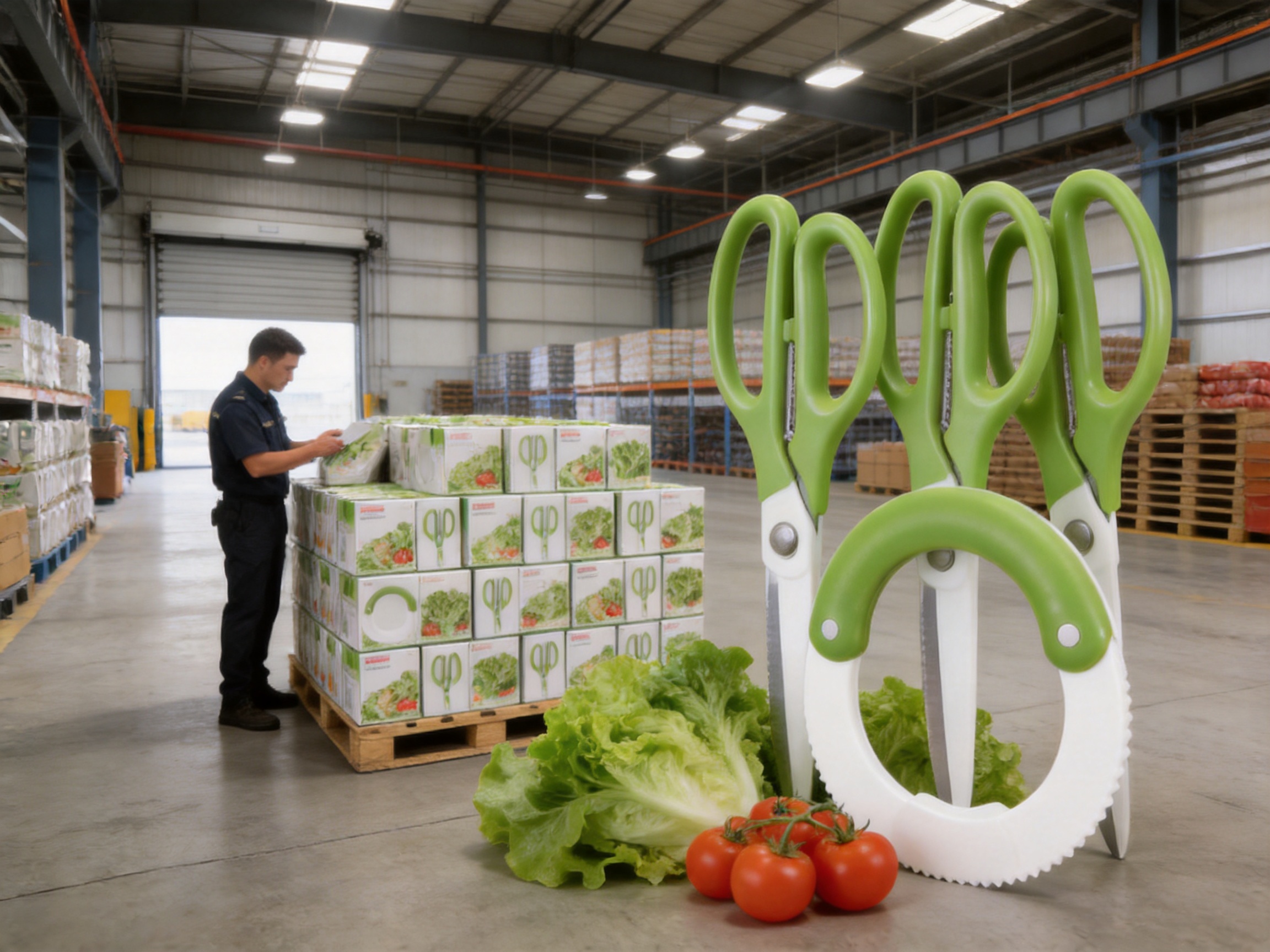
The packing quantity is 80 pieces per carton. The listed carton measurement is 60 x 33 x 35.5 cm, with a net weight of 10 kg and a gross weight of 11 kg. These figures help buyers estimate warehouse space, shipping arrangements, handling requirements, and landed cost calculations.
Container loading information is also provided. The stated capacity is 28,400 pieces for one 20-foot container and 62,560 pieces for one 40-foot high-cube container. The 40-foot standard container figure is listed as unavailable. Buyers should verify all loading quantities with the supplier before confirming a shipment, particularly when packaging, carton dimensions, palletization, or product specifications are changed.
Simple Retail Communication
The product concept is easy to explain: it is a manual tool for cutting salad ingredients and vegetables. Clear communication is beneficial in retail because customers often make quick decisions based on packaging and product presentation. The product can be introduced through demonstrations, recipe content, meal-preparation displays, seasonal kitchen promotions, or bundled kitchen accessory collections.
Its value can be shown visually without complex technical language. Retail demonstrations may show how the tool can help cut leafy ingredients above a bowl, prepare herbs, or divide larger leaves into smaller pieces. Demonstration-based merchandising can help consumers understand the product more quickly than a technical specification alone.
5. Manufacturing Strengths Supporting Product Quality
CIXI GSTAR ELECTRIC APPLIANCE CO., LTD. has a development history that includes both electric kitchen appliances and non-electric innovative products. This combination is relevant to the manufacturing of salad shears because effective kitchen product development requires more than electrical engineering. It also requires attention to ergonomics, plastic construction, assembly, packaging, user habits, and retail presentation.
The company reports a wholly owned plant with a production area of approximately 15,000 square meters and more than 200 experienced workers. Earlier company information describes a factory with a 10,000-square-meter site and an 18,000-square-meter building area, together with approximately 150 workers, 10 engineers in research and development, and 10 employees in quality control. These figures reflect the company’s expansion over time and its growing manufacturing organization.
A factory structure of this scale can provide several advantages. It allows different activities to be coordinated within one production system, including product development, material preparation, assembly, inspection, packaging, and shipment planning. It can also support greater control over production schedules than a purely trading-based supply model.
Product Development Experience
The company’s history began with experience in sourcing, customer service, quality control, and international product sales. The company later developed non-electric innovative products, including kitchen and food-service items. This background is valuable because it places emphasis on real user needs rather than focusing only on the manufacturing process.
Product development experience can influence the design of a manual kitchen tool in several ways. Engineers and designers can consider how the product is held, how food is positioned, how the tool is stored, how it is cleaned, and how it is packaged for retail. They can also study the requirements of different sales channels, including supermarkets, importers, online retailers, hospitality suppliers, and professional distributors.
Engineering and R&D Resources
The company reports a dedicated research and development department with engineering personnel. An organized R&D function supports the transition from an initial product idea to a repeatable manufactured item. This process may include reviewing user requirements, preparing design drawings, evaluating materials, developing molds, checking component fit, conducting trial production, and making adjustments before mass production.
For a plastic kitchen accessory, engineering precision is important even when the product appears simple. Small differences in dimensions can affect the movement of components, the feeling of the grip, the alignment of the cutting mechanism, and the overall appearance. Consistent engineering work helps reduce variation between samples and production units.
Quality Control Organization
The company also reports a dedicated quality control team. Quality control is particularly important for products that are handled directly by consumers and used around food. Inspection activities may include checking material appearance, surface finish, assembly condition, product operation, packaging integrity, carton quantity, and shipping documentation.
Quality control should be considered throughout the production process rather than only at the end. Incoming material inspection helps identify issues before components enter production. In-process inspection can identify assembly or molding problems early. Final inspection helps confirm that finished goods meet the agreed product and packing requirements before shipment.
For international buyers, consistent quality is connected with customer satisfaction, return rates, retailer confidence, and long-term purchasing decisions. A supplier with established quality procedures is better positioned to identify recurring issues and improve production stability.
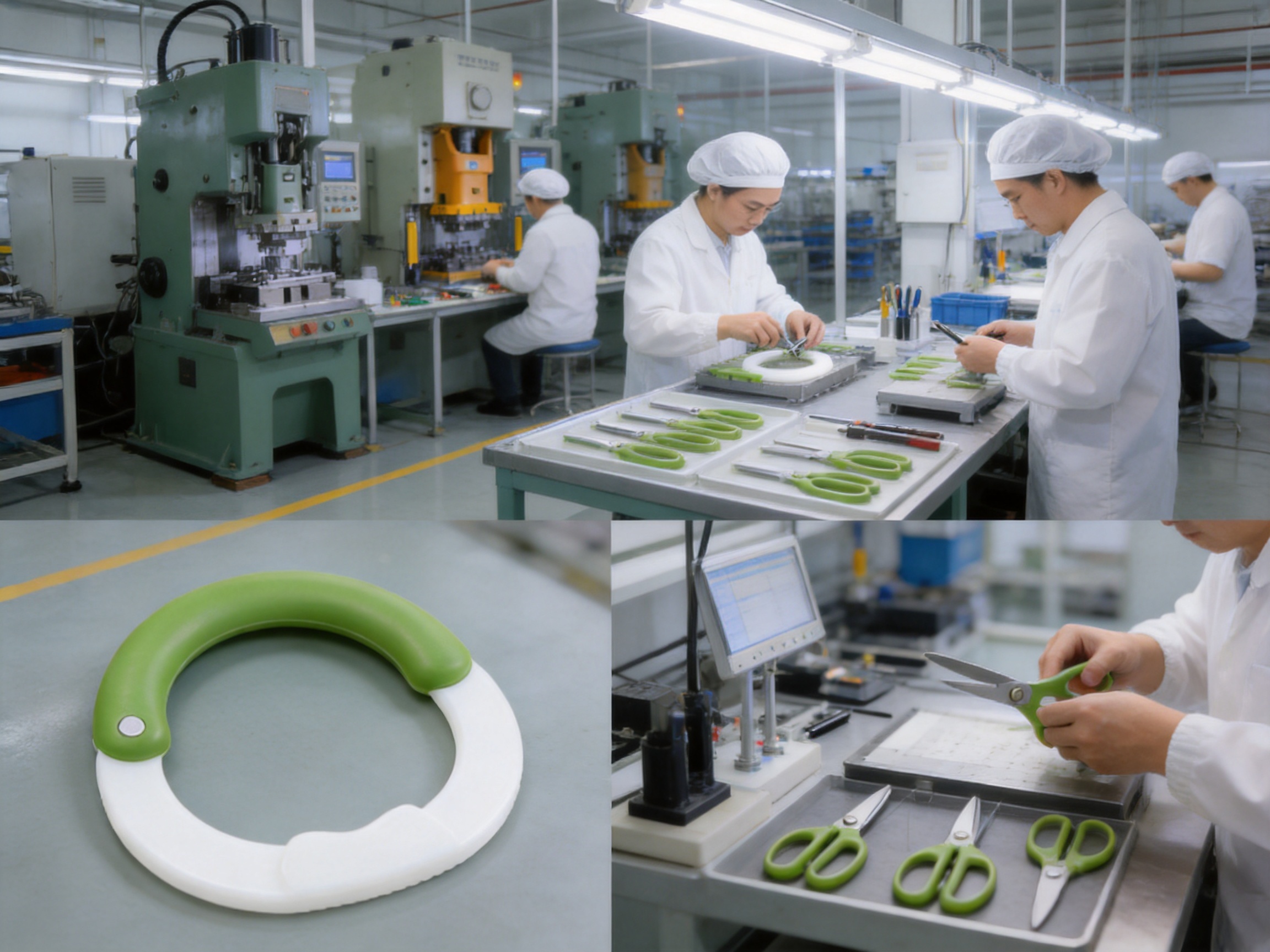
6. Manufacturing Process for an ABS Manual Kitchen Tool
Design and Specification Review
The manufacturing process begins with a clear product specification. This includes the product name, item number, dimensions, material, intended application, packaging quantity, and customer requirements. At this stage, engineering teams review the intended use and identify critical areas such as grip structure, moving parts, cutting performance, appearance, and storage requirements.
Specification review is also the stage where buyers and manufacturers can confirm whether the product is intended for a particular market. Packaging language, labeling, color, logo application, barcode requirements, food-contact expectations, and regulatory documentation may vary by destination. Confirming these details before mass production helps prevent avoidable delays.
Mold and Tooling Preparation
ABS components are commonly produced through injection molding. The mold determines the external form, surface details, assembly features, and dimensional consistency of the plastic parts. Careful tooling preparation is essential because a mold affects both the appearance and the functionality of the finished product.
During mold development, engineers consider wall thickness, draft angles, gates, cooling channels, ejector positions, and areas where components will join. A well-planned mold can help reduce visible defects, warping, incomplete filling, and unnecessary material waste. It can also support efficient cycle times during mass production.
Injection Molding
In injection molding, ABS material is heated until it reaches a suitable flow condition and is then injected into the mold cavity. After the material fills the cavity, it cools and solidifies before the component is removed. Process control is important because temperature, pressure, injection speed, cooling time, and material preparation can influence the result.
Consistent injection molding helps maintain uniformity across a production batch. Important checks may include color consistency, surface quality, dimensional accuracy, flash, sink marks, warping, and structural integrity. The molded parts must also be compatible with the subsequent assembly process.
Component Trimming and Finishing
After molding, components may require trimming or removal of excess material. Finishing work helps improve the appearance and reduces unwanted edges that could affect handling. For a hand-operated kitchen accessory, smooth finishing is especially important because the user holds the product repeatedly.
Visual inspection at this stage can identify surface marks, color differences, molding imperfections, and other issues. Consistent finishing contributes to the product’s perceived value and helps the item meet retail presentation expectations.
Assembly
Assembly brings the molded body and functional components together. The assembly sequence must be controlled so that moving parts are correctly positioned and the final product operates as intended. Workers may follow standardized work instructions, use simple fixtures, and perform functional checks during the process.
Assembly consistency is important for manual shears because the user expects the handles and cutting components to move in a predictable manner. Excessive looseness, resistance, misalignment, or incomplete fastening can affect usability. Production teams therefore need to pay attention to both appearance and operating feel.
Functional Inspection
Functional inspection verifies that the finished product performs its intended task. Inspectors may open and close the shears, check the alignment of the cutting components, examine the body for damage, and confirm that the product is complete. The exact inspection standard should be agreed with the buyer and documented for production use.
Where relevant, inspection can also include repeated operation checks, grip assessment, component security, and packaging review. A sample-based inspection plan may be used for larger quantities, while additional checks can be added for new products or updated designs.
Packaging and Carton Packing
Packaging protects the product during handling, storage, and transportation. It also communicates the product’s use and selling points to the consumer. Packaging design should balance protection, visibility, information, and shipping efficiency.
Bulk carton packing must be controlled carefully. The manufacturer should confirm the number of pieces in each carton, carton dimensions, net weight, gross weight, product identification, and shipping marks. Correct carton information helps prevent warehouse discrepancies and supports accurate logistics planning.
7. Hygiene, Handling, and Responsible Use
Salad shears are intended for food preparation, so appropriate hygiene practices are essential. Users should follow the cleaning instructions supplied with the product and keep the tool clean before and after use. Food residues should not be allowed to remain on the cutting components or in joints.
Users should handle the cutting area carefully and keep the product away from children unless they are supervised by a responsible adult. Like any cutting tool, salad shears should be used only for appropriate food ingredients and should not be applied to materials that could damage the cutting mechanism.
The product’s ABS body should be evaluated and maintained according to the manufacturer’s care instructions. Buyers who plan to sell the product in markets with specific food-contact or kitchenware regulations should confirm the required testing, documentation, and labeling before placing an order.
Professional users in restaurants, hotels, and catering operations should establish their own cleaning and storage procedures. A designated utensil area can help prevent cross-contamination and reduce the likelihood of the shears being mixed with unsuitable tools.
8. Applications Across Different Market Segments
Household Kitchens
In the home, salad shears can support everyday meal preparation. They may be used when preparing green salads, cutting leafy vegetables, dividing herbs, or adding fresh ingredients to a bowl. Their ease of use makes them suitable for quick meals as well as larger family preparations.
Restaurants and Cafés
Restaurants and cafés often require quick preparation of garnish, herbs, leafy vegetables, and salad components. A compact manual tool can be kept near a preparation station for small tasks that do not justify starting a larger appliance. Its quiet operation may also be helpful in open kitchens or front-of-house preparation areas.
Hotels and Catering Operations
Hotels and catering businesses prepare food in different locations and in varying quantities. A portable tool can support buffet preparation, room-service kitchens, event stations, and banquet work. Because it requires no electrical connection, it can be useful at temporary serving or preparation points.
Retail and Supermarket Channels
The product can be included in household kitchenware assortments, seasonal cooking promotions, meal-preparation collections, and gift-oriented utensil ranges. Its simple function makes it suitable for product demonstrations and short-form retail descriptions.
Promotional and Private-Label Programs
Importers and promotional product suppliers may consider manual kitchen accessories for campaigns connected with food brands, supermarkets, cooking events, hospitality programs, or household promotions. Any customization, logo application, packaging adjustment, or color requirement should be discussed in detail before production.
9. Why Supplier Capability Matters
When purchasing a kitchen accessory in volume, product selection is only one part of the decision. Buyers also need confidence in the supplier’s ability to deliver consistent quality, maintain communication, meet schedules, and support future orders. A product that performs well in a sample but varies significantly in mass production can create problems for retailers and end users.
A manufacturer with in-house development experience can help customers evaluate product details before production begins. Engineering support may be useful when adjusting packaging, confirming materials, reviewing product colors, or preparing a market-specific version. Quality control resources can also help establish inspection criteria and manage production feedback.
Manufacturing scale can support order planning as well. The GS023 product has a stated minimum order quantity of 2,000 pieces, a carton quantity of 80 pieces, and a delivery time of 30 days. These figures provide a starting point for procurement discussions. Actual production schedules may depend on order volume, packaging requirements, material availability, holidays, inspection arrangements, and shipping conditions.
The company’s experience with international customers and large retail programs demonstrates familiarity with export-oriented production. Its reported product range includes blenders, slicers, choppers, food processors, smokeless grills, hot pots, air fryers, air ovens, ice buckets, beverage dispensers, pitchers, graters, and other kitchen products. This range indicates experience serving several kitchen product categories rather than relying on a single item.
10. Product Data for Purchasing Planning
| Specification | Details |
| Item Number | GS023 |
| Product Name | Salad Shears |
| Product Category | Manual Vegetable Slicer |
| Material | ABS |
| Pieces per Carton | 80 pieces |
| Carton Measurement | 60 x 33 x 35.5 cm |
| Net Weight | 10 kg per carton |
| Gross Weight | 11 kg per carton |
| Minimum Order Quantity | 2,000 pieces |
| Stated Delivery Time | 30 days |
| 20-Foot Container Loading | 28,400 pieces |
| 40-Foot High-Cube Loading | 62,560 pieces |
| 40-Foot Standard Container Loading | Not listed |
These specifications are useful for initial purchasing analysis, but buyers should confirm the latest production and shipping data before issuing a final purchase order. Small changes in packaging or product configuration can affect carton volume, weight, loading capacity, and delivery planning.
11. Quality and Competitive Positioning
The competitive advantage of salad shears does not depend only on being different from a conventional knife. It comes from combining a focused function with convenience, portability, simple operation, and manageable supply-chain characteristics. The GS023 product is positioned for users who need a specialized tool for small and frequent preparation tasks.
Compared with a large electric processor, the product is simpler, quieter, more portable, and easier to use for small amounts. Compared with a conventional knife, it may offer more direct cutting over a container and reduce the need for a separate cutting board. Compared with bulky multi-function tools, it can be stored more easily and operated with less preparation.
For buyers, another advantage is the support of a supplier with experience in both manual and electric kitchen product development. The company’s history of innovation, reported factory resources, engineering team, quality control personnel, and export experience provide a foundation for stable production and future cooperation.
Competitive positioning should always remain accurate and supported by confirmed specifications. Buyers should avoid presenting the product as suitable for every ingredient or every kitchen task. Its strongest market message is focused convenience: a compact manual tool for quick preparation of salads, leafy vegetables, herbs, and related ingredients.
12. Frequently Asked Questions
Q1: What is the GS023 Salad Shears product?
The GS023 is a manual vegetable slicer called Salad Shears. It is designed to assist with the preparation of salad ingredients, leafy vegetables, herbs, and similar food items. It operates manually and does not require electricity or batteries.
Q2: What material is used to make the product?
The listed material is ABS. ABS is commonly used for consumer products because it can provide a lightweight, rigid, and practical body structure when processed correctly.
Q3: Is the product an electric kitchen appliance?
No. The GS023 is a manual kitchen tool. It does not use a motor, power cord, battery, or charging system.
Q4: What are the main benefits compared with a knife?
The product can provide a convenient alternative for small preparation tasks and may allow users to cut ingredients directly over a bowl or container. It can reduce the need for a cutting board and may simplify cleanup for quick salad preparation.
Q5: Can the shears replace a food processor?
No. A food processor is more suitable for larger quantities or tasks requiring powered processing. Salad shears are intended for convenient manual preparation of smaller quantities and should be marketed according to that focused purpose.
Q6: Where can the product be used?
The shears can be used in household kitchens, restaurants, cafés, hotels, catering operations, buffet preparation areas, office kitchens, and other suitable food preparation environments. Users should follow proper hygiene and handling practices in every setting.
Q7: What is the minimum order quantity?
The stated minimum order quantity is 2,000 pieces. Buyers should confirm whether this quantity applies to the standard product, customized packaging, private-label orders, or other variations.
Q8: How many pieces are packed in one carton?
The listed packing quantity is 80 pieces per carton.
Q9: What are the carton dimensions and weights?
The listed carton measurement is 60 x 33 x 35.5 cm. The net weight is 10 kg and the gross weight is 11 kg per carton.
Q10: What is the stated delivery time?
The stated delivery time is 30 days. The final schedule should be confirmed according to order quantity, packaging requirements, production status, inspection arrangements, and shipping conditions.
Q11: Is the product suitable for wholesale distribution?
Yes. The defined item number, carton quantity, minimum order quantity, container loading information, and export-oriented manufacturing background make it suitable for wholesale discussions. Buyers should confirm commercial terms and current specifications directly with the manufacturer.
Q12: Can the product be customized?
Customization may be possible depending on the project. Potential topics can include packaging, color, labeling, logo application, carton marks, and market-specific documentation. These details should be reviewed and approved before production begins.
Q13: What quality checks should buyers request?
Buyers may request confirmation of material specifications, visual standards, assembly condition, operating performance, packing quantity, carton measurements, labeling, and inspection procedures. For regulated markets, appropriate testing and compliance documentation should also be discussed.
Q14: Why is the manufacturer’s R&D capability important?
R&D capability helps a manufacturer develop and refine product structures, evaluate materials, improve assembly, prepare tooling, and respond to customer requirements. This is useful even for a simple manual kitchen tool because dimensional accuracy and consistent operation influence user satisfaction.
Q15: How should the product be presented to consumers?
The clearest presentation should focus on convenience, manual operation, compact storage, direct food preparation, and suitability for salads and leafy ingredients. Product demonstrations, recipe content, and visual instructions can help customers understand its purpose quickly.
13. Recommended Purchasing and Launch Process
A professional purchasing process should begin by confirming the product specification and intended market. Buyers should review the sample, verify the material, assess the operation, examine the finish, and check the packaging concept. If the product will be sold under a private label, branding and packaging requirements should be documented at this stage.
The next step is to confirm production terms. This includes the minimum order quantity, unit price, payment terms, delivery time, carton quantity, loading plan, inspection method, and shipping documentation. Buyers should also confirm whether the quoted product is the same configuration as the sample.
Before mass production, the manufacturer and buyer should approve a production sample or pre-production sample. This provides a reference for color, appearance, packaging, labeling, and functionality. A clear approved sample can reduce disagreement during final inspection.
During production, quality feedback should be recorded and communicated through the responsible sales, engineering, or quality control contact. If the product is being purchased for a major retail program, buyers may arrange third-party inspection or use an agreed inspection standard.
After shipment, customer feedback should be collected and reviewed. Information about user experience, packaging damage, retail presentation, and product performance can support future improvements. A manufacturer that works closely with customers can use this information to refine products and strengthen long-term cooperation.
14. The Value of a Long-Term Manufacturing Partnership
A single purchase may meet an immediate product requirement, but a long-term partnership can provide broader benefits. Regular cooperation allows the manufacturer to understand the buyer’s quality expectations, packaging style, market position, sales calendar, and forecast requirements. It may also make future product development more efficient.
For a company with a broad kitchen product portfolio, the relationship can extend beyond one item. A buyer interested in salad shears may also require slicers, graters, choppers, food processors, beverage products, or other kitchen accessories. Working with a supplier that develops multiple categories can simplify communication and product sourcing.
CIXI GSTAR ELECTRIC APPLIANCE CO., LTD. states that its core approach is based on innovative products, competitive pricing, timely delivery, after-sales service, and cooperation with customers as engineering partners. These principles are relevant to the GS023 product because the success of a kitchen accessory depends on coordinated product design, manufacturing, quality assurance, and customer support.
The company’s reported history includes supplying international markets and well-known retail groups. Such experience can help a manufacturer understand the importance of stable specifications, documentation, packaging accuracy, and delivery coordination. Buyers should nevertheless confirm the exact capabilities and terms required for each project.
15. Conclusion
The GS023 Salad Shears provide a practical answer to a common kitchen need: preparing small quantities of salad ingredients quickly and conveniently. Their manual design avoids the need for electricity, supports quiet operation, and allows flexible use in homes, restaurants, hotels, catering environments, and temporary preparation areas.
The ABS construction contributes to a lightweight and practical product body, while the compact format supports easy storage, retail display, and bulk logistics. Compared with conventional preparation methods, the shears can help reduce equipment requirements and may allow ingredients to be cut directly over a serving container.
For wholesale buyers, the item number, carton quantity, shipping measurements, minimum order quantity, delivery information, and container loading figures provide a foundation for purchasing planning. For manufacturers and distributors, the product offers a focused value proposition that is easy to demonstrate and communicate.
The product is supported by a manufacturer with experience in innovative kitchen products, electric appliances, engineering development, quality control, export production, and customer cooperation. Its reported factory resources and product development history provide a foundation for consistent manufacturing and continued product improvement.
Ultimately, the strongest advantage of salad shears is practical simplicity. They are designed for a specific, frequent task and can help users prepare food with less equipment and less interruption. When supported by careful material control, accurate molding, reliable assembly, thorough inspection, and organized delivery, this compact kitchen tool can become a useful addition to both household and professional food preparation ranges.
References
1. Product specification information for GS023 Salad Shears, including material, packing, dimensions, weights, order quantity, and delivery details.
2. Manufacturer-provided company profile and product portfolio information for CIXI GSTAR ELECTRIC APPLIANCE CO., LTD.
3. Manufacturer-provided information concerning factory facilities, research and development personnel, quality control organization, production workers, and international supply experience.
4. General reference material on ABS plastic properties and injection molding practices for consumer products.
5. General food-preparation and kitchen utensil handling principles concerning hygiene, cleaning, storage, and safe use.