
 English
 中文简体
中文简体 Español
 English
 中文简体
中文简体 Español
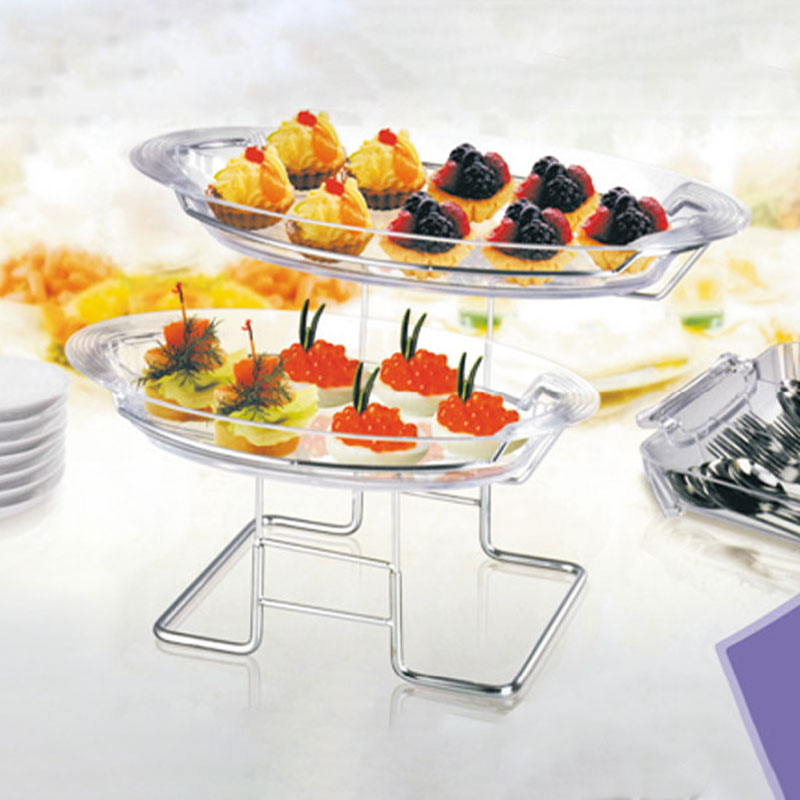
A well-designed dessert tray does more than hold food. It organizes a serving area, improves presentation, supports efficient handling, and helps create a more attractive experience for guests. The 2-Tier Dessert Tray, item GS063, is designed to meet these needs with a compact two-level structure, durable materials, and a practical format suitable for domestic and commercial environments.
Made from PS and stainless iron, this two-tier serving solution combines lightweight convenience with structural support. Its stacked design creates additional display space without requiring a large table footprint. Cakes, pastries, fruit, sandwiches, snacks, and other prepared foods can be separated by level, allowing users to create a more organized and visually appealing presentation.
The product is part of a broader tableware and daily-use product range developed by CIXI GSTAR ELECTRIC APPLIANCE CO., LTD. Although the company is widely associated with small kitchen appliances, its experience in product development, materials selection, quality control, and international manufacturing also supports the production of practical non-electric kitchen and hospitality items.
For distributors, importers, retailers, restaurants, hotels, catering businesses, and household consumers, the GS063 offers a useful balance of appearance, capacity, portability, and cost efficiency. Its straightforward construction makes it suitable for everyday use, while its two-tier profile gives it stronger visual impact than a conventional single-level plate or tray.
Product Overview
The 2-Tier Dessert Tray is a raised serving stand intended for presenting desserts and other small foods. Its two-level configuration allows products to be displayed vertically, making better use of limited counter or table space. The design can be used for afternoon tea, birthday parties, buffet service, family gatherings, café displays, hotel events, and seasonal retail promotions.
The upper and lower serving areas provide a natural separation between different food categories. For example, users may place cupcakes on one level and fruit or pastries on the other. The structure can also be used to separate sweet and savory foods or to create a coordinated color and height arrangement for a special occasion.
The product uses PS, commonly known as polystyrene, together with stainless iron components. PS can provide a smooth and presentable surface while helping keep the product relatively light. The metal structure contributes to support and stability when the tray is loaded appropriately. This material combination is practical for a product that must be moved, displayed, cleaned, stored, and used repeatedly.
The item number is GS063, and the listed product name is 2-Tier Dessert Tray. The product is supplied in cartons of four pieces. Its stated carton measurement is 53.5 by 48.5 by 47 centimeters, with a net weight of 7.5 kilograms and a gross weight of 8 kilograms. The minimum order quantity is 2,000 pieces, and the standard delivery time is 30 days.
| Specification | Details |
| Item Number | GS063 |
| Product Name | 2-Tier Dessert Tray |
| Product Category | Tableware |
| Primary Material | PS and stainless iron |
| Packing Quantity | 4 pieces per carton |
| Carton Measurement | 53.5 x 48.5 x 47 cm |
| Net Weight | 7.5 kg per carton |
| Gross Weight | 8 kg per carton |
| 20-foot Container Loading | 933 pieces |
| 40-foot High-Cube Container Loading | 2,266 pieces |
| 40-foot Container Loading | Not specified |
| Minimum Order Quantity | 2,000 pieces |
| Standard Delivery Time | 30 days |
Why a Two-Tier Format Is Valuable
The main advantage of a two-tier tray is the additional display capacity created by vertical organization. A single flat tray uses only one horizontal surface. A two-tier design provides another serving level above it, helping users display more products while occupying less table area.
This characteristic is especially valuable in homes with limited dining space and in commercial settings where every countertop area must be used efficiently. Cafés, bakeries, hotels, and event venues can display a broader selection of products without covering the entire serving table with separate plates.
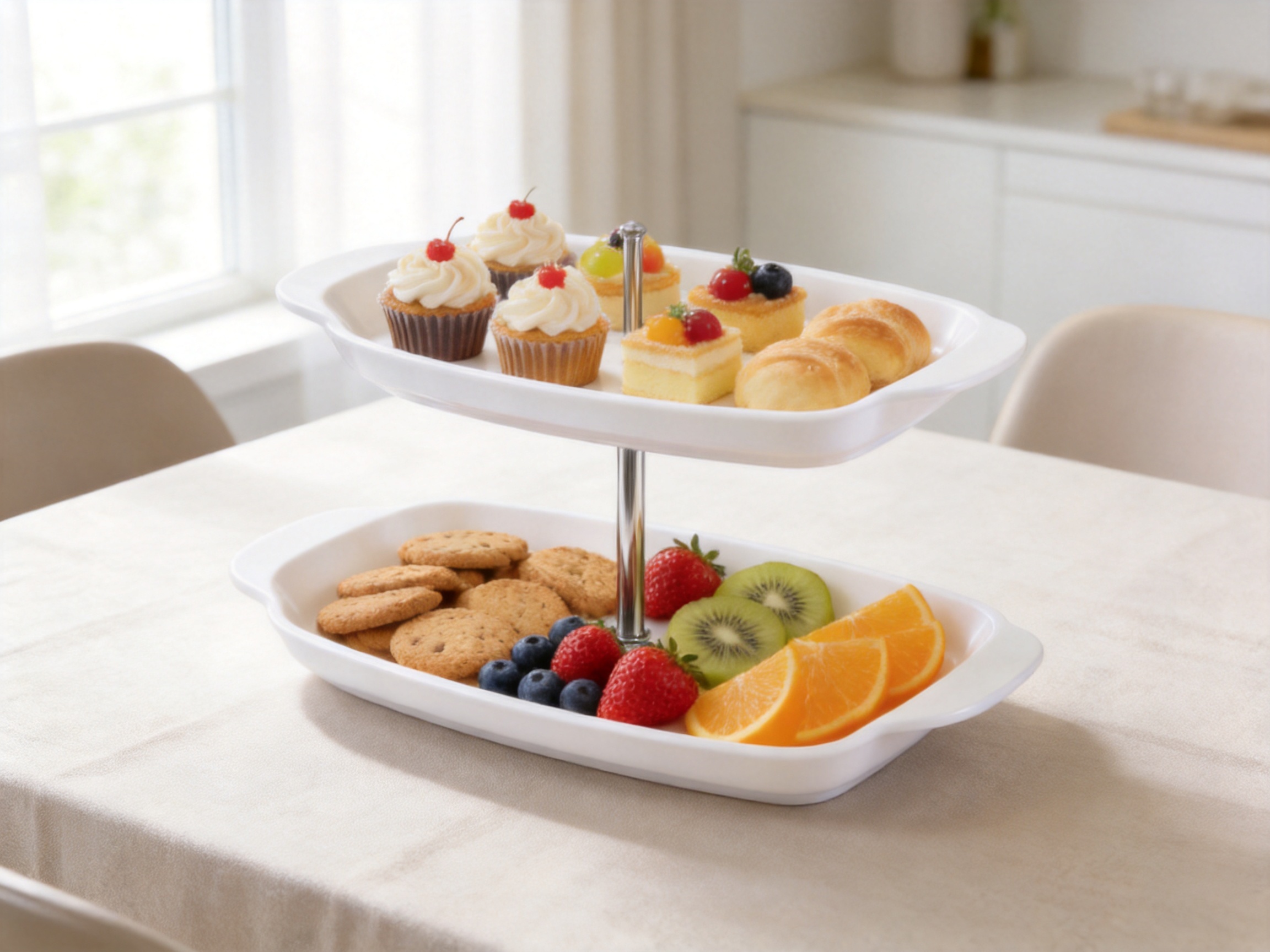
Height also improves visibility. Items placed on the upper level can be seen more clearly from different angles, while the lower level remains accessible for guests. When arranged with contrasting colors, different shapes, or varied product sizes, the two levels can create a more attractive presentation than a flat arrangement.
The vertical layout can support themed presentation as well. A user may arrange a wedding dessert selection, a holiday snack collection, a children’s birthday display, or an afternoon tea service. The product can function as a practical serving tool while also contributing to the visual style of the event.
Compared with multiple unrelated plates, a two-tier tray provides a more unified appearance. It helps create a coordinated serving station and reduces the number of separate tableware pieces needed. This can simplify setup and cleanup for both household users and professional food-service teams.
2-Tire Dessert Tray
Material Combination and Functional Performance
The choice of PS and stainless iron reflects the functional requirements of a serving product. The tray needs to present food attractively, remain manageable during handling, and provide sufficient support for normal serving use. A combination of polymer and metal can address these requirements more effectively than relying on a single material for every component.
PS Components
PS is commonly selected for molded household and food-presentation components because it can be formed into smooth, consistent shapes. Its surface may support a clean visual appearance and can help reduce the overall weight of the finished product. For distributors and consumers, lower weight can make the tray easier to move between kitchens, dining rooms, counters, and storage areas.
The molded nature of PS also supports repeatable production. When tooling and process parameters are properly controlled, each piece can be produced with consistent dimensions and a similar appearance. Consistency is important for wholesale buyers, especially when products are sold as part of a coordinated tableware collection.
Stainless Iron Support
The stainless iron structure provides a metal element in the product design. It can contribute to rigidity, support, and the visual impression of durability. In a two-tier tray, the supporting components must hold the levels in position and help maintain the intended spacing during normal use.
Metal support also gives the product a more substantial feel than a completely lightweight plastic construction. This balance between a molded tray surface and a metal structure can create a practical compromise between portability and stability.
Balanced Product Construction
The overall material combination is suitable for a tableware product that may be used repeatedly. However, like any serving tray, the product should be used according to its intended purpose. Users should distribute food evenly, avoid excessive loads, and handle the product carefully when carrying it between locations.
Food-contact suitability, cleaning instructions, and any market-specific compliance requirements should be confirmed with the supplier before commercial distribution. Different countries and regions may apply different standards to tableware materials, labeling, testing, and packaging.
Advantages Compared with Conventional Serving Options
The GS063 has several practical advantages over ordinary flat plates, basic single-level trays, and loosely arranged serving dishes. These advantages are related to capacity, presentation, table-space efficiency, and product coordination.
More Display Area Without a Large Footprint
A two-tier arrangement increases usable display area while limiting the amount of table surface occupied. This is useful when a user wants to serve several products but has limited room for plates and bowls. The product can help make a compact serving station appear fuller and more organized.
Improved Product Visibility
The raised upper level gives selected food items greater visibility. In a retail, café, or hospitality environment, visibility can help attract attention to featured products. In a household setting, it can make a dessert arrangement look more deliberate and festive.
Organized Food Separation
Separate levels make it easier to organize different items. Cookies, fruit, pastries, chocolates, sandwiches, and cakes can be arranged in a logical way. This may support better presentation and reduce the visual clutter associated with several unrelated dishes placed side by side.
Reusable Presentation Equipment
Instead of relying on disposable serving containers for every event, users can employ a reusable two-tier tray for repeated occasions. This can help reduce dependence on single-use presentation products and provide a consistent serving style for hospitality or catering businesses.
Suitable for Multiple Usage Scenarios
The product is not limited to one type of dessert. It can be used for afternoon tea, buffet arrangements, birthday celebrations, hotel breakfasts, family meals, café service, wedding receptions, and promotional displays. This versatility gives distributors more opportunities to position the item across different customer groups.
Suitable for Wholesale Programs
The carton quantity, container loading information, and established minimum order quantity provide useful planning information for importers and distributors. Buyers can estimate inventory requirements, warehouse space, shipping arrangements, and expected replenishment cycles before placing an order.
Applications in Homes and Hospitality
Home Dining and Entertaining
In a home environment, the two-tier tray can be used to serve desserts after a meal or to prepare a self-service snack display. It is suitable for informal family use as well as more carefully arranged events. The raised form helps transform ordinary baked goods into a more decorative presentation.
For afternoon tea, users may place small cakes, cookies, fruit, and pastries on separate levels. For a birthday party, the tray may hold cupcakes, candies, and bite-sized snacks. During holiday gatherings, it can display seasonal desserts or decorative food items in a central location.
Cafés and Bakeries
Cafés and bakeries often need tableware that combines attractive presentation with efficient use of counter space. A two-tier tray can be used for selected pastries, sampler sets, or promotional products. It can also support table service by allowing several small items to be delivered in a visually organized arrangement.
For a bakery display, the tray can help create height variation among products. Height variation makes a display more dynamic and can help separate featured products from the surrounding merchandise. Food-service operators should still observe appropriate hygiene procedures and use liners or serving accessories when required by their operating standards.
Hotels and Catering Services
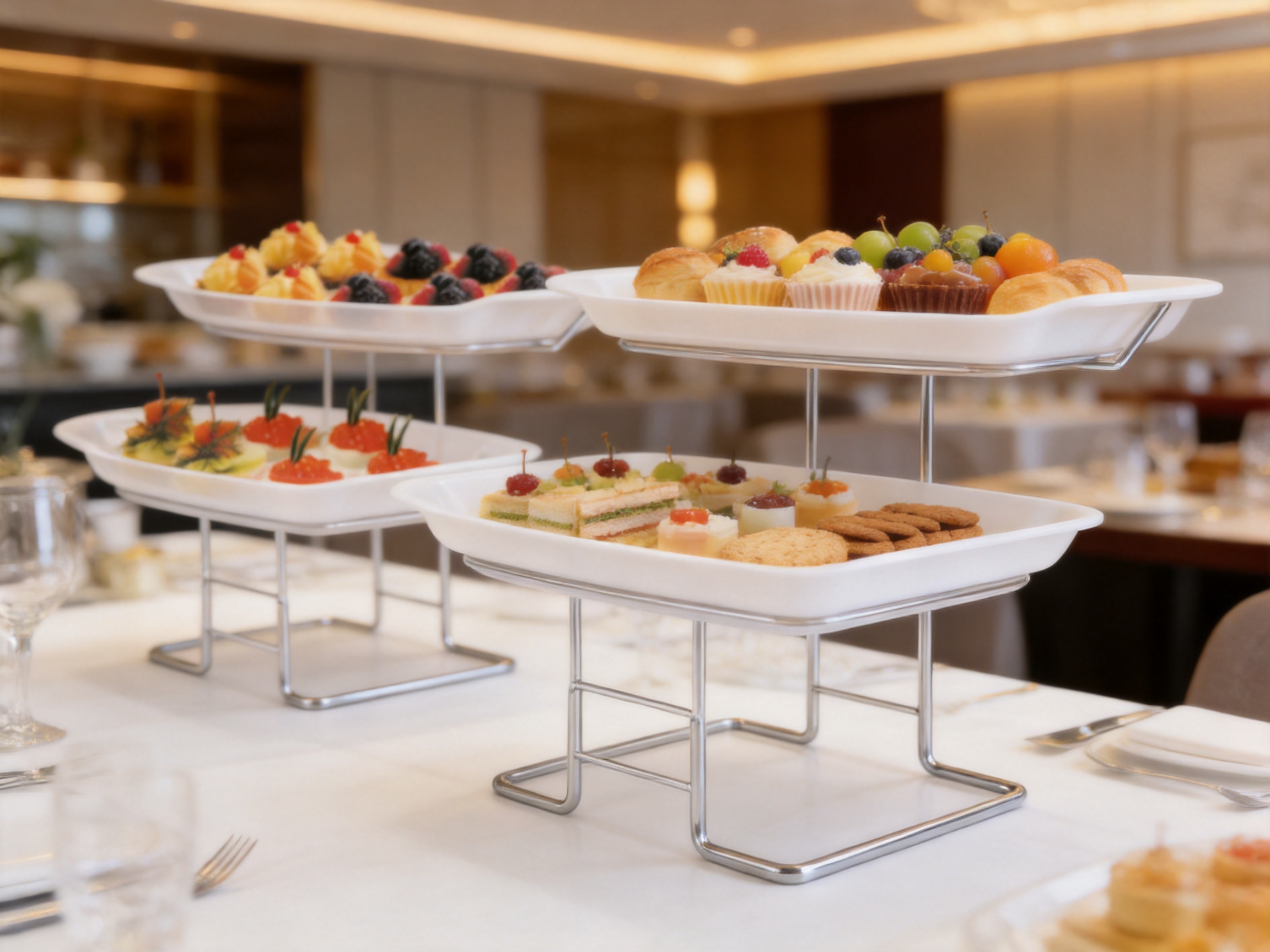
Hotels and caterers frequently prepare food displays for meetings, weddings, conferences, banquets, and private events. The GS063 can support dessert and snack service in these settings. Its two-tier layout can help make buffet tables more structured while reducing the need for numerous individual serving platforms.
Because catering equipment is often transported between locations, manageable weight and practical packing are important. The stated carton configuration of four pieces per carton can help buyers plan storage and transportation. Professional users should establish internal procedures for loading, carrying, cleaning, inspection, and replacement.
Retail and Promotional Displays
Retailers may use the product in seasonal kitchenware programs, home entertaining collections, baking accessories, or party-supply departments. Its appearance and multifunctional use allow it to be marketed beyond the dessert category. It may appeal to consumers looking for serving accessories, event tableware, or decorative storage and display solutions.
Manufacturing Strengths Behind the Product
CIXI GSTAR ELECTRIC APPLIANCE CO., LTD. has developed experience across product design, engineering, manufacturing, quality control, and international business. The company began with non-electric innovative products and later expanded into small electric kitchen appliances. This combination of product categories gives the manufacturer experience with both molded components and assembled household goods.
The company operates a wholly owned plant with a production area of approximately 15,000 square meters and more than 200 experienced workers, according to the supplied company information. Earlier information also describes a factory of approximately 10,000 square meters and a building area of 18,000 square meters after relocation in 2018. These figures indicate an established manufacturing base with room for product development, assembly, storage, and quality-management activities.
Product Development Experience
The company’s history emphasizes the development of innovative household and kitchen products rather than dependence only on standard commodity items. Its product range includes blenders, slicers, choppers, food processors, smokeless grills, hot pots, air fryers, air ovens, beverage dispensers, pitchers, ice buckets, graters, and other kitchen or hospitality products.
This broad category experience can be valuable when developing or supplying tableware. Product development teams working across kitchen products are familiar with consumer expectations related to usability, cleaning, packaging, appearance, storage, and retail presentation. Such experience can support practical improvements in future product versions and coordinated product families.
Engineering and Research Resources
The supplied company profile states that the business has engineers in its research and development department and dedicated personnel in quality control. A structured engineering team can contribute to mold development, material selection, product testing, assembly improvement, packaging review, and production problem solving.
For a two-tier tray, engineering attention may be applied to the alignment of the tray levels, the connection between plastic and metal components, the stability of the support structure, and the protection of surfaces during transportation. Consistent engineering review is important because even a simple tableware product must meet expectations for fit, finish, appearance, and everyday handling.
Quality Control Process
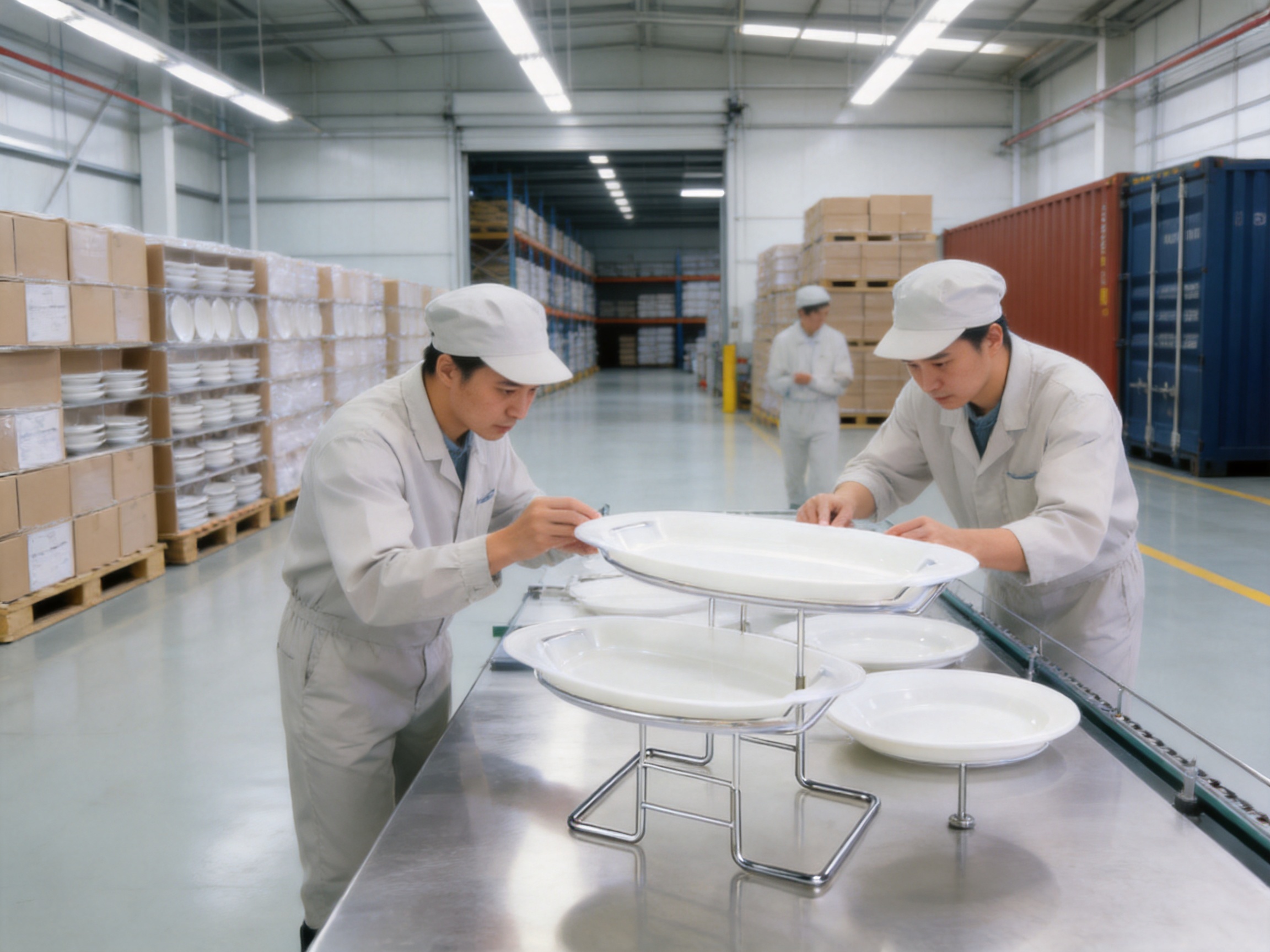
Quality control should begin with incoming material inspection and continue through production and final packing. For this product, appropriate control points may include checking PS component dimensions, surface finish, color consistency, metal component condition, assembly alignment, connection strength, carton protection, and product quantity.
Process control is particularly important for products supplied in wholesale quantities. Buyers expect the appearance and function of units in the same shipment to remain consistent. A clear inspection procedure can help identify defects before products are packed and shipped, reducing the risk of avoidable claims or returns.
International Supply Experience
The company reports supplying products to customers and major retail channels in multiple international markets. Experience with overseas buyers can help a manufacturer understand requirements related to packaging, labeling, delivery schedules, documentation, container loading, and communication across different time zones and business cultures.
International experience is also useful when a customer requires private labeling, customized packaging, product adjustments, or coordinated shipments. The precise availability of these services should be confirmed during the quotation and sampling process, but the company’s product-development background provides a foundation for discussing such requirements.
Production Process for a PS and Stainless Iron Tray
Although exact internal procedures may vary according to the final design, a product of this type generally involves several controlled manufacturing stages. Understanding these stages helps buyers evaluate the product beyond its appearance and compare suppliers more effectively.
Material Preparation
Production begins with the preparation and inspection of PS material and stainless iron components. Material specifications, color requirements, surface standards, and dimensional expectations should be established before production. Proper material control supports consistent results from one batch to another.
Plastic Forming
PS tray components are formed using suitable molding processes and tooling. The mold determines key features such as shape, edge profile, surface appearance, and dimensional accuracy. Production operators monitor the forming conditions to reduce problems such as deformation, uneven surfaces, short forming, or visible defects.
Metal Component Processing
Stainless iron elements may require cutting, bending, forming, joining, polishing, or surface treatment depending on the final structure. These processes should be controlled to maintain consistent dimensions and reduce sharp edges or uneven connections. The metal parts must fit correctly with the PS components during assembly.
Assembly
Assembly brings the molded and metal components together. Operators or assembly equipment align the two levels, attach the support structure, and verify that the tray maintains its intended shape. Proper assembly is essential to the product’s stability and appearance.
Inspection and Functional Testing
Finished products may be inspected for visual quality, dimensional consistency, connection security, balance, and general stability. Inspection criteria should be agreed with the buyer where special requirements apply. Packaging checks are also important because a well-made product can still be damaged if it is not adequately protected during transport.
Packing and Container Loading
The stated packing configuration is four pieces per carton. Carton dimensions, net weight, and gross weight provide useful references for logistics planning. Container loading quantities are listed as 933 pieces for a 20-foot container and 2,266 pieces for a 40-foot high-cube container. Actual loading may vary according to packaging revisions, loading methods, and shipping requirements, so final quantities should be reconfirmed before shipment.
Packaging, Storage, and Logistics Considerations
For a two-tier serving product, packaging must protect both the plastic surfaces and the metal structure. Internal separation or protective materials may help reduce rubbing, scuffing, deformation, and movement during transportation. Cartons should be sufficiently strong for stacking and should be stored in a dry environment away from excessive heat or moisture.
Importers should consider the product’s assembled or unassembled condition when planning warehouse space. If the product is shipped assembled, it may be ready for immediate retail display but require more volume. If a design allows partial disassembly, it may improve packing efficiency, although assembly instructions and additional quality checks may then be necessary.
The carton data supplied for GS063 can assist buyers in estimating freight costs and warehouse capacity. With four pieces per carton, purchasing departments can organize orders in full-carton quantities. The 2,000-piece minimum order quantity should also be considered when calculating initial inventory investment and expected sales turnover.
Retail packaging should communicate the product name, material information, care instructions, dimensions, country-of-origin requirements, and any applicable compliance information. Buyers selling through supermarkets, online channels, or specialty stores may also require barcode labels, outer-carton marks, multilingual instructions, or customized artwork.
Care and Responsible Use
To maintain the product’s appearance and service life, users should follow suitable cleaning and handling practices. Food residue should be removed after use, and the product should be cleaned according to the final material and supplier instructions. Non-abrasive cleaning tools are generally preferable when the surface finish needs to be preserved.
Users should avoid placing loads that exceed the product’s intended capacity. Food should be distributed evenly across the two levels rather than concentrated heavily on one side. The tray should be carried with both hands when loaded, especially when transporting it across a room or serving area.
Exposure to excessive heat should be avoided unless the supplier specifically confirms that the product is suitable for that condition. The tray is intended for food presentation and serving, not as a cooking vessel or direct heat-support product. Buyers should communicate proper use instructions to end customers through packaging or product documentation.
Commercial operators should inspect trays regularly for cracks, loose connections, deformation, damaged surfaces, or other signs that could affect safe use. Damaged products should be removed from service. A simple inspection routine can support hygiene, safety, and consistent presentation quality.
Commercial Advantages for Buyers
Broad Customer Appeal
The product can be marketed to household consumers, cafés, bakeries, hotels, caterers, restaurants, event planners, and gift retailers. This broad appeal can help distributors avoid dependence on a single sales channel. It can also be included in different seasonal and promotional programs.
Easy Product Positioning
The product has a clear function that can be communicated easily: it is a two-level tray for desserts and small food presentations. Its use can be demonstrated through photographs, packaging graphics, retail displays, and online product pages. Simple communication is valuable because customers can quickly understand how the product fits into daily life.
Opportunities for Bundling
Distributors may bundle the tray with baking accessories, serving utensils, cake decorations, table linens, coffee products, party supplies, or small kitchen appliances. Because the item belongs to the broader home and kitchen category, it can complement multiple product lines.
Efficient Container Planning
The listed loading quantities allow professional buyers to develop preliminary logistics plans. A 20-foot container is listed at 933 pieces, while a 40-foot high-cube container is listed at 2,266 pieces. These figures can help buyers compare full-container purchasing with mixed-container or consolidated shipment strategies.
Potential for Custom Programs
Manufacturers with product engineering and international supply experience may be able to discuss packaging, colors, branding, or design adjustments. Any customization depends on tooling, order volume, material availability, testing, and commercial agreement. Buyers should request samples and written specifications before approving mass production.
How the Product Compares with Common Alternatives
| Evaluation Area | 2-Tier Dessert Tray | Single Flat Tray | Multiple Separate Plates |
| Vertical Use of Space | High | Low | Low |
| Presentation Height | Built in | Limited | Depends on arrangement |
| Food Separation | Two natural levels | Requires separate sections or dishes | Possible, but less unified |
| Table Organization | Compact and coordinated | Simple but less distinctive | Can appear crowded |
| Suitability for Events | High | Moderate | Moderate |
| Handling Efficiency | One coordinated unit | One unit | Several units |
| Visual Impact | Enhanced by two-tier height | Basic horizontal display | Depends on separate arrangements |
This comparison does not mean that a two-tier tray replaces every other serving item. Flat trays and individual plates remain useful for many applications. The advantage of the GS063 is that it provides a specialized presentation format for occasions where height, organization, and efficient use of space are important.
Quality, Communication, and Order Management
Successful wholesale purchasing depends on clear communication between the buyer and supplier. Before placing an order, the buyer should confirm the final product dimensions, material description, color, packaging method, carton markings, loading quantity, delivery schedule, inspection standard, and applicable compliance documents.
Samples should be reviewed for surface appearance, balance, fit, finish, and overall presentation. If the product will be sold under a private label, the buyer should also approve artwork, packaging text, barcodes, warning statements, and care instructions before mass production begins.
The stated standard delivery time is 30 days. Delivery timing may depend on order confirmation, material availability, production scheduling, packaging approval, inspection, and shipping arrangements. Buyers should coordinate order milestones in advance, especially when the product is intended for a seasonal promotion or a fixed retail launch date.
Good communication is also important after delivery. Feedback about packaging performance, customer response, retail presentation, and product use can help guide future orders. A manufacturer with engineering and quality-control resources may use this information to refine packaging, improve components, or develop related products.
Company Manufacturing and Product Development Background
CIXI GSTAR ELECTRIC APPLIANCE CO., LTD. was established after its founder gained experience in sales, sourcing, quality control, and international product development. The supplied company history describes an evolution from trading and sourcing activities to the creation of proprietary household products and, later, the development of electric kitchen appliances.
The company’s product experience includes both innovative non-electric kitchen goods and small electrical appliances. This combination is significant because it reflects knowledge of different production requirements. Non-electric products often depend on molded parts, mechanical structures, surface quality, and packaging efficiency. Electric appliances require additional attention to electrical safety, component integration, testing, and regulatory requirements.
The company reports that its products have been supplied to customers in Europe, South America, Asia, and other markets. It also describes cooperation with international retail and wholesale channels. Such experience can support the practical needs of buyers seeking stable supply, clear documentation, quality consistency, and responsive communication.
The company’s stated principles include innovative products, competitive pricing, quick delivery, quality after-sales service, and close cooperation with customers. For a tableware product such as the GS063, these principles can be applied through product specification control, production planning, inspection procedures, packaging improvement, and customer support.
Frequently Asked Questions
What is the 2-Tier Dessert Tray used for?
The tray is designed for presenting desserts and other small foods. It can be used for cakes, pastries, cupcakes, fruit, cookies, snacks, sandwiches, afternoon tea, parties, buffets, cafés, hotels, catering events, and home entertaining.
What materials are used?
The listed materials are PS and stainless iron. PS is used for molded tray components, while stainless iron contributes to the supporting structure. Buyers should confirm detailed material grades, food-contact documentation, and care instructions for their target market.
How many levels does the product have?
The product has two serving levels. The raised structure provides additional display space and helps improve visibility while using less horizontal table area than two separate flat trays.
How many pieces are packed in one carton?
The listed packing quantity is four pieces per carton.
What are the carton dimensions and weights?
The listed carton measurement is 53.5 by 48.5 by 47 centimeters. The net weight is 7.5 kilograms, and the gross weight is 8 kilograms.
What is the minimum order quantity?
The stated minimum order quantity is 2,000 pieces. Buyers should confirm whether the minimum applies to one color, one packaging format, one design, or a combined order program.
What is the standard delivery time?
The listed delivery time is 30 days. The actual schedule should be confirmed according to order details, sample approval, production capacity, packaging requirements, and shipping arrangements.
How many pieces can be loaded in a container?
The supplied information lists 933 pieces for a 20-foot container and 2,266 pieces for a 40-foot high-cube container. The 40-foot container quantity is not specified. Final loading should be reconfirmed because packaging and loading methods can affect capacity.
Can the tray be used in restaurants and hotels?
Yes. Its two-tier design is suitable for dessert and snack presentation in restaurants, hotels, cafés, catering businesses, and event venues. Commercial users should follow their own hygiene, inspection, and cleaning procedures.
Can the product be customized?
Customization possibilities should be discussed directly with the supplier. Potential options may include packaging, color, labeling, or product adjustments, subject to minimum quantities, tooling requirements, testing, and commercial approval.
Is the tray suitable for direct cooking or high heat?
The product is intended for serving and presentation. It should not be used for direct cooking, on a stovetop, or under high heat unless the supplier specifically confirms suitability for that application.
What should buyers confirm before ordering?
Buyers should confirm the final specifications, material details, color, dimensions, packaging, labeling, inspection requirements, compliance documents, minimum order quantity, delivery schedule, payment terms, and shipping arrangements before placing a production order.
Conclusion
The GS063 2-Tier Dessert Tray is a practical tableware product designed to improve the presentation and organization of desserts and small foods. Its two-level structure adds display capacity, increases visibility, and makes efficient use of table space. The combination of PS and stainless iron supports a balance of manageable weight, appearance, and structural function.
Compared with a basic flat tray or several separate plates, the two-tier format offers a more coordinated presentation solution. It can serve households, cafés, bakeries, hotels, caterers, restaurants, event organizers, retailers, and distributors. Its broad application range provides opportunities for both everyday sales and seasonal promotional programs.
The product is supported by a manufacturer with experience in small kitchen appliances, non-electric household products, engineering, product development, international supply, and quality control. A production base, research and development resources, dedicated quality personnel, and experience with overseas customers provide a foundation for serving wholesale and private-label requirements.
For buyers, the most important next steps are to request a sample, confirm material and compliance details, approve packaging, review inspection standards, and coordinate the production schedule. With appropriate product positioning and reliable order management, the 2-Tier Dessert Tray can become a useful addition to tableware, home entertaining, hospitality, and kitchenware product programs.
References
1. Supplier product specification for item GS063, including product name, materials, packing information, carton dimensions, weights, container loading data, minimum order quantity, and delivery time.
2. Supplier company profile and manufacturing background, including product categories, factory information, research and development resources, quality-control personnel, and international market experience.
3. General principles of household tableware product design, material selection, packaging protection, storage, and quality inspection.
4. General food-service practices for dessert presentation, buffet organization, catering setup, cleaning, handling, and equipment inspection.