
 English
 中文简体
中文简体 Español
 English
 中文简体
中文简体 Español
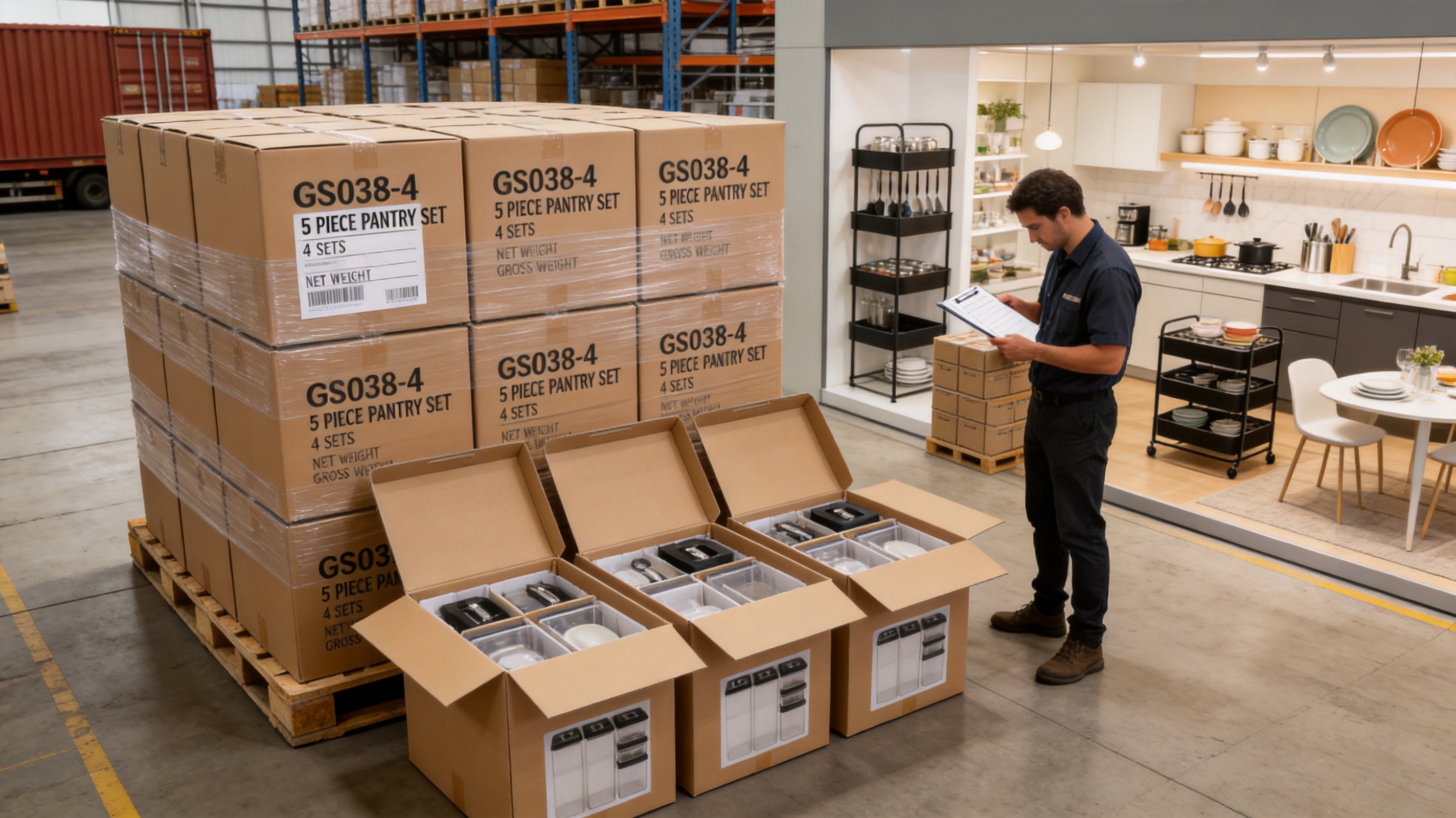
A well-organized kitchen depends on more than cabinets and shelves. Everyday convenience also comes from having the right containers, dependable utensils, and practical storage accessories in the places where food preparation and serving take place. The 5-Piece Pantry Set, identified as GS038-4, is designed for households that want a simple and coordinated solution for pantry organization, countertop storage, and daily kitchen routines.
This five-piece set combines useful household functionality with a compact, attractive format. Its construction uses PS, ABS, and silicone, three materials selected for their complementary characteristics. PS can provide a smooth and lightweight body, ABS contributes structural strength and impact resistance, and silicone can support flexible sealing or grip-related functions. Together, these materials create a product intended to be easy to handle, convenient to clean, and suitable for repeated household use when maintained according to normal care instructions.
The product is manufactured by CIXI GSTAR ELECTRIC APPLIANCE CO., LTD., a Chinese manufacturer with experience in small kitchen products, household accessories, and food-related appliances. Although the company is widely associated with electric kitchen appliances, its product development background also includes non-electric household innovations and practical kitchen items. This combination of product engineering, mold development, assembly management, quality control, and export experience supports the production of household sets that are suitable for retailers, distributors, hospitality buyers, and private-label programs.
For buyers comparing pantry sets, the most important factors are usually not simply the number of pieces in a package. They include organization value, material selection, appearance, ease of use, carton efficiency, production consistency, order capacity, and delivery reliability. The GS038-4 model addresses these requirements with a coordinated five-piece format and commercial packing data that can help importers plan purchasing and logistics.
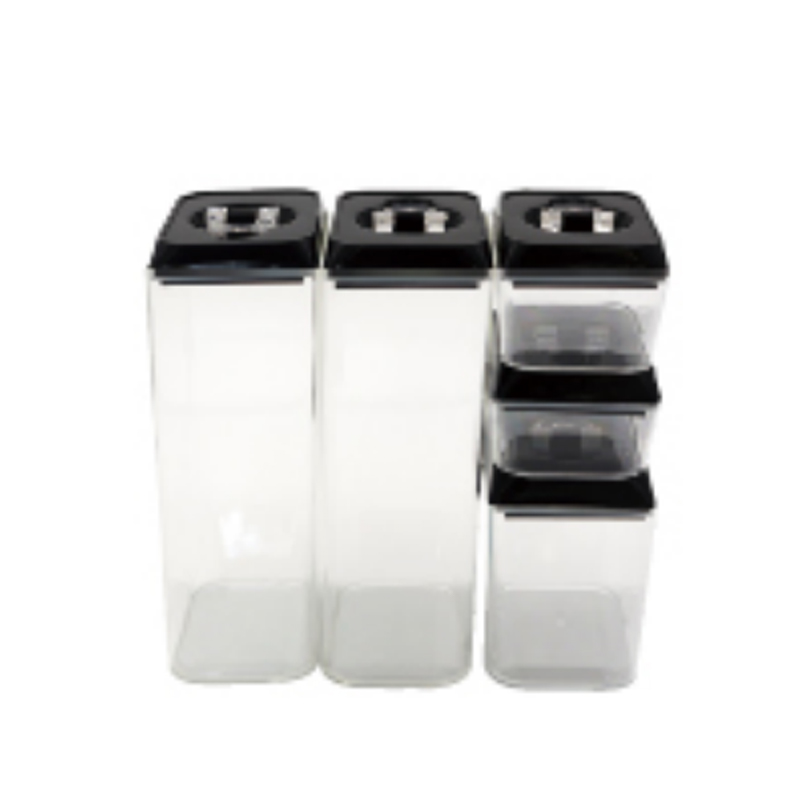
5pcs Pantry Set
Product Overview
The GS038-4 is presented as a 5pcs Pantry Set under the tableware category. The product is intended for everyday household organization and kitchen use. A coordinated set is often more useful than purchasing individual containers because all components can share a similar appearance and can be arranged together on a shelf, worktop, pantry area, or serving station.
A five-piece configuration offers a practical balance between variety and simplicity. It gives users several matching pieces without creating an unnecessarily large assortment that may occupy excessive cabinet space. For retailers, this format is also easy to explain: the customer receives one complete set rather than needing to select several separate products. A packaged set can therefore support gift sales, seasonal kitchen promotions, home-organization displays, and everyday household merchandising.
The product description identifies the item as GS038-4. This item number provides a clear reference for quotations, purchase orders, packaging artwork, sample approval, and production communication. Clear model identification is particularly important for buyers who may source several similar household products at the same time. It helps prevent confusion between different colors, configurations, packaging versions, and product sizes.
The listed material is PS+ABS+Silicone. These materials have different properties and may be used in different parts of the set according to functional requirements. A rigid polymer can be appropriate for the primary container or body, while ABS may be applied where additional strength or dimensional stability is needed. Silicone can be useful for flexible elements, seals, grips, or soft-touch components. The final application of each material should be confirmed through an approved sample and technical specification before mass production.
The set is supplied in a commercial carton containing four sets. The stated carton measurement is 30 × 14 × 28.5 centimeters, providing a compact outer-carton format for storage and transportation. The net weight is listed as 5.6 kilograms, while the gross weight is 7.3 kilograms. These figures allow buyers to estimate freight charges, warehouse handling requirements, pallet planning, and distribution costs.
| Product Item | Specification |
| Item number | GS038-4 |
| Product name | 5pcs Pantry Set |
| Category | Tableware and household kitchen organization |
| Material | PS, ABS, and silicone |
| Pieces per carton | 4 sets per carton |
| Carton measurement | 30 × 14 × 28.5 cm |
| Net weight | 5.6 kg |
| Gross weight | 7.3 kg |
| Minimum order quantity | 2,000 pieces |
| Estimated delivery time | 30 days |
| Container loading reference | 2,040 pieces in one 20-foot container; 4,960 pieces in one 40-foot high-cube container |
Why Pantry Organization Matters
Pantry organization directly influences the efficiency of a kitchen. When frequently used items are grouped in coordinated containers, users can identify contents more easily, reduce countertop clutter, and make better use of available storage space. A visually consistent set can also make open shelving look cleaner and more intentional.
Individual storage products are often purchased at different times, resulting in mismatched shapes, colors, lids, and sizes. Although this approach may be economical at first, it can make a pantry appear disordered and can reduce the usable capacity of shelves. A coordinated five-piece set provides a more uniform solution. It enables users to create a dedicated storage zone for dry ingredients, snacks, condiments, small kitchen supplies, or other appropriate household contents.
Organization is also valuable in commercial environments. Small cafés, guesthouses, hotels, office kitchens, rental properties, and catering operations need compact products that look presentable and can be managed efficiently. A matching set can contribute to a tidy preparation area and simplify replacement purchasing because all pieces are linked to a common product model.
For retailers, pantry organization products benefit from broad consumer relevance. They are not limited to one demographic or one specific kitchen style. They can be promoted to first-time homeowners, families, students, apartment residents, professional organizers, and customers preparing seasonal gifts. Their practical nature also supports repeat interest when customers are renovating kitchens, moving homes, or upgrading storage systems.
Material Advantages of PS, ABS, and Silicone
PS for Lightweight Everyday Use
Polystyrene, commonly abbreviated as PS, is frequently used in household products that require a lightweight and smooth molded structure. Its relatively low weight can make containers easier to lift, move, and arrange on shelves. A lighter product can also reduce handling effort during packaging and distribution.
PS may provide a clean surface that is suitable for household designs with simple lines and transparent, translucent, or opaque visual effects, depending on the selected grade and production specification. For a pantry set, a smooth surface can contribute to a neat appearance and can make ordinary wiping and cleaning more convenient.
Material selection must always be linked to the intended use. Buyers should confirm the specific grade, temperature limitations, food-contact requirements, and care instructions before approving a final version. The manufacturer can then align material procurement, molding parameters, and quality inspection with the agreed specification.
ABS for Strength and Dimensional Stability
ABS is valued in many household products because it combines rigidity with practical impact resistance. It can help components maintain their shape during normal handling, packaging, and transportation. In a multi-piece set, dimensional consistency is important because lids, bodies, clips, handles, or other fitted parts must work together properly.
ABS can also support a more substantial hand-feel than a very thin or highly flexible plastic. This can be an advantage in retail products where consumers judge quality by appearance and handling. A product that feels stable, closes properly, and maintains its form can create greater confidence than an item that appears fragile.
For manufacturers, ABS can be molded into detailed shapes with consistent repeatability when tooling and process parameters are properly controlled. Its use may therefore support clean edges, stable assembly, and a coordinated appearance across multiple pieces.
Silicone for Flexible Functional Elements
Silicone is commonly used where flexibility, softness, or sealing performance is required. Depending on the design, silicone may be applied to a gasket, grip, sealing ring, protective edge, or other flexible component. Its presence can improve the user experience by making certain parts easier to hold or operate.
A silicone component can also help create a closer fit between rigid parts. This may be useful when the product design includes a cover or closure that should sit securely on a container. The exact performance depends on the geometry, hardness, thickness, compression, and production quality of the silicone component.
Because silicone is a separate material from PS and ABS, careful assembly and inspection are important. The components should fit correctly without excessive stretching, uneven edges, or loose sections. A controlled manufacturing process helps ensure that flexible pieces are installed consistently from one set to the next.
The Benefit of a Multi-Material Construction
The principal advantage of combining PS, ABS, and silicone is that each material can perform a different role. Instead of forcing one material to provide every required property, the product can use rigid materials for structure and silicone for flexibility or comfort. This approach can improve the balance between appearance, usability, strength, and cost.
Multi-material construction does require effective production coordination. Incoming materials must be identified correctly, components must be matched to the right model, and assembly workers must follow clear instructions. Quality inspectors should check not only individual parts but also the performance of the completed set. The manufacturing background of the supplier is therefore an important part of the buying decision.
Design and Everyday Usability
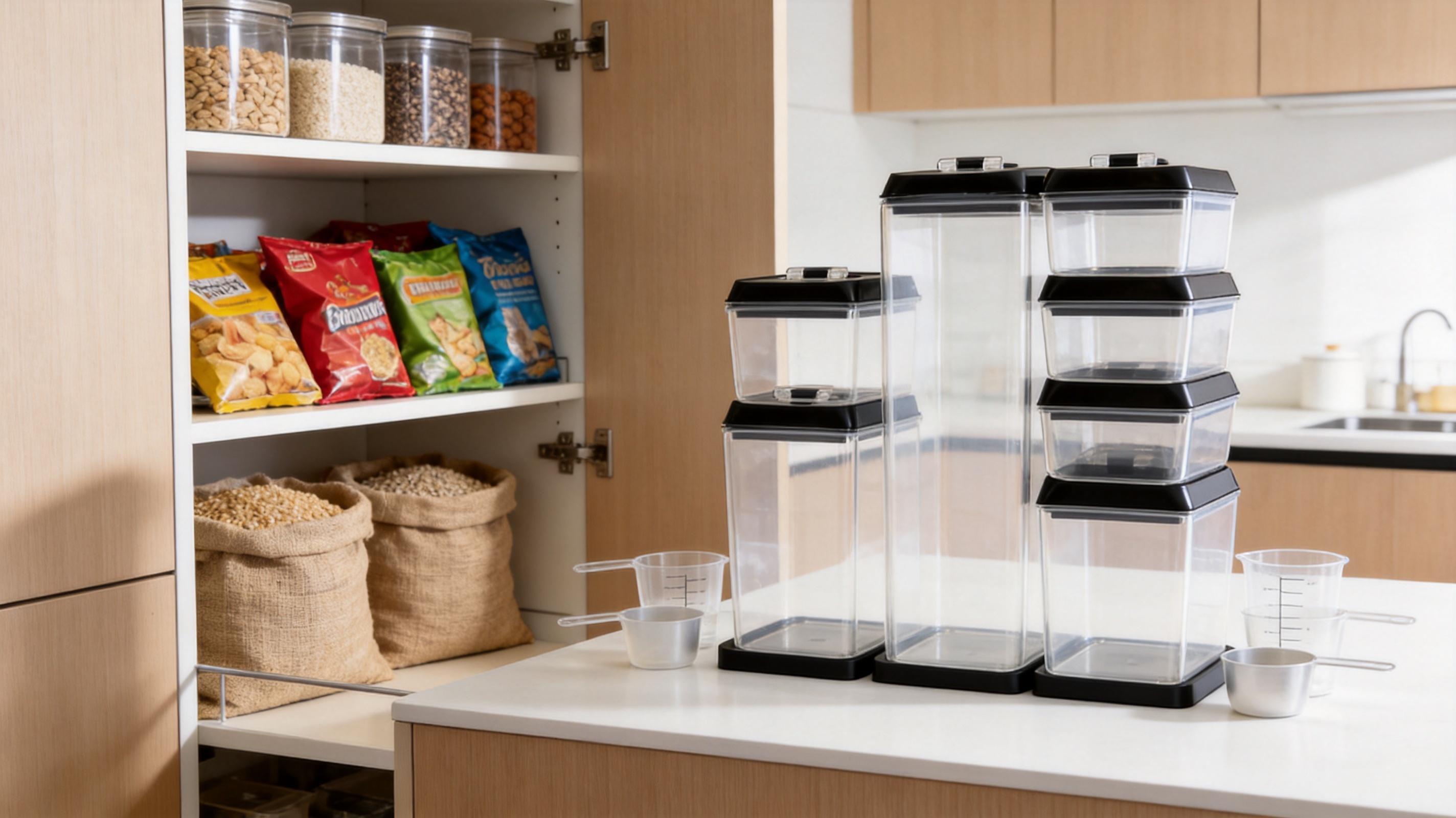
A pantry set succeeds when it solves routine problems without creating new ones. The five-piece format gives users a manageable collection of matching products. It can be used to group similar contents, separate ingredients by type, or create a consistent arrangement on a shelf. The set can also be positioned in a kitchen display where coordinated design is more important than maximum capacity.
The product’s compact commercial packaging is another usability advantage for retailers and distributors. Four sets per carton creates a defined wholesale unit that is easy to count, store, and resell. Compact outer-carton dimensions may support more efficient use of warehouse shelving and reduce unnecessary empty space during transport.
Good household products should be intuitive. Users should be able to understand the purpose of each component with minimal instruction. A coordinated five-piece set is naturally approachable because the pieces belong together visually and functionally. Retail packaging can further support this advantage by showing the complete set, identifying the material, explaining care instructions, and communicating suitable uses.
The product can appeal to consumers who prefer practical home improvements rather than complicated organizational systems. It does not require specialized equipment or installation. Users can incorporate it into existing kitchens and rearrange it as their storage needs change. This flexibility can be particularly valuable in smaller homes, apartments, dormitories, and rented properties.
Advantages Compared with Uncoordinated or Lower-Quality Alternatives
Complete Set Value
One major advantage over uncoordinated alternatives is that the customer receives a complete five-piece group. Individual low-cost containers may seem attractive, but they can result in inconsistent dimensions and a disorganized appearance. A set simplifies the purchasing decision and provides an immediate improvement in visual order.
Retailers can communicate this value clearly through packaging and shelf presentation. Instead of marketing five unrelated items, the retailer can promote one integrated pantry solution. This can improve product comprehension and make the item suitable for promotional bundles, home-organization campaigns, and seasonal displays.
Balanced Material Selection
Some competing products rely on one inexpensive material for every component, even when different parts would benefit from different characteristics. The use of PS, ABS, and silicone allows the product design to assign materials according to function. Rigid parts can support shape retention, while silicone can serve areas that require flexibility or a softer contact surface.
This balanced construction can offer a more refined user experience than a product with brittle edges, poorly fitted covers, or uncomfortable handling surfaces. It can also help the product occupy a quality position between basic disposable storage items and premium specialty systems with much higher prices.
Commercially Practical Packing
The four-set carton configuration and defined carton dimensions provide a clear logistics structure. Importers can plan purchase quantities, warehouse capacity, and container loading with greater confidence. The stated loading references indicate that the product has been considered for international commercial distribution rather than only small local sales.
Efficient packing is important because freight is a major part of the landed cost of household products. A product that occupies reasonable carton space can be easier to distribute through wholesale channels. Buyers should still verify final carton dimensions and loading quantities after packaging artwork, protective materials, and any market-specific labeling have been finalized.
Suitable Minimum Order Quantity
The listed minimum order quantity is 2,000 pieces. This quantity is appropriate for distributors, importers, supermarket suppliers, and private-label buyers that require a meaningful commercial volume but may not need a very large first order. It can support a market test while still providing a production quantity suitable for factory planning.
A buyer ordering 2,000 pieces can evaluate consumer response, retail price positioning, packaging performance, and repeat-order potential. If the product performs well, subsequent orders can be planned using actual sales data instead of assumptions. Buyers should discuss the relationship between the minimum order quantity, color selection, packaging options, and any customized branding requirements.
Manufacturing Capabilities and Company Strengths
CIXI GSTAR ELECTRIC APPLIANCE CO., LTD. has developed its business around the design, development, and manufacture of small kitchen appliances and household products. Its product range includes blenders, slicers, choppers, food processors, smokeless grills, hot pots, air fryers, air ovens, and other kitchen equipment. The company also has experience with products used in bars, restaurants, and hotels, including ice buckets, beverage dispensers, pitchers, slicers, and graters.
This broad product background is relevant to the 5-Piece Pantry Set because kitchen products require more than basic molding. They require an understanding of household behavior, cleaning expectations, food-related applications, retail presentation, and product safety considerations. Experience with appliances can also contribute to a disciplined approach to engineering documentation, assembly processes, inspection records, and product improvement.
The company’s development history includes non-electric innovative household products as well as electric appliances. Its earlier work with patented and independently developed items established experience in turning product concepts into manufacturable designs. This is valuable for buyers that want more than an off-the-shelf item. A supplier with design and development experience may be better positioned to discuss modifications to color, shape, packaging, accessory configuration, and private-label requirements.
The company reports a dedicated research and development team and a quality control department. The stated organization includes engineers working in product development and personnel responsible for quality inspection. For a multi-component pantry set, these functions can support drawing review, prototype evaluation, tooling adjustment, material verification, assembly standards, and final inspection.
The company also reports substantial factory and production resources, including a plant with a production area of approximately 15,000 square meters and more than 200 experienced workers. Earlier company information also describes a facility with a building area of approximately 18,000 square meters. Exact factory figures may vary according to the reporting period or facility classification, so commercial buyers should confirm current site details during supplier qualification. Even so, the reported scale indicates an established manufacturing organization rather than a small trading-only operation.
Product Development and Engineering
A strong product development process begins with understanding the intended use. Engineers can review the number of pieces, component relationships, material requirements, packaging limitations, and target cost. They can then prepare prototypes for functional and visual evaluation.
For the GS038-4 model, engineering attention may include dimensional accuracy, fit between rigid and flexible components, edge finishing, stability, appearance, and packaging protection. If a silicone element is included, the design should account for stretching, compression, placement, and long-term fit. If several plastic parts are assembled, the production team should establish reliable methods to prevent misalignment or incomplete assembly.
Tooling design is also important. Well-designed molds can support repeatable dimensions, consistent surface quality, controlled wall thickness, and efficient cycle times. Mold maintenance and process monitoring help reduce variation during longer production runs. The manufacturer’s experience with many household product categories can support the selection of practical manufacturing methods.
Material and Component Control
Material control begins before production. Incoming PS, ABS, silicone, packaging materials, and any accessory components should be checked against the approved specification. Color, texture, hardness, dimensions, and labeling should be controlled so that the finished sets remain consistent.
Component identification is especially important in a product that uses multiple materials. Workers need clear instructions for which part belongs to which position. A controlled bill of materials, labeled workstations, sample boards, and first-piece approval can help prevent mixing errors. The use of standardized production documents also makes it easier to repeat quality requirements for future orders.
Assembly and In-Process Inspection
Assembly should follow a defined sequence. The production line can be arranged so that molded parts are inspected before assembly, flexible pieces are installed correctly, and completed sets are checked for completeness. In-process inspection can identify problems earlier than final inspection, reducing rework and preventing large quantities of defective goods from advancing through the line.
Typical checks may include missing components, surface marks, flash, deformation, color inconsistency, loose silicone pieces, poor fitting, sharp edges, and incorrect quantity. The precise inspection plan should be agreed with the buyer and linked to the approved sample and product specification.
Final Quality Control
Final inspection provides a last opportunity to verify the condition of finished goods before shipment. A quality team may review appearance, dimensions, component quantity, packaging, carton marks, and basic functional performance. For export orders, inspection can also include carton drop or transportation simulation requirements when requested by the buyer.
Quality control is not limited to rejecting defective products. It is also a feedback system for improving tooling, assembly instructions, worker training, and packaging design. When inspection data is recorded and analyzed, recurring issues can be addressed at their source. This approach can improve consistency across repeat orders.

Packaging, Logistics, and Import Planning
The 5-Piece Pantry Set is listed with four sets per carton. The stated carton size is 30 × 14 × 28.5 centimeters. This information allows buyers to estimate how many cartons can be placed on pallets, how much warehouse space is needed, and how shipping costs may affect the final retail price.
The net weight of 5.6 kilograms reflects the product weight inside the carton, while the gross weight of 7.3 kilograms includes packaging and other shipping materials. The difference between these figures is important for freight calculations and manual handling. Buyers should use the gross weight when assessing transportation and warehouse requirements.
The stated container-loading references are 2,040 pieces for one 20-foot container and 4,960 pieces for one 40-foot high-cube container. A 40-foot standard container quantity is listed as unavailable or not specified. These figures should be treated as planning references until the final packaging configuration is approved. Inner cartons, palletization, protective inserts, and local shipping regulations can influence actual loading quantities.
| Logistics Factor | Listed Information | Why It Matters |
| Sets per carton | 4 sets | Supports wholesale counting and carton-level inventory control |
| Carton dimensions | 30 × 14 × 28.5 cm | Helps estimate storage, pallet, and freight space |
| Net weight | 5.6 kg | Indicates product weight excluding outer packaging |
| Gross weight | 7.3 kg | Useful for freight and handling calculations |
| 20-foot container reference | 2,040 pieces | Supports smaller commercial shipment planning |
| 40-foot high-cube reference | 4,960 pieces | Supports larger-volume import planning |
| Minimum order quantity | 2,000 pieces | Allows a commercial launch or market test |
| Delivery time | 30 days | Provides a preliminary production-planning reference |
Importers should confirm whether the listed quantity refers to individual pieces or complete five-piece sets. In ordinary commercial language, the product quantity is generally expected to refer to sellable sets, but this point should be stated clearly in the purchase contract. Buyers should also confirm whether carton measurements include all export packaging and whether loading figures are based on floor loading or pallet loading.
Packaging design should protect the product while avoiding unnecessary material use. Internal separators or protective bags may help prevent scratches, pressure marks, and component loss. The outer carton should carry the model number, quantity, gross weight, net weight, carton dimensions where required, country-of-origin information, handling marks, and buyer-specific shipping marks.
Retail and Private-Label Potential
The 5-Piece Pantry Set can be positioned through several retail channels. Supermarkets may place it in kitchenware aisles, household organization sections, or seasonal home-improvement displays. Home-goods stores can present it alongside storage bins, cookware, food-preparation tools, and countertop accessories. Online retailers can use the complete set format to offer a clearly defined product with multiple-use appeal.
Private-label buyers may be interested in changing the packaging, color scheme, printed materials, or product presentation while maintaining the core structure. The feasibility of these changes depends on order quantity, tooling requirements, material availability, and production scheduling. Buyers should request a detailed quotation that separates product cost, packaging cost, mold charges, testing charges, and any artwork or sample fees.
Retail presentation should emphasize practical benefits without making unsupported claims. Suitable messaging may focus on coordinated storage, everyday organization, a five-piece configuration, compact packaging, and multi-material construction. Any statements concerning food contact, dishwasher use, microwave use, heat resistance, or airtight performance should be made only after the relevant product specification and testing have been confirmed.
Online product pages should include clear photographs of the complete set, dimensions, material information, care instructions, package contents, and warnings where appropriate. Customers are more likely to trust a household product when they can understand exactly what is included and how it should be used.
Quality, Safety, and Compliance Considerations
Household products that may come into contact with food or kitchen surfaces require careful specification. Buyers should identify the destination markets before production because applicable requirements can vary. Material declarations, migration testing, labeling rules, packaging regulations, and consumer-product standards may all need review.
The use of PS, ABS, and silicone does not by itself establish that a product is suitable for every food-contact or temperature-related application. The exact grades, additives, pigments, and manufacturing conditions matter. The buyer and manufacturer should agree on the intended use, including whether the product is designed for dry food storage, room-temperature use, refrigeration, hand washing, or other applications.
Care instructions should be realistic and easy to understand. If a component should not be used in a microwave, oven, freezer, or dishwasher, the packaging should say so clearly. If hand washing is recommended, that instruction should be visible. Clear guidance protects consumers and reduces avoidable complaints.
Quality requirements should be recorded in an approved product specification. This document may include drawings, dimensions, color standards, material descriptions, acceptable surface conditions, assembly requirements, packing methods, carton markings, and inspection procedures. An approved golden sample can serve as a visual reference, but it should be supported by written technical information for measurable characteristics.
How the Product Can Improve Over Time
Product development does not end when the first shipment leaves the factory. Feedback from retailers, distributors, and consumers can reveal opportunities for improvement. For example, buyers may discover that a particular color performs better, that customers prefer a different label format, or that a certain component requires clearer care instructions.
The manufacturer can use this information to refine packaging, improve component fit, adjust surface finishing, or develop related models. Because the company works across kitchen appliances and household products, it may be able to extend the pantry concept into additional storage, serving, or food-preparation products. A coordinated product family can create stronger shelf presentation and encourage repeat purchases.
Future versions may also focus on reducing packaging volume, improving recyclability, increasing the percentage of recyclable materials, or simplifying component separation at the end of product life. Any environmental statement should be supported by documented material and packaging information rather than general marketing language.
Customization may include color matching, printed logos, sleeve packaging, gift boxes, multilingual instructions, barcode labels, or retail-ready cartons. Such changes should be discussed early because they may affect the production schedule and minimum order quantity. A clear development process helps the buyer decide which changes add meaningful market value and which would create unnecessary cost.
Recommended Buyer Evaluation Process
Before placing a production order, a buyer should request a complete product sample. The sample should represent the proposed materials, colors, components, packaging, and labeling. It should be inspected for appearance, fit, ease of use, dimensions, and overall presentation.
The buyer should then confirm the technical specification. This should include the exact product name, item number, number of pieces, material information, dimensions, weight, color, packaging method, carton quantity, and shipping marks. If the set is intended for food-related use, the buyer should identify the required compliance documents and testing plan.
A production timeline should distinguish between sample approval, packaging artwork approval, material preparation, tooling or adjustment, mass production, inspection, and shipment. The listed delivery time is 30 days, but the final schedule may depend on order details, packaging customization, raw-material availability, and the date on which all approvals are completed.
After production, the buyer may arrange a pre-shipment inspection. The inspection can check product quantity, workmanship, packaging, carton marks, dimensions, weight, and randomly selected functional characteristics. This provides additional assurance that the shipment corresponds to the approved standard.
Reliable communication is essential throughout the process. Questions about materials, intended use, labeling, packaging, and delivery should be answered in writing. A well-documented order reduces misunderstandings and creates a useful record for repeat purchases.
Q&A About the 5-Piece Pantry Set
What is the product?
It is a five-piece pantry set identified by item number GS038-4. It belongs to the tableware and household kitchen organization category and is designed for practical storage and coordinated everyday use.
What materials are used?
The listed materials are PS, ABS, and silicone. These materials may serve different functions within the product, with rigid plastics supporting structure and silicone providing flexible or soft-touch functionality. Buyers should confirm the exact material allocation and grade in the approved specification.
How many pieces are included?
Each sellable product is described as a five-piece set. The stated outer-carton packing is four sets per carton. Buyers should confirm the exact definition of “piece” and “set” on the commercial invoice and packing list.
What is the carton size?
The listed carton measurement is 30 × 14 × 28.5 centimeters. Final measurements should be confirmed after packaging materials and any customized retail packaging have been approved.
What are the net and gross weights?
The listed net weight is 5.6 kilograms, and the listed gross weight is 7.3 kilograms. Gross weight should be used for freight and handling estimates because it includes outer packaging.
What is the minimum order quantity?
The listed minimum order quantity is 2,000 pieces. Buyers should clarify whether the quantity refers to complete five-piece sets and whether different colors or packaging versions can be combined within the minimum order.
How long is the delivery time?
The stated delivery time is 30 days. This should be treated as a preliminary production reference and confirmed according to the order quantity, packaging requirements, material availability, sample approval, and shipping plan.
Can the product be customized?
Potential customization may include color, packaging, labels, printed branding, instructions, and retail presentation. The available options, costs, minimum quantities, and development time must be confirmed with the manufacturer before commitment.
Is it suitable for food contact?
The material list alone does not confirm food-contact suitability for every market or application. Buyers should define the intended use and request the relevant material declarations and test documentation before making food-contact claims.
Can it be used in a microwave, oven, freezer, or dishwasher?
These uses should not be assumed. The buyer should obtain written confirmation based on the exact materials, design, and testing results. Clear care instructions should be included on the packaging when necessary.
What makes this set competitive?
Its competitive strengths include a coordinated five-piece format, multi-material construction, compact commercial packing, a manageable minimum order quantity, and support from a manufacturer with experience in kitchen appliances and household products. Its value is strongest when product consistency, packaging quality, and market-appropriate documentation are properly controlled.
Who may purchase this product?
Suitable buyers may include importers, distributors, supermarket suppliers, home-goods retailers, hospitality suppliers, online sellers, and private-label companies. It may also suit businesses that want a practical kitchen-organization item for promotional or seasonal programs.
Conclusion
The GS038-4 5-Piece Pantry Set is a practical household product built around organization, coordinated design, and everyday convenience. Its five-piece format gives consumers a straightforward way to improve pantry and kitchen storage without purchasing a collection of mismatched items. The combination of PS, ABS, and silicone supports a balanced approach to structure, handling, and flexible functionality.
For commercial buyers, the product offers more than a simple household accessory. The defined item number, four-set carton packing, stated logistics data, 2,000-piece minimum order quantity, and approximately 30-day delivery reference provide a foundation for wholesale planning. The compact carton format can assist warehouse management and international distribution, while the set format gives retailers a clear product story.
The manufacturer’s broader strengths add value to the sourcing decision. Experience in small kitchen appliances, non-electric household products, product development, tooling, assembly, and quality control creates a suitable foundation for producing coordinated kitchen goods. Reported engineering and quality-control resources can support sample development, production consistency, inspection, and future customization.
As with any household product, final performance depends on the exact material grades, design details, manufacturing controls, packaging, and intended-use instructions. Buyers should approve a representative sample, confirm technical and compliance requirements, verify logistics information, and establish a clear inspection standard before mass production. When these steps are completed carefully, the 5-Piece Pantry Set can serve as a useful, marketable, and commercially efficient addition to a modern kitchenware range.
References
1. Product specification for GS038-4, 5pcs Pantry Set, including material, packaging, carton, weight, order quantity, and delivery information.
2. Manufacturer-provided company profile describing product development, kitchen-appliance manufacturing, household-product experience, engineering resources, and quality-control capabilities.
3. General polymer engineering references concerning the characteristics and common household applications of polystyrene and acrylonitrile butadiene styrene.
4. General silicone-material references concerning flexibility, sealing applications, hardness selection, and household-product performance.
5. General international logistics references concerning carton measurement, gross and net weight, container loading, pallet planning, and export packaging.
6. General consumer-product quality references concerning incoming-material inspection, first-piece approval, in-process inspection, final inspection, packaging control, and pre-shipment verification.
7. General food-contact product compliance references concerning material declarations, intended use, migration testing, labeling, and market-specific requirements.